



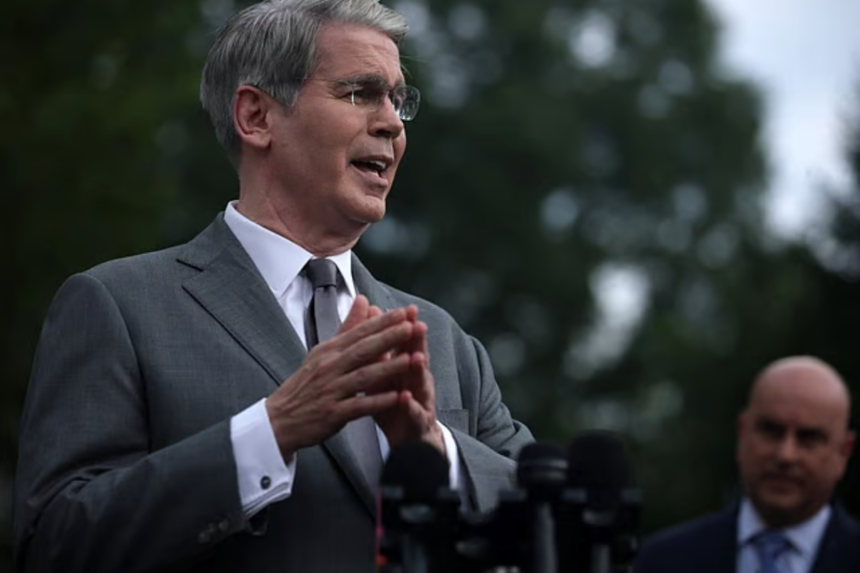
Treasury Secretary Scott Bessent warned that countries that continue economic ties with Iran could face consequences as Washington prepares tougher sanctions.
The United States is stepping up economic pressure on Iran, with Treasury Secretary Scott Bessent calling on allies and China to join what Washington describes as an unprecedented campaign of economic isolation.
Bessent said the US would impose the “toughest sanctions in history” on Iran and warned countries that continue providing economic lifelines to Tehran that they could face consequences. He said the strategy is intended to put enough pressure on Iran to avoid a renewed large-scale military campaign.
The escalation comes as diplomatic efforts remain stalled and the Strait of Hormuz continues to disrupt global energy markets.
Washington Pushes China to Cut Iran Ties
China is at the centre of the US pressure campaign because it remains Iran’s largest oil buyer. Reuters reported that China imported an average of about 1.38 million barrels per day of Iranian oil in 2025, accounting for more than 80% of Iran’s shipped oil.
Bessent urged Beijing to cooperate with Washington, arguing that China’s dependence on Gulf energy gives it a strong reason to support efforts to reopen the Strait of Hormuz.
China has rejected the approach.
A Chinese embassy spokesperson said sanctions and pressure would not resolve the dispute and called for political and diplomatic solutions instead.
That creates a difficult calculation for Washington. Pressuring China over Iranian oil could widen the confrontation beyond Tehran and add another source of tension to an already complicated US-China economic relationship.
US Targets Iran’s Economy
Bessent described the strategy as a combination of economic sanctions and the US naval blockade of Iran.
He said Washington expects the measures to weaken Iran’s ability to finance its government and regional allies, while reducing the need for additional military action.
The Treasury secretary is expected to provide more details about the new measures at a press conference on Monday.
The United States has already imposed extensive sanctions on Iran over decades. The proposed escalation therefore represents an attempt to target the remaining channels through which Tehran earns foreign currency and maintains international trade.
Iran Calls the Campaign Economic Terrorism
Tehran has rejected the US strategy and accused Washington of using economic pressure to compensate for what Iranian officials describe as the failure of the military campaign.
Iranian Foreign Minister Abbas Araghchi called Trump’s proposed measures “economic terrorism” and argued that sanctions would increase hostility rather than force Tehran into accepting US demands.
Iranian Deputy Foreign Minister Kazem Gharibabadi similarly said Washington was attempting to portray its military campaign as successful by launching a new economic offensive.
Iran has nevertheless indicated that it remains open to negotiations, although officials say talks would require specific conditions and credible commitments from Washington.
Hormuz Remains the Critical Pressure Point
The economic confrontation cannot be separated from the Strait of Hormuz, through which roughly one-fifth of global oil consumption normally passes.
Disruptions to shipping have already pushed energy prices higher. Brent crude settled at $93.78 a barrel on Thursday, up 2.4%, while US West Texas Intermediate reached $87.83.
The continuing disruption is particularly important for Asian economies, European energy markets and Gulf states whose exports depend on reliable maritime routes.
Oman has called for regional peace and diplomacy, arguing that lasting security in Hormuz cannot be achieved through military escalation alone.
A Wider Economic Test
The US campaign now extends beyond Iran itself.
China faces pressure because of its oil purchases. Turkey continues significant trade with Iran. Iraq depends on Iranian gas, while Oman maintains longstanding commercial and diplomatic links with Tehran. The UAE has historically been one of Iran’s major trading partners, although its economic ties have been disrupted amid the conflict.
This makes the proposed sanctions campaign more than another round of restrictions on Tehran. Washington is effectively asking countries and companies to choose how far they are willing to go in reducing economic exposure to Iran.
Whether that pressure leads to negotiations or to a wider economic confrontation will depend heavily on China’s response, the future of Hormuz shipping, and Iran’s willingness to make concessions.
For now, Washington is betting that economic isolation can achieve what military pressure and diplomacy have not. Tehran is betting that its remaining economic and strategic relationships will allow it to withstand the pressure.
Secretary of the Treasury Scott Bessent speaks to members of the press outside the West Wing at the White House on August 20, 2026, in Washington, DC.
AFP
Source: Gulf News