



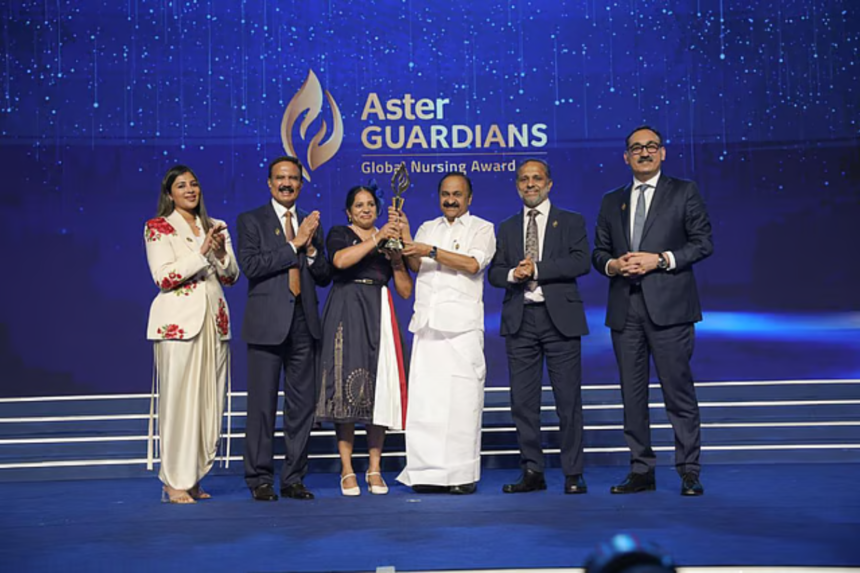
Agimol Pradeep, a senior transplant coordinator at King’s College Hospital, was recognised for her work promoting organ and stem-cell donation, especially among South Asian communities.
Agimol Pradeep, an Indian nurse based in the UK, has won the Aster Guardians Global Nursing Award 2026, receiving a $250,000 prize for her work in organ and stem-cell donation, transplant care and nursing advocacy.
A senior transplant coordinator at King’s College Hospital in London and an honorary senior lecturer at the University of Salford, Pradeep was selected from more than 134,000 registrations across 214 countries and economies. She was announced as the winner at a ceremony in Kochi, India.
The award recognises nurses whose work has made a wider impact on healthcare, with the 2026 selection process involving eligibility screening, expert assessment and a Grand Jury, with Ernst & Young serving as process adviser.
A Career Focused on Organ Donation
Pradeep’s work has extended well beyond her responsibilities in transplant care.
Her research has focused particularly on the shortage of ethnically matched organ donors among South Asian communities. According to Aster Guardians, she pursued doctoral research examining cultural, religious and social barriers affecting organ donation among Indian, Pakistani and Bangladeshi communities.
That research contributed to awareness campaigns and wider discussions around the UK’s move towards an opt-out organ donation system. She has also worked directly with religious leaders, community organisations and families to address misconceptions surrounding organ and stem-cell donation.
Her advocacy has continued through Upahaar, a community initiative focused on organ, blood and stem-cell donation. The organisation’s work has included recruiting donors and building awareness within communities where cultural and religious concerns can influence attitudes towards donation.
Turning Transplant Care Into Community Action
Pradeep’s motivation comes from seeing the consequences of organ failure and the shortage of available donors first-hand.
She has said that patients continue to die while waiting for organs, even in healthcare systems with established transplant services. Her goal is to use the international platform provided by the award to promote donation awareness in countries where transplant infrastructure and support for patients with organ failure remain limited.
“It’s surreal still. I’m trying to absorb everything,” Pradeep told Gulf News after being announced as the winner. She also described the award as recognition for the nursing profession rather than an individual achievement.
For her, increasing awareness remains one of the most practical ways to address the gap between people who need transplants and the availability of suitable organs.
From Research to Policy
One of the notable aspects of Pradeep’s career has been the connection between academic research and practical change.
The Aster Guardians profile says her work helped influence national conversations around organ donation in the UK. Her approach has centred on understanding why some communities are less likely to register as donors and addressing those concerns through dialogue rather than simply asking people to change their behaviour.
The University of Salford has similarly highlighted her work as a campaigner for organ, blood and stem-cell donation, particularly within minority ethnic communities. The university describes her as a British Empire Medal recipient whose advocacy has had an impact beyond her clinical role.
A Broader Role for Nurses
Pradeep has also argued that modern nursing offers far more career paths than traditional bedside care.
Alongside transplant coordination, her work has included education, research, mentoring and advocacy. Her own career reflects the broader roles nurses increasingly occupy across healthcare systems, from specialist clinical practice to public policy and community health.
She has described continuous learning as essential because both medical care and nursing practice continue to change.
That emphasis on education is also reflected in her academic work at the University of Salford and her efforts to support nurses and healthcare professionals through training and mentorship.
Using the Award to Expand Organ Donation Awareness
Pradeep has said she hopes to use the prize to support work promoting organ and stem-cell donation, particularly in developing countries where patients with organ failure may have fewer options.
Her ambition is to take lessons from the UK’s transplant system and adapt them to communities where donation rates, infrastructure and public awareness remain limited.
The $250,000 award gives that work an international platform and additional resources at a time when the need for transplant services continues to outpace the availability of donated organs.
Recognition From a Global Nursing Field
Pradeep entered the 2026 award as one of 10 finalists selected from more than 134,000 registrations worldwide. The other finalists came from countries including Sweden, Saudi Arabia, Hong Kong, India, Colombia, Namibia, Nigeria and Papua New Guinea.
Her selection as the winner places a spotlight not only on transplant nursing but also on the role nurses can play in addressing wider healthcare inequalities.
For Pradeep, the award represents an opportunity to take a message she has spent years promoting in the UK to a much larger audience: that organ donation can give patients waiting for a transplant another chance at life.
Read more news and follow us on Instagram.
Agimol Pradeep (third from left), Aster Guardians Global Nursing Award 2026 winner
Supplied