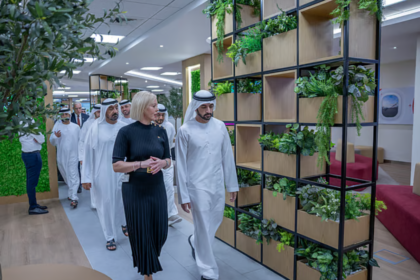



The inspection highlights Dubai’s continued push to strengthen public safety and smart mobility through next-generation urban infrastructure.
A System Built for Response, Not Reaction
Sheikh Hamdan bin Mohammed bin Rashid Al Maktoum reviewed a set of new transport and safety initiatives developed by the Roads and Transport Authority, each designed to extend the city’s capacity to respond under pressure rather than recover after disruption.
The projects reflect a broader shift in how Dubai approaches infrastructure. The focus is no longer limited to expansion. It is centered on readiness, integration, and real-time adaptability.
Emergency Response as Infrastructure
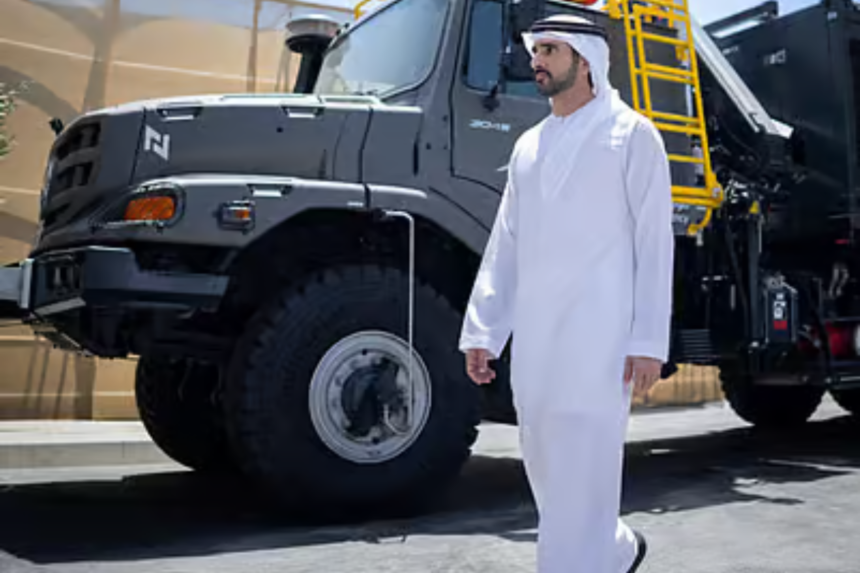
At the center of the review was a rapid intervention vehicle built for extreme weather, particularly heavy rainfall. Dubai designed the system to respond quickly to water accumulation on roads while keeping traffic moving through high-density areas.
Equipped with four high-capacity pumps, the vehicle can handle around 60,000 liters per minute. That gives it the capability of several conventional units combined. Its purpose goes beyond water removal — it is designed to maintain continuity of movement across the city.
The visit also highlighted Dubai’s shift toward fully digital transit infrastructure. Sheikh Hamdan reviewed a near-complete smart bus station in Al Barsha 2, located along Sheikh Zayed Road near Mall of the Emirates.
Unlike traditional bus shelters, the station functions as a contactless and fully integrated transit hub. It connects with the Nol card network and the S’hail app, while AI-powered tools monitor crowd flow and detect violations.
Environmental sensors track air quality, while solar panels reduce energy dependence. As a result, the station operates as a self-contained smart system rather than a passive waiting point. Construction has reached 90 percent, with full completion expected by the end of April.
The review also focused on Dubai’s push to strengthen last-mile mobility. A third initiative addresses the rapid growth in bicycle and electric scooter use across the emirate.
To support this shift, new parking facilities will include shaded structures, charging stations, and smart monitoring systems that track usage patterns. This formalizes short-distance transport as a core part of Dubai’s wider mobility network.
The numbers show the scale of that transition. Bicycle trips rose 23 percent, reaching 57.6 million in 2025.
Dubai will begin with pilot locations in 2026 before expanding gradually toward permanent integration by 2028.
A Unified Approach to Urban Mobility
According to Mattar Al Tayer, these projects are part of a larger framework aimed at strengthening operational resilience while advancing sustainability and technological integration.
The strategy is not fragmented. Emergency response, public transport, and micro-mobility are being developed as interconnected systems rather than isolated solutions.
Conclusion
The projects reviewed signal a clear direction. Dubai is moving from infrastructure that supports movement to infrastructure that anticipates disruption, adapts in real time, and sustains continuity under pressure.
The city is not just expanding how people move. It is redefining how movement is maintained.