


CEO says UAE carrier will exceed last year’s operational capacity by June 15
Airline leadership is often judged during periods of growth. The real test, however, comes when uncertainty arrives.
For Antonoaldo Neves, Chief Executive Officer of Etihad Airways, that test arrived in the form of regional conflict, rising fuel prices, disrupted airspace, and an aviation industry facing some of its most challenging operating conditions in years.
Yet while many companies would respond by slowing expansion plans and preserving resources, Neves has chosen a different path. His strategy has been centered on accelerating growth, investing in new aircraft, expanding international routes, and preparing Etihad for the next phase of global aviation.
His leadership offers an important lesson in how organizations can navigate disruption without abandoning long-term ambitions.
Building Momentum Before the Crisis
Before geopolitical tensions escalated across the Middle East, Etihad Airways was experiencing one of its strongest periods in recent years.
The airline had been steadily rebuilding its network, improving operational performance, and strengthening profitability. Early results in 2026 pointed toward a potentially record-breaking financial year.
The situation changed rapidly as conflict triggered airspace restrictions, disrupted passenger confidence, and pushed jet fuel prices sharply higher.
Airlines across the region suddenly faced a very different operating environment.
Many carriers responded with caution.
Neves focused on adaptability.
Rather than abandoning growth plans, he concentrated on maintaining operational flexibility while continuing investments that could strengthen Etihad’s long-term position.
The First Priority: Stability
When the conflict erupted, the airline industry entered unfamiliar territory.
Passenger demand became uncertain. Flight schedules changed rapidly. Operational risks increased across the region.
For Etihad, the immediate focus shifted away from commercial performance and toward passenger support.
Aircraft were temporarily grounded while authorities assessed the evolving situation. Teams worked around the clock to assist travelers affected by cancellations and disruptions.
Hotels, meals, alternative flights, and customer support became the primary concern.
According to Neves, the first days of the crisis were not about business performance. They were about taking care of passengers and ensuring safe operations.
That response highlights a critical principle of effective leadership. During moments of uncertainty, protecting trust becomes more important than protecting short-term results.
Choosing Expansion Over Retrenchment
What makes Etihad’s approach particularly noteworthy is that the airline has continued pursuing aggressive growth plans despite the difficult environment.
Neves has indicated that the company is exploring additional aircraft acquisitions and accelerating expansion efforts rather than delaying them.
This reflects a long-term belief that aviation demand will eventually recover and that airlines positioned for growth will benefit most when conditions improve.
The strategy requires confidence.
Aircraft purchases involve billions of dollars in commitments. New routes require significant investment. Expanding capacity during uncertain periods carries obvious risks.
Yet history often shows that companies willing to invest during downturns emerge stronger when markets stabilize.
Neves appears to be applying that principle to Etihad’s future.
Recovery Through Flexibility
One of the airline’s biggest strengths during the crisis has been operational flexibility.
Etihad operates a diverse fleet that allows management to adjust capacity according to demand conditions.
When passenger volumes weaken on a particular route, smaller aircraft can be deployed. When demand strengthens, larger aircraft can quickly replace them.
This flexibility allows the airline to protect profitability while maintaining network connectivity.
It also reduces the need for drastic cuts that can damage customer confidence and long-term market position.
The approach reflects a broader leadership philosophy. Rather than reacting emotionally to temporary challenges, Neves has emphasized measured adjustments based on market conditions.
Looking Beyond Traditional Markets
Even while managing immediate challenges, Etihad continues to focus on future opportunities.
China and Africa have emerged as major priorities within the airline’s expansion strategy.
Both markets offer significant long-term growth potential as economic development, tourism, and business travel continue to increase.
Expanding into these regions is not simply about adding destinations. It is about positioning Etihad within some of the world’s most important future aviation markets.
The strategy aligns with Abu Dhabi’s broader ambition to strengthen its role as a global business, tourism, and connectivity hub.
By investing during a difficult period, the airline is effectively preparing for future demand rather than waiting for perfect conditions to return.
The Fuel Price Challenge
Perhaps the most immediate challenge facing airlines today is fuel.
Jet fuel remains one of the largest operating expenses for any carrier. Rising prices can quickly erode profitability, particularly when competitive conditions prevent airlines from passing higher costs directly to passengers.
Neves has acknowledged that fuel continues to represent a significant portion of Etihad’s cost structure.
The airline has relied partly on hedging strategies to reduce exposure to extreme price fluctuations, but industry-wide pressure remains substantial.
Managing this challenge requires balancing pricing, operational efficiency, network planning, and capacity management.
It is a reminder that airline leadership often involves navigating variables largely outside management’s control.
A Leadership Philosophy Built for Uncertainty
One of the most interesting aspects of Antonoaldo Neves’ approach is his emphasis on resilience.
Rather than building an airline optimized only for ideal conditions, he appears focused on creating an organization capable of absorbing shocks.
That philosophy can be seen in fleet flexibility, financial discipline, operational planning, and long-term investment decisions.
Strong years are used to build buffers.
Growth is pursued with an understanding that setbacks are inevitable.
Expansion is balanced with adaptability.
These principles have become increasingly important in an industry shaped by geopolitical events, economic cycles, fuel volatility, and changing travel patterns.
The Road Ahead
The coming months remain uncertain for the aviation industry.
Fuel prices continue to fluctuate. Regional tensions remain a concern. Passenger demand can shift quickly in response to global events.
Yet Etihad’s trajectory suggests that recovery is already underway.
Load factors have improved significantly, international demand remains resilient in several key markets, and capacity is expected to exceed previous levels as operations normalize.
For Antonoaldo Neves, the challenge is no longer simply managing a crisis.
It is ensuring that Etihad emerges from this period stronger, larger, and better positioned for the future than it was before the disruption began.
His leadership demonstrates that successful organizations do not merely survive uncertainty. They use it as an opportunity to strengthen their foundations, refine their strategy, and prepare for what comes next.
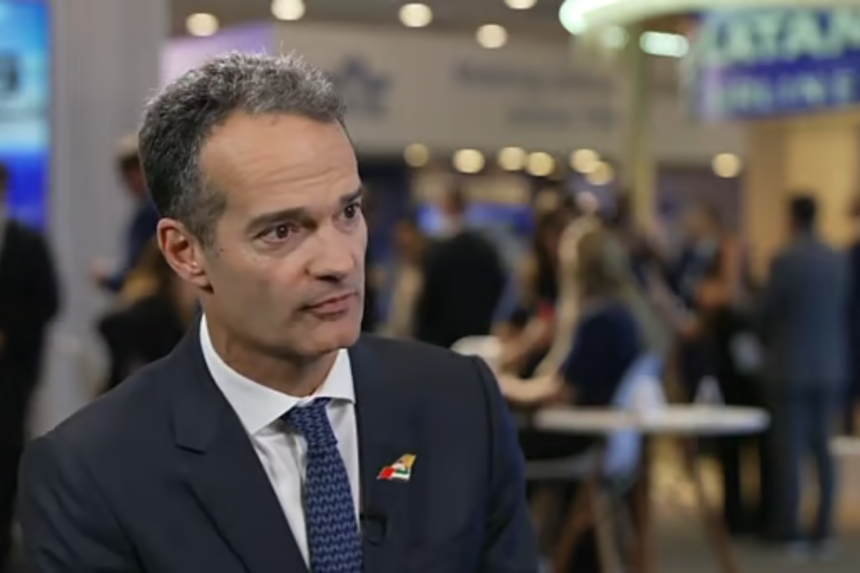
“Foreign investors want to come to Abu Dhabi, and they want to tell Abu Dhabi, I’m here with you,” said Neves on recovering corporate travel at the IATA AGM 2026.
Screengrab/ Bloomberg
Source: Gullf News