


Reports say Israel’s military chief opposed a proposed strike on Iran before the election, while Israeli officials deny a rift within the leadership.
Israeli Prime Minister Benjamin Netanyahu reportedly pushed for a new military operation against Iran in the weeks before Israel’s closely contested election but faced resistance from senior military commanders who questioned the urgency and timing of the proposed action, according to an investigation by The New York Times.
The report, which cited three senior Israeli defense officials and three other people briefed on the discussions, said military chief Lieutenant General Eyal Zamir opposed launching an attack before the vote. Israel’s government has denied any rift between political and military leaders, with Defense Minister Israel Katz describing reports of disagreements over Iran as “entirely baseless and false.”
The competing accounts have raised questions about Israel’s military decision-making, the political sensitivities surrounding the election, and the risk of renewed conflict with Iran.
Israeli Military Chief Questioned the Urgency of an Attack
According to The New York Times, Zamir argued that there was no immediate military requirement for an attack on Iran before the election. Air force commander Major General Omer Tischler reportedly also raised concerns about the proposed timing and the difficulty of explaining to the Israeli public why military action had to take place before voters went to the polls.
The report said Zamir was not opposed to military action against Iran in principle. His objections concerned the urgency and timing of the proposed operation.
In recent days, Zamir reportedly became concerned that Netanyahu was also pushing for a separate operation that would stop short of an overt strike. The precise nature of that proposed action was not disclosed.
According to an Israeli official and another person briefed on the matter, Zamir feared that such an operation could provoke an Iranian response and lead to a wider confrontation.
Israel’s military said operational decisions were guided by security considerations and its responsibilities as a national institution. The reasons behind Netanyahu’s reported push for action before the election remain unclear.
Netanyahu’s Government Denies a Rift With Military Leaders
The controversy gained attention after Israel’s Channel 12 reported on Sunday that Netanyahu and Zamir had clashed over an unspecified directive concerning Iran.
According to that report, Zamir demanded detailed discussions, legal guarantees, and signatures from political leaders before implementing the directive. It also cited concerns within the military that the conflict with Iran could be used for political purposes.
Netanyahu dismissed the allegations as “rubbish.” Katz also rejected claims of disagreements between the political leadership and the military, insisting that both were fully coordinated on Iran.
On Monday, Katz said Israel had no intention of initiating an attack on Iran before the election.
The New York Times subsequently published a more detailed account of the reported deliberations, citing officials and people familiar with the discussions who spoke anonymously because they were not authorized to discuss them publicly. Netanyahu’s spokesmen did not immediately respond to the newspaper’s requests for comment.
The reported objections and the government’s denials remain competing accounts of discussions whose full details have not been made public.
Could Renewed Fighting With Iran Affect Israel’s Election Outcome?
Beyond the immediate dispute, The New York Times examined how a renewed confrontation with Iran could affect the political negotiations following the election.
Israel’s parliamentary system requires a governing coalition to command sufficient support in the 120-seat Knesset. A party or bloc does not automatically form a government simply by winning the most seats.
Opinion polls cited in the report suggested that neither Netanyahu’s right-wing bloc nor the opposition associated with former military chief Gadi Eisenkot was assured of the 61 seats needed for a parliamentary majority.
That uncertainty could make coalition negotiations decisive in determining who governs Israel after the vote.
The newspaper reported that renewed hostilities could complicate efforts by Netanyahu’s opponents to form a government, even if they performed strongly at the polls. A fresh conflict could also create pressure for a national unity government that included Netanyahu.
These are possible political consequences rather than established plans or inevitable outcomes. The eventual effect would depend on the election results, the course of any renewed fighting, and the positions taken by parties during coalition negotiations.
Netanyahu’s Political Rivals Call for an Investigation
The reports have drawn criticism from opposition figures, some of whom have questioned whether political considerations influenced the reported push for military action.
Former defense minister Avigdor Lieberman said on Monday that he had asked Israel’s attorney general to investigate whether Netanyahu attempted to draw the country into a confrontation with Iran for political reasons.
Lieberman accused the prime minister of pressuring security officials in ways that could lead to a dangerous miscalculation. He described any attempt to provoke a war out of concern about electoral defeat as a betrayal of the country.
Opposition leader Yair Lapid also criticized Netanyahu, saying the prime minister had lost his grip on events. Left-wing leader Yair Golan described him as a threat to Israel’s security.
Eisenkot expressed confidence in Zamir and warned against using the military as an instrument of political survival.
The allegations have not been established by an official investigation, and Netanyahu’s government rejects the reported divisions.
Netanyahu Highlights the Iranian Threat During the Campaign
Throughout the election campaign, Netanyahu has presented himself as the leader best equipped to confront Iran and its regional allies. He has argued that Israel must complete its military objectives against Tehran and warned that an opposition victory could weaken national security.
On Sunday, Netanyahu posted an AI-generated image depicting a nuclear mushroom cloud over Tel Aviv, reinforcing his warnings about what he described as an existential threat from Iran.
He also warned that Iran and its proxies could attempt attacks intended to disrupt the election.
Iran’s foreign ministry dismissed the significance of the vote, saying it made no difference which Israeli leader emerged victorious.
US President Donald Trump renewed his endorsement of Netanyahu on Sunday, describing him as an outstanding wartime prime minister.
What Happens Next?
The reported dispute has added another layer to an Israeli election shaped by security concerns, the consequences of war, and divisions over the country’s political leadership.
For Netanyahu, the controversy raises questions about how voters will assess his handling of national security. For his opponents, the reports provide another basis to demand scrutiny of the government’s decisions.
The wider regional concern is whether political uncertainty in Israel could coincide with renewed military escalation involving Iran.
For now, the reported proposal for military action, the objections attributed to senior commanders, and the government’s denials remain unresolved. The full details of the discussions have not been made public, and an official investigation has yet to establish the allegations.
With input from AFP.
Read more news and follow us on Instagram.
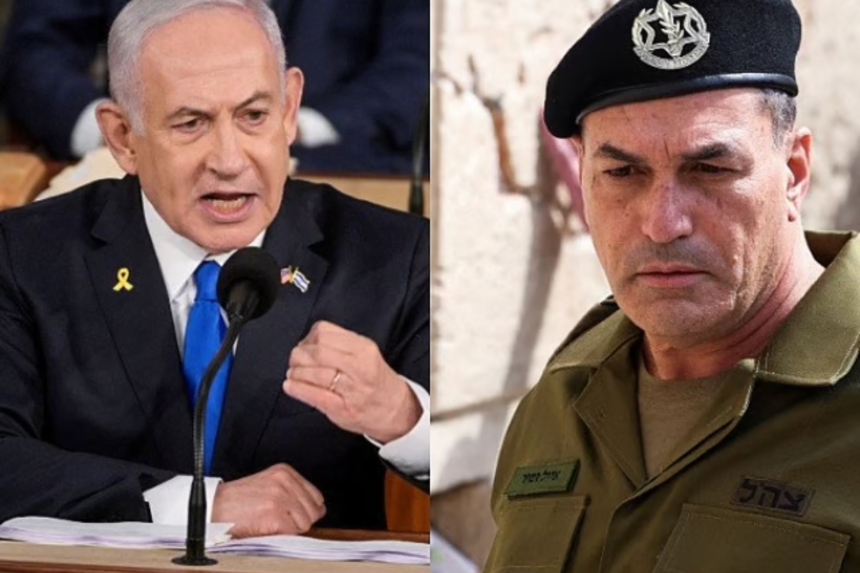
Israeli Prime Minister Benjamin Netanyahu and IDF Chief of Staff Lt. Gen. Eyal Zamir. According to The New York Times, Zamir opposed launching an attack before the election.
Source: Gulf News