


The US plans to use ship escorts, military strikes, and sanctions to pressure Iran and protect shipping through the Strait of Hormuz.
Six months into the war with Iran, US President Donald Trump is pursuing a strategy that combines military force, naval protection, and economic pressure to weaken Tehran’s ability to threaten the Strait of Hormuz.
The approach came into sharp focus on Tuesday, when US forces escorted 40 commercial vessels carrying about 18 million barrels of oil through the strategic waterway while striking nearly 60 Iranian military targets in the area, according to US officials cited by CNN. The operation involved air, sea, and space assets, as American forces also defended the commercial convoy against Iranian drones and anti-ship missiles.
The operation illustrates the three elements of Washington’s current approach: keep commercial shipping moving through Hormuz, repeatedly target Iranian military systems that threaten the waterway, and intensify economic pressure on Tehran.
US Tries to Keep Strait of Hormuz Open
The Strait of Hormuz remains at the centre of the conflict because of its importance to global energy markets.
Before the war, around 20 million barrels of oil were estimated to pass through the waterway each day. US Energy Secretary Chris Wright said more than 17 million barrels crossed on Monday, the highest level since the conflict began. The 18-million-barrel convoy escorted by US forces on Tuesday marked another wartime high.
For Washington, demonstrating that commercial vessels can still transit the strait is becoming an important part of the military campaign.
US forces have carried out mine-clearance operations and strikes on Iranian systems that Washington says could be used to threaten shipping. The latest operation targeted radar and air-defence systems, maritime assets, communications installations and mine-laying capabilities.
The objective is not simply to destroy individual weapons systems. It is to reduce Iran’s ability to use the waterway as leverage over international oil shipments.
Repeated Airstrikes on Iran’s Hormuz Defences
The military campaign is also becoming increasingly focused on preventing Iran from rebuilding the capabilities needed to threaten shipping.
US officials have acknowledged that Iranian forces have been able to reconstruct radar, missile and other military infrastructure after earlier strikes. That means Washington may need to keep returning to the same targets or attack replacement systems as they emerge.
Trump said on September 2 that American forces had again destroyed Iranian radar and missile equipment around Hormuz, including a rocket system that Iran was developing to deploy mines. He also indicated that the US was prepared to strike again if necessary.
That creates an important challenge for the administration. Keeping the waterway open could require a continuing US military presence rather than a single decisive operation.
Washington Is Also Targeting Iran’s Oil Revenue
The military campaign is being matched by an increasingly aggressive economic offensive.
Iranian crude exports have fallen sharply during the conflict, with recent reporting indicating that fresh crude exports have come close to zero under the US maritime blockade.
At the same time, Treasury Secretary Scott Bessent has signalled further sanctions targeting Iranian financial institutions and organisations linked to the Islamic Revolutionary Guard Corps.
Bessent said on September 1 that Washington was likely to announce sanctions against another Iranian bank and indicated that additional measures could follow. He has described the broader objective as economically isolating and severely pressuring the Iranian regime.
The strategy therefore goes beyond traditional sanctions. Washington is trying to restrict Iran’s ability to export oil while simultaneously limiting its access to international financial channels.
Iran Still Has Leverage Over Hormuz
Despite the increased US military presence, Tehran has not abandoned its ability to disrupt shipping.
Iran has expanded a blacklist of vessels it says have violated its navigation rules in the Strait of Hormuz. On September 2, 11 additional vessels were added to the list, taking the total to 56. The affected ships include crude oil tankers, LNG and LPG carriers,s and clean-product vessels. Iran has threatened penalties including fines, confiscation and detention.
The development highlights the continuing risks for shipping companies even as US forces try to demonstrate that the waterway can be used safely.
Insurance costs, tanker rates and security concerns remain major considerations for operators. LNG shipping is particularly sensitive because of the potential consequences of an attack on a vessel carrying liquefied natural gas.
The fact that ships are moving through Hormuz again does not necessarily mean that commercial confidence has returned to pre-war levels.
Nuclear Pressure Takes a Back Seat
Another significant feature of the current US strategy is the apparent shift in immediate priorities.
Rather than concentrating primarily on Iran’s nuclear infrastructure, the US military campaign has increasingly focused on securing the Strait of Hormuz, protecting commercial shipping and restricting Iran’s ability to move oil.
That represents a narrower operational objective. Washington is concentrating on the physical mechanisms through which Iran can exert pressure on global energy markets, while simultaneously trying to reduce the economic resources available to Tehran.
Is Trump’s Strategy Working?
There are signs of progress from the US perspective.
Oil flows through the Strait of Hormuz have increased from the lowest levels seen earlier in the conflict. American forces have demonstrated an ability to escort large commercial convoys, while repeated strikes have damaged Iranian radar, air-defence and maritime capabilities. Iran’s crude exports have also been severely disrupted.
But those developments do not necessarily amount to a political breakthrough.
Iran has continued rebuilding military infrastructure and asserting its authority over the waterway. The expansion of its vessel blacklist shows that Tehran still has tools to raise the cost and uncertainty of shipping through Hormuz.
The economic pressure also carries escalation risks. More sanctions could restrict Iran’s access to international finance, but they could also push Tehran towards further retaliation against US interests or commercial shipping.
The Bigger Question for Trump
Trump’s emerging strategy is designed to create pressure from several directions at once.
US military forces are trying to keep Hormuz open for international shipping. Airstrikes are aimed at making it harder for Iran to threaten that traffic. Sanctions are intended to reduce Tehran’s oil revenue and financial access.
The central question is whether the combination will produce a political concession from Iran.
So far, Washington has shown that it can increase the cost of Iran’s control over the waterway. It has not yet demonstrated that the pressure will be enough to force Tehran to change course.
For Trump, the calculation is becoming increasingly clear: maintain military pressure, restore the flow of commercial oil, and steadily tighten the economic squeeze until Iran has fewer options.
Whether that produces a negotiated outcome or simply prolongs the conflict remains the biggest uncertainty.
Read more news and follow us on Instagram.
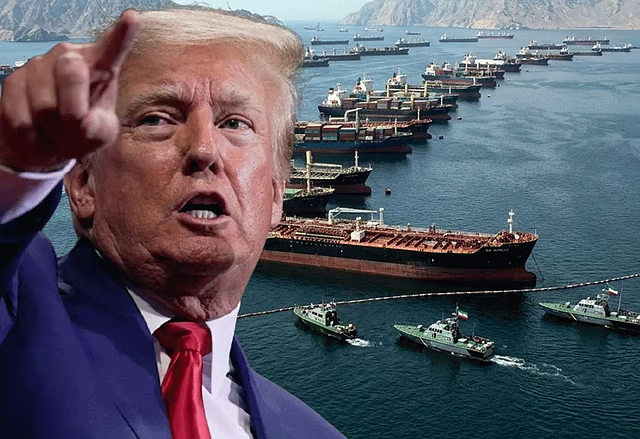
Illustrative image: US President Donald Trump is betting that military strikes, protected shipping and mounting economic pressure can erode Iran’s leverage over the Strait of Hormuz.
Source: Gulf News