

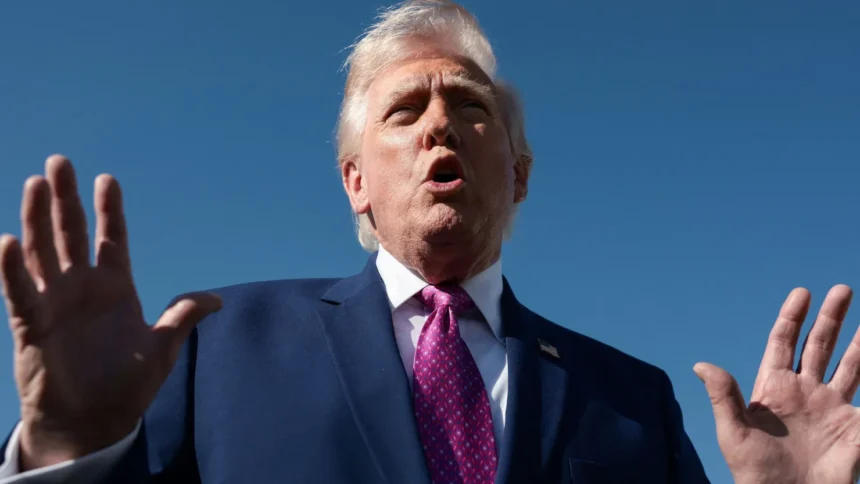
A social media post from Donald Trump underscores rising geopolitical tension as stalled negotiations and Hormuz disruptions keep markets on edge.
Donald Trump intensified his rhetoric against Iran with a Truth Social post that combined direct warning with symbolism.
“Iran can’t get their act together… They’d better get smart soon,” he wrote, alongside an AI-generated image depicting himself holding a weapon with the phrase “No more Mr. Nice guy.”
The message was not policy. It was positioning. A signal aimed at multiple audiences at once, Tehran, domestic observers, and markets already sensitive to escalation.
Negotiations Stall as Leverage Shifts
Recent diplomatic efforts have struggled to move. Talks that were expected to continue in Islamabad were canceled, and an earlier engagement led by JD Vance failed to deliver a breakthrough.
Tehran’s latest proposal introduced a sequencing problem. It suggested reopening the Strait of Hormuz in exchange for lifting U.S. restrictions, while postponing nuclear discussions.
From Washington’s perspective, that structure removes immediate leverage. From Tehran’s perspective, it reduces upfront concessions.
The result is a negotiation loop where both sides are waiting for the other to move first, without giving up strategic ground.
Oil Markets React to Signal, Not Outcome
Here’s a tighter version with clearer transitions and active voice:
Markets reacted immediately—not to a deal, but to the absence of one. As uncertainty deepened, Brent crude climbed above $110 per barrel, while West Texas Intermediate moved past $100. This response reflects a familiar pattern: energy markets price in risk long before they price in resolution.
At the centre of that concern is the Strait of Hormuz. Because it carries a significant share of global oil supply, continued disruption keeps market risk structurally elevated.
Structural Pressure Beyond the Headlines
The escalation comes at a time when supply conditions are already under strain. The United States continues to pressure Iranian exports. At the same time, shipping routes remain unstable, and political trust between both sides stays low.
As a result, even if negotiations restart, normal market conditions will not return immediately. Tankers have shifted position. Supply chains have absorbed disruption. Any recovery will likely trail behind a formal agreement.
What the Signal Actually Means
The AI-generated image is not the story. It is the surface. The underlying reality is a negotiation shaped by leverage, timing, and pressure points tied directly to energy flows. Until those fundamentals shift, rhetoric will continue to substitute for resolution, and markets will continue to respond accordingly.
U.S. President Donald Trump speaks to the media before boarding Air Force One on his way to Virginia, at Joint Base Andrews in Maryland, U.S., April 10, 2026.
Evelyn Hockstein | Reuters
Source: CNBC