


Developers are accelerating deliveries as demand for premium and mid-market housing remains strong.
Strong transaction activity, rising rents, and growing investor demand are reinforcing Abu Dhabi’s position as one of the UAE’s fastest-growing real estate markets.
The Abu Dhabi property market is strengthening its position as one of the UAE’s most resilient and rapidly expanding real estate sectors, supported by rising transaction volumes, strong rental growth, and sustained demand for premium residential and commercial assets.
According to the latest Q1 2026 market assessment released by Colliers, the capital continues attracting investors, multinational corporations, and high-net-worth residents despite broader geopolitical uncertainty across the region.
The report highlights how Abu Dhabi’s market is gradually transitioning from the explosive post-pandemic boom period into a more stable and mature growth cycle, while still maintaining strong momentum across residential, office, and investment segments.
More Than 8,000 Homes Expected This Year
Developers are accelerating project handovers across the emirate as housing demand remains strong in both premium and mid-market communities.
Around 1,200 residential units were delivered during the first quarter of 2026, while another 7,000 units are expected to be completed before the end of the year.
At the same time, developers launched 22 new projects during the quarter, including nine branded residential developments, signaling continued long-term confidence in Abu Dhabi’s housing market.
The scale of upcoming deliveries reflects how developers are responding to sustained buyer demand, particularly from professionals relocating to the UAE capital and investors seeking stable long-term returns.
Rental Growth Remains Strong Across Key Communities
Residential rents across Abu Dhabi continued rising sharply during Q1 2026, although analysts noted that growth is beginning to moderate compared to the aggressive increases seen during earlier phases of the market cycle.
Average apartment rents climbed 15 percent year-on-year, while some mid-market developments recorded rental growth exceeding 20 percent.
Villa rents also continued to rise, increasing by 6 percent annually and 1 percent quarter-on-quarter.
Premium residential communities on Yas Island remained among the strongest-performing areas in the emirate, benefiting from lifestyle-driven demand, waterfront developments, and growing international buyer interest.
The continued rise in rents reflects both strong population growth and limited availability of high-quality residential supply in established communities.
Abu Dhabi’s Office Market Is Becoming One of Its Biggest Growth Drivers
The commercial property sector has emerged as one of Abu Dhabi’s strongest-performing real estate segments.
Occupancy rates across key office districts climbed above 95 percent during the quarter, while office rents rose between 8 percent and 20 percent annually, depending on asset quality and location.
Demand remains especially strong for Grade A office space as multinational corporations, financial institutions, and technology companies continue expanding operations in the emirate.
The handover of Shams Tower on Al Reem Island introduced fresh commercial inventory into the market, while upcoming projects such as Masdar City Square and The Link are already attracting substantial occupier interest ahead of completion.
Analysts increasingly view sustainable and environmentally efficient office buildings as one of the most important structural trends shaping Abu Dhabi’s commercial real estate sector.
Property Transactions Continue Climbing
Residential transaction activity in Abu Dhabi remained exceptionally strong throughout the quarter.
Around 7,800 property deals were recorded during Q1 2026, representing a 10 percent increase quarter-on-quarter and a remarkable 119 percent surge compared to the same period last year.
Sales prices also continued rising sharply.
Average apartment prices climbed 32 percent year-on-year, while villa prices increased 21 percent annually.
The combination of rising prices, strong transaction volumes, and sustained rental demand suggests that buyer confidence in Abu Dhabi’s long-term growth story remains firmly intact.
Dubai’s Market Is Entering a More Balanced Phase
While Abu Dhabi continues to accelerate, the Dubai property market appears to be gradually transitioning out of the rapid expansion phase that followed the pandemic-era boom.
Apartment handovers exceeded 10,000 units for the second consecutive month during Q1 2026, while approximately 1,900 villas were delivered.
Another 65,000 apartments and 12,500 villas are expected to enter Dubai’s market before the end of the year, although analysts expect some delays across certain developments.
Despite the large incoming supply pipeline, rental growth remains positive, especially in affordable and mid-market communities supported by continued expatriate inflows and population growth.
Apartment rents increased 2 percent quarter-on-quarter, while villa rents largely stabilized as tenants became more price-conscious.
The report also noted that Dubai’s office sector continues outperforming many residential segments due to limited Grade A commercial supply in key business hubs such as DIFC and Business Bay.
Northern Emirates Continue Evolving Beyond Commuter Markets
Real estate markets across the Northern Emirates are also gradually evolving into independent lifestyle destinations rather than functioning solely as lower-cost alternatives to Dubai.
Around 5,200 residential units were launched across the Northern Emirates during Q1 2026, although launch volumes declined sharply compared to the exceptionally active market conditions seen during 2025.
Sharjah led new launches with around 1,700 units, followed by Ras Al Khaimah, Ajman, and Umm Al Quwain.
Rental growth across these markets moderated significantly, while new handovers continued in communities such as Aljada, Sharjah Sustainable City, and Al Zahia.
UAE Property Markets Remain Resilient Despite Regional Pressures
According to Colliers, UAE real estate markets have so far remained largely insulated from broader geopolitical uncertainty in the region.
However, analysts believe the coming quarters will be critical in determining whether rising supply levels and global economic pressures eventually slow transaction activity or stabilize pricing growth across key markets.
For now, Abu Dhabi continues standing out as one of the UAE’s strongest real estate growth stories, supported by economic diversification, infrastructure investment, corporate expansion, and sustained investor confidence.
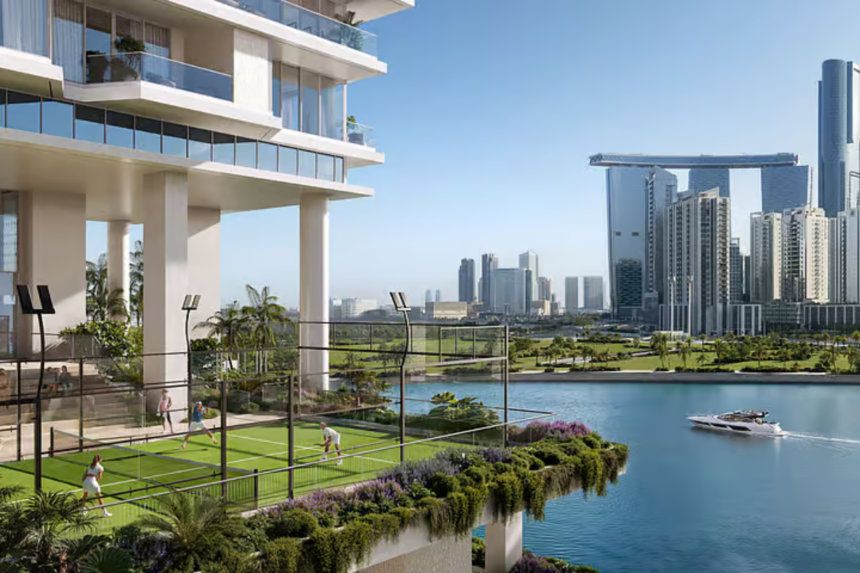
source: The Abu Dhabi skyline. The UAE capital continues to outperform several regional markets amid rising demand for high-quality residential communities and Grade A commercial assets. Photo: KT file