


Microsoft’s AI transformation is no longer just about products and infrastructure. It is now reshaping who holds influence inside the company itself.
For decades, Microsoft operated through a traditional corporate hierarchy built around massive business divisions, senior executives, and carefully layered management structures.
That model helped the company dominate the enterprise software and cloud era.
Now, according to reports from Business Insider, CEO Satya Nadella is dismantling much of that legacy structure in favor of something faster, flatter, and far more technically focused as Microsoft races to compete in the artificial intelligence era.
The shift reflects a broader realization spreading across Silicon Valley: large corporations can no longer move slowly while AI development accelerates at startup speed.
The Quiet End of Microsoft’s Old Leadership Structure
One of the biggest internal changes reportedly involved the quiet retirement of Microsoft’s traditional Senior Leadership Team, commonly known inside the company as the SLT.
For years, that structure concentrated power among high-ranking executives who managed enormous business divisions and reported directly to the CEO.
Now Nadella appears to be replacing that model with smaller operating groups designed to stay closer to engineering, product development, and technical execution.
The reasoning is simple.
AI development cycles move too quickly for heavy corporate layers.
According to people close to Nadella, Microsoft believes its own size has increasingly become a disadvantage in the AI race, especially against smaller companies capable of making decisions faster and shipping products rapidly.
That urgency has intensified after Microsoft faced growing investor pressure to justify its enormous AI spending while competing against rivals moving aggressively across the sector.
A New Inner Circle Focused on AI Execution
The new structure reportedly centers around highly focused leadership groups rather than sprawling executive hierarchies.
One key group is Microsoft’s corporate leadership team, which now handles governance and companywide operations through a smaller circle that includes Nadella, President Brad Smith, CFO Amy Hood, Chief People Officer Amy Coleman, and Commercial CEO Judson Althoff.
Alongside that sits a separate engineering leadership structure involving roughly 35 engineering and product leaders working directly on AI and technical strategy.
The model resembles startup operating systems more than traditional enterprise management.
Instead of routing decisions through large managerial chains, engineers, researchers, designers, and product builders increasingly work in tightly connected groups.
The structure also mirrors changes happening across Big Tech more broadly.
Even Amazon CEO Andy Jassy has reportedly expanded leadership access deeper into operational teams to improve decision speed and information flow.
Copilot Becomes the Center of Microsoft’s AI Push
At the center of Microsoft’s AI strategy sits Microsoft Copilot.
Nadella reportedly now runs dedicated weekly meetings around Copilot leadership involving executives such as Charles Lamanna, Jacob Andreou, and Ryan Roslansky.
Each executive focuses on different parts of the AI ecosystem, including infrastructure, interface design, and Office integration.
The structure reveals how central Copilot has become to Microsoft’s long-term AI ambitions.
The company no longer sees AI as a side initiative attached to existing products. Instead, AI increasingly functions as the organizing layer sitting across the entire Microsoft ecosystem.
That requires leadership structures capable of moving with unusual speed.
Technical Leaders Are Gaining More Influence
One of the most striking parts of Nadella’s restructuring is who appears to be gaining influence internally.
Veteran technical leaders and engineering-focused executives are rising closer to the CEO, often bypassing traditional corporate ladders.
For example, Microsoft veteran Arun Ulag reportedly now plays a larger strategic role beyond overseeing the company’s Fabric data analytics platform.
Similarly, Pavan Davuluri, who oversees Windows and devices, has emerged as another trusted operational figure inside Nadella’s evolving structure.
Meanwhile, Nadella reportedly continues reviewing AI metrics personally every week, signaling how deeply involved he remains in technical execution.
The broader pattern suggests Microsoft increasingly values engineering velocity and product intuition over traditional enterprise management experience.
Longtime Power Brokers Are Losing Influence
As new AI-focused leaders rise, several longtime Microsoft executives have either transitioned into narrower roles or begun stepping away entirely.
Mustafa Suleyman, who joined Microsoft in 2024 to lead its AI division, now reportedly oversees a smaller superintelligence-focused organization.
Longtime marketing executive Yusuf Mehdi recently announced his departure from operational leadership, while influential product leader Rajesh Jha is preparing to retire.
Perhaps the most surprising change came inside Microsoft’s gaming business.
In February, Nadella appointed Asha Sharma as CEO of Microsoft Gaming, replacing longtime Xbox leader Phil Spencer.
The decision surprised many employees because Sharma came from Microsoft’s Core AI division and lacked deep gaming-industry roots.
However, the move strongly signaled Nadella’s willingness to prioritize AI-oriented leadership over traditional organizational seniority.
Microsoft Is Trying to Behave More Like a Startup
The deeper story here is cultural. Nadella appears increasingly convinced that Microsoft cannot survive the AI transition while operating like a slow-moving enterprise giant.
That explains why the company is studying startup structures, flattening leadership layers, and pushing executives toward more demanding operational expectations.
Internally, the company reportedly now emphasizes faster iteration, tighter collaboration, and direct engagement between leadership and engineering teams.
Even accelerator meetings reportedly now prioritize ideas from rank-and-file employees rather than relying only on executive-level discussions. The goal is not simply efficiency. It is survival in an industry where AI competition is compressing timelines dramatically.
The Real Risk Behind Microsoft’s AI Rebuild
The challenge, however, remains enormous. Restructuring a 220,000-person corporation into something capable of operating with startup-level agility may be one of the hardest management experiments happening inside the technology industry right now.
Jason Schloetzer, associate professor at Georgetown University’s McDonough School of Business, described the core issue clearly.
Large companies increasingly need information to flow rapidly from frontline engineers to senior leadership because technological shifts now move too fast for traditional reporting structures. Yet very few massive organizations have successfully solved that challenge. Microsoft is now attempting to do so in real time while competing in the most significant technological transition since the rise of cloud computing. In the process, Nadella’s AI strategy is doing far more than reshaping Microsoft’s products; it is rebuilding the company’s internal power structure from the inside out.
Source: BI
Read more news, and follow us on Instagram
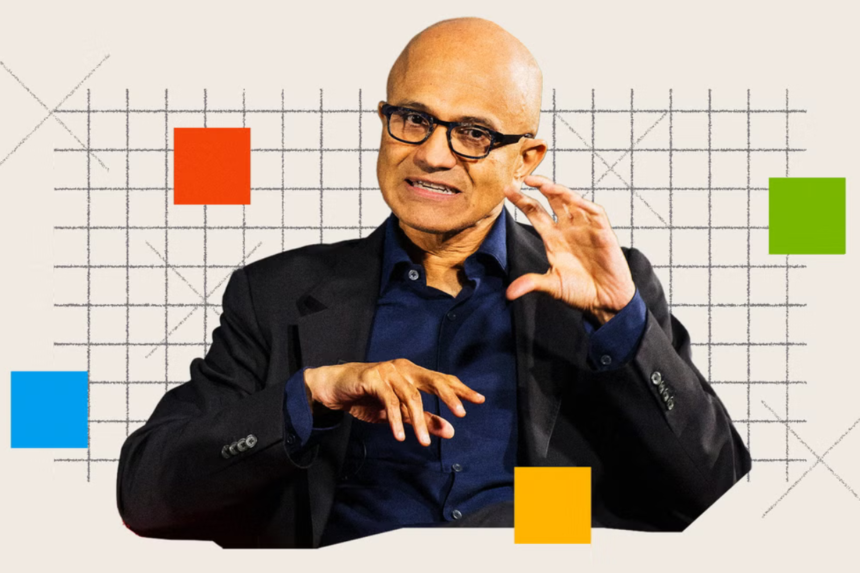
Photo: Microsoft CEO Satya Nadella. Ben Kriemann/Getty; Tyler Le/BI