



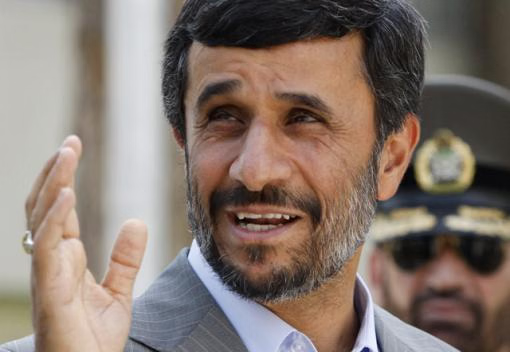
Report claims ex-Iranian president Mahmoud Ahmadinejad was being positioned for a post-war leadership role.
In the days following the massive Israeli strikes that reportedly killed key Iranian military leaders and Supreme Leader Ali Khamenei, discussions inside Washington and Tel Aviv appear to have moved far beyond battlefield objectives. According to a detailed report by The New York Times, officials quietly explored an ambitious regime-change strategy that included positioning former Iranian president Mahmoud Ahmadinejad as part of a possible post-war political transition in Iran.
The proposal, however, reportedly unraveled almost as quickly as it emerged.
A High-Risk Political Gamble
According to officials cited in the report, the broader strategy envisioned far more than weakening Iran’s nuclear and military infrastructure. Instead, Washington and Tel Aviv allegedly hoped the opening phase of the war would trigger internal instability severe enough to collapse the Islamic Republic’s ruling structure altogether.
As part of that thinking, Ahmadinejad emerged as an unexpected figure in discussions surrounding a potential transitional leadership arrangement.
The idea shocked many observers because Ahmadinejad had long been viewed internationally as one of Iran’s hardest-line leaders. During his presidency from 2005 to 2013, he became globally controversial for anti-Israel rhetoric, Holocaust denial, and aggressive support for Iran’s nuclear program.
Yet despite that history, officials reportedly believed he could function as a nationalist figure capable of stabilizing Iran after a leadership vacuum.
Israeli Strike Reportedly Targeted Ahmadinejad’s Residence
The report further claimed that an Israeli strike targeted Ahmadinejad’s residence during the opening day of the conflict.
According to US officials cited by the newspaper, the operation allegedly aimed to eliminate Revolutionary Guard personnel monitoring him under house arrest conditions, effectively freeing him to participate in the broader transition effort.
Ahmadinejad reportedly survived the strike but suffered injuries.
Afterward, officials said he became disillusioned with the wider regime-change strategy and disappeared from public view. His current whereabouts remain unclear.
If accurate, the episode would represent one of the most extraordinary and risky geopolitical maneuvers attempted in recent Middle Eastern history.
Iran’s State Structure Did Not Collapse
Although Israeli and US military operations reportedly succeeded in eliminating several senior Iranian figures, the larger political strategy failed to unfold as expected.
The report stated that planners anticipated multiple destabilizing developments occurring simultaneously, including Kurdish uprisings along Iran’s borders, mass political fragmentation inside Tehran, and the rapid weakening of state institutions.
None of those developments materialized at the scale anticipated.
Instead, Iran’s political and security structure absorbed the initial shock more effectively than many officials expected. While military damage was significant, the state itself remained functional.
That resilience reportedly forced Washington and Tel Aviv to reconsider assumptions about how quickly external pressure could destabilize the Iranian system.
Ahmadinejad’s Complicated Political Position
In recent years, Ahmadinejad had become increasingly isolated from Iran’s clerical leadership despite once serving as one of the Islamic Republic’s most prominent political figures.
Iranian authorities barred him from running in the presidential elections in 2017, 2021, and 2024, while he openly criticized corruption and elite power structures within the country.
At the same time, his rhetoric toward the West occasionally softened compared with his earlier presidency. In a 2019 interview, he described Donald Trump as “a man of action” and called for better relations between Iran and the United States.
Those contradictions may explain why some officials viewed him as a politically useful figure despite his deeply controversial history.
Regime Change Remains a Dangerous Calculation
The revelations described in the report highlight how modern conflicts increasingly extend beyond military operations into attempts at political restructuring and influence engineering.
However, regime-change strategies have historically carried enormous risks, particularly in countries with deeply entrenched political, military, and ideological systems.
In Iran’s case, analysts say Washington and Tel Aviv may have underestimated how strongly external intervention can consolidate nationalist sentiment inside the country, even among populations critical of the government itself.
The failure of the reported Ahmadinejad strategy also underscores a larger geopolitical reality.
Removing leadership figures by military force does not automatically lead to political collapse, especially in states with extensive institutional security networks and long experience navigating external pressure.
A Conflict That Expanded Beyond Military Objectives
While the White House publicly framed the campaign around military and security goals tied to Iran’s missile infrastructure and regional proxy networks, the reported discussions reveal that some officials were simultaneously thinking about reshaping Iran’s leadership entirely.
Even after the initial strategy faltered, some Israeli officials reportedly continued believing regime change remained achievable through further destabilization efforts.
For now, however, the reported plan appears to have collapsed under the weight of Iran’s institutional strength, internal political realities, and the unpredictability that always follows attempts to engineer leadership transitions through conflict.
Read more news, and follow us on Instagram
Ahmadinejad, once one of the West’s most vilified adversaries, was known for fiery anti-Israel rhetoric, Holocaust denial, and hardline support for Iran’s nuclear ambitions during his presidency from 2005 to 2013.
Source: Gulf News file