



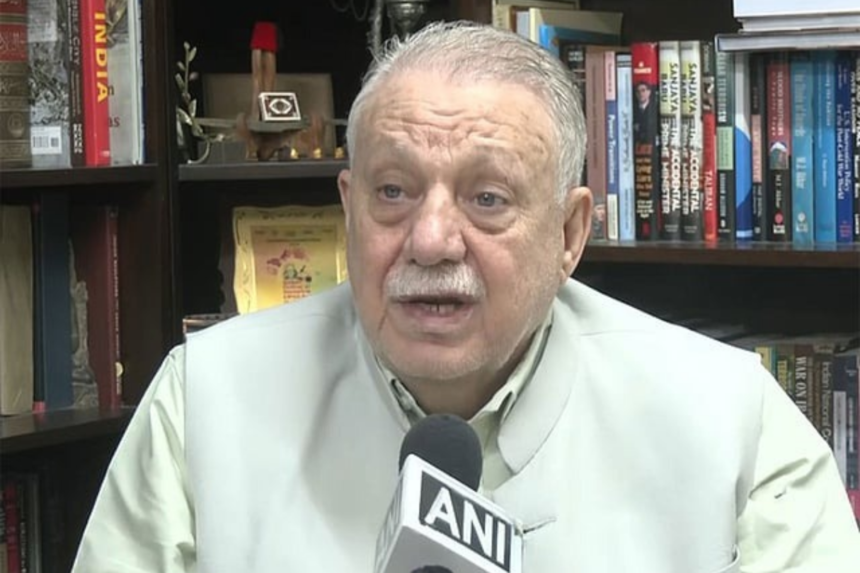
Waiel Awwad claims Washington is seeking to weaken Iran and expand Israel’s regional influence rather than reach a nuclear agreement with Tehran.
NEW DELHI: Foreign affairs expert Waiel Awwad has alleged that the United States is seeking regime change in Iran rather than a negotiated settlement over its nuclear program, arguing that Washington’s strategy could reshape the regional balance of power in Israel’s favor.
Speaking to ANI, Awwad said conflicting messages from the White House, ranging from threats of military action to proposals for dialogue, reflected what he described as a broader effort to weaken Iran and reshape the Middle East.
“The United States objective is no more the oil, no more the nuclear issues… It’s a regime change, the destruction of Iran, and the disintegration of Iran, which makes Israel a dominant force in the region,” Awwad told ANI.
His remarks come amid heightened military tensions across the Middle East, concerns over energy supplies, and uncertainty surrounding diplomatic efforts to resolve the confrontation.
Awwad Links US Strategy to Regional Power Politics
Awwad argued that Washington’s approach to Iran was driven by objectives extending beyond nuclear negotiations. He claimed the conflict was part of a broader effort to weaken Tehran and strengthen Israel’s position in the region.
He also suggested that domestic political considerations were influencing the US administration’s approach, pointing to the upcoming American midterm elections.
“This has also created some sort of a reassessment of the situation to improve his scoring in the American midterm election,” he said.
The assessment reflects Awwad’s interpretation of US policy. Washington’s stated objectives and the motivations behind its actions would need to be assessed separately through official statements and other evidence.
Iran Sees the Conflict as an Existential War, Expert Says
Addressing Tehran’s retaliatory posture and reports of potential threats to undersea internet cables in the Gulf, Awwad said Iran viewed the confrontation as a fight for its survival.
“For Iran, it has now become an existential war,” he said, adding that Tehran’s threats to trigger a wider global crisis were intended to signal its readiness to respond to further US military action.
Awwad argued that Iran was prepared to defend itself and inflict further costs on the United States if the conflict escalated.
The possibility of threats to undersea communications infrastructure adds another dimension to regional security concerns. Damage to such cables could affect international data connectivity, although the supplied report does not establish that any cables have been attacked.
Doubts Over Diplomatic Efforts Between Washington and Tehran
Awwad expressed skepticism about the prospects for a diplomatic resolution, saying Iran had submitted proposals following the United Nations General Assembly but had not received a clear response from Washington.
“I don’t believe that the United States is serious about the diplomatic outcome of this crisis,” he said.
His comments underline the uncertainty surrounding negotiations as military tensions continue. Whether diplomatic efforts can make progress will depend on the positions adopted by Washington and Tehran, the terms under discussion, and the willingness of both sides to pursue an agreement.
Rising Oil Prices Raise Concerns for India’s Energy Security
Awwad also pointed to the economic consequences of the conflict, particularly for countries that depend on imported energy.
With crude oil reported at $117 per barrel, he warned of possible pressure on India’s energy security, domestic inflation, and price stability.
Higher oil prices can increase import costs for energy-dependent economies and place pressure on transport, manufacturing, and household expenses. The impact on India would depend on how long prices remain elevated, the availability of alternative supplies, and changes in global demand.
The situation also places renewed attention on the Strait of Hormuz, a major route for global oil shipments. Any sustained disruption to shipping through the strait could affect energy markets and raise costs for importing countries.
Why the Jamnagar Refinery Matters
Commenting on US Secretary of State Marco Rubio’s visit to India and the reported visit to Reliance Industries’ refinery complex in Jamnagar, Awwad said Washington was seeking to bring Venezuelan oil supplies into the international market to offset potential disruptions.
He described the refinery as an important strategic asset for India because of its capacity to process crude oil and produce refined petroleum products for domestic and international markets.
“Jamnagar refinery is not merely a giant factory; in fact, it is one of India’s strategic assets, where India can produce more diesel to serve the world and make some kind of balance in the international market,” he said.
India’s ability to source crude from different suppliers and process it through its refining network can help it respond to changes in global oil flows. However, the effect of any additional Venezuelan supplies would depend on their availability, commercial terms, refinery requirements, and the wider international sanctions environment.
A Wider Contest Over Oil and Maritime Routes
Awwad warned that rising tensions around the Strait of Hormuz and Bab al-Mandeb reflected a wider struggle over energy supplies, maritime access, and regional influence.
“It’s a war of corridors and the war of dominance in the oil market,” he said.
The two waterways are important to international trade. The Strait of Hormuz connects the Persian Gulf with the Gulf of Oman and the Arabian Sea, while Bab al-Mandeb links the Red Sea with the Gulf of Aden and the wider Indian Ocean.
Disruption at either passage could affect shipping schedules, freight costs, and energy markets. Further escalation could also increase the risk of military incidents involving regional and international forces.
Awwad assesses that the confrontation is about more than Iran’s nuclear program. He argues that the conflict is tied to competing regional ambitions, control over strategic routes, and the balance of power in the Middle East.
It remains uncertain whether the crisis will move toward diplomacy or further military action. For India and other energy-importing economies, the immediate concerns are the stability of oil supplies, the cost of imports, and the risk that a prolonged confrontation could disrupt trade across key maritime routes.
Read more news and follow us on Instagram
Waiel Awwad ANI
Source: Gulf News