


Seven key developments reveal the growing Saudi-Houthi crisis, from deadly attacks and Aramco’s headquarters evacuation to the US withdrawal of embassy staff and mounting concerns over regional security.
DUBAI: Saudi Arabia’s confrontation with Yemen’s Houthi movement has entered a dangerous phase, with reported attacks on airports and energy facilities killing civilians, raising security concerns around Saudi Aramco operations, and prompting the United States to withdraw non-emergency diplomatic personnel from the kingdom.
Four people, including an Indian national, were killed in separate incidents involving Dammam airport and the Shaybah oilfield, according to the supplied report. Saudi air defenses also continued intercepting drones over several parts of the country.
The escalating confrontation has disrupted air travel, raised concerns over critical oil infrastructure, and prompted additional international security measures. The developments have renewed fears that fighting involving Yemen’s Houthis could widen into a broader regional conflict.
Here are seven major developments and what they could mean for Saudi Arabia and the wider region.
1. Why Has Saudi Aramco Evacuated Its Headquarters?
Saudi Aramco reportedly instructed its remaining staff at its headquarters in Dhahran to leave the premises and work remotely until further notice, according to sources cited by AFP and Reuters on Thursday.
Non-essential employees had already been working from home following an earlier Houthi attack on the company’s extensive headquarters complex.
Saudi officials confirmed that a building in the area housing Aramco’s operations center had been struck. Employees described extensive damage, although AFP could not independently verify its full extent.
The latest evacuation did not include residential areas within the complex, and the number of employees affected was not immediately known.
The move highlights concerns over the security of Saudi Arabia’s energy infrastructure. Any sustained threat to major oil facilities could have consequences beyond the kingdom, given Saudi Arabia’s importance to global energy supplies.
2. What Happened at Dammam Airport?
An attack on King Fahd International Airport in Dammam on Wednesday night killed two people, an Indian resident and a Saudi citizen, and injured eight others, according to the supplied report.
The injured included two Indians, two Yemenis, two Bangladeshis, one Nepalese national, and one Saudi national.
Saudi Arabia’s General Authority of Civil Aviation said airport operations subsequently resumed and air traffic returned to normal.
The incident added to the civilian death toll from attacks on Saudi airports. An AFP tally of official figures cited in the report put the number of people killed in such attacks this month at 22.
Repeated strikes have also disrupted aviation, with Riyadh’s international airport previously closed for several days. Further attacks could complicate travel, affect airline operations, and increase security concerns for passengers and airport workers.
3. Drone Debris Kills Two Workers Near Shaybah Oilfield
Two foreign nationals, a Filipino and a Nepalese worker, were killed by falling debris from an intercepted drone targeting Saudi Aramco’s Shaybah oilfield, according to the supplied report. An Indian national and a Pakistani national were injured.
Saudi authorities said the debris caused a fire in a contractor’s vehicle outside the facility’s perimeter. Oilfield operations were not affected.
The incident demonstrates that intercepting an incoming drone does not eliminate every risk. Debris from destroyed or diverted aircraft can still endanger workers and other civilians near the intended target.
It also raises questions about the protection of contractors and support staff working around major energy installations, where security threats can extend beyond the facilities themselves.
4. Are Riyadh and Medina Facing Further Drone Threats?
Saudi Arabia reported additional drone interceptions on Thursday, including threats in the Riyadh and Medina areas. The Saudi-led coalition also reported interceptions over the Eastern Province as security operations continued.
The reports did not establish that Medina’s holy sites had been struck.
The Houthis had previously denied launching drones toward Medina, despite statements from the Saudi-led coalition reporting interceptions.
The geographical spread of reported threats presents a challenge for Saudi air defenses, which must protect population centers, airports, and energy facilities across a large area.
Further attacks could increase pressure on security services and disrupt civilian activity, even in locations where incoming drones are intercepted before reaching their intended targets.
5. Why Is the United States Withdrawing Diplomatic Personnel?
The United States ordered non-emergency government employees and their families to leave Saudi Arabia because of the deteriorating security situation, according to the supplied report.
The US State Department cited Houthi attacks on civilian airports and critical infrastructure that had caused casualties and significant travel disruption.
Reuters also reported that US officials anticipated departures involving family members at other Gulf diplomatic missions. However, the confirmed departure order described in the report applied to Saudi Arabia.
The measure represents a significant security precaution as attacks increasingly threaten civilian and diplomatic infrastructure.
A departure order for non-emergency personnel does not, by itself, mean that all diplomatic operations have stopped. It does, however, indicate that US authorities consider the security environment serious enough to reduce the number of people exposed to potential danger.
6. Could the Conflict Spread Beyond Saudi Arabia and Yemen?
The confrontation is drawing greater international involvement, according to the supplied report.
Britain announced additional defensive military support for Saudi Arabia, including RAF Typhoon patrols intended to help intercept missiles and drones. Egypt also pledged support for Saudi security.
Meanwhile, the Houthis threatened Saudi energy installations and declared a maritime blockade, bringing the strategically important Red Sea shipping routes further into the confrontation.
Saudi Arabia responded with airstrikes against Houthi-controlled areas of Yemen.
The renewed fighting follows the breakdown of a prolonged truce and a Houthi offensive along Yemen’s Red Sea coast, according to the report.
The risk of a wider conflict depends partly on what happens next. Further attacks on shipping, oil facilities, or civilian infrastructure could prompt additional military responses and draw more countries into the confrontation.
Disruption around the Red Sea could also affect commercial shipping and regional trade, adding an economic dimension to the security crisis.
7. What Happens Next: Escalation or Diplomacy?
Saudi Arabia faces a difficult choice between defending its territory and avoiding a prolonged confrontation that could disrupt aviation, oil operations, and regional trade.
The Houthis have demonstrated their ability to threaten targets beyond Yemen, while Saudi forces continue to target the group’s military capabilities.
The United States and other partners are strengthening security precautions, but an expanding military response carries the risk of further escalation.
Diplomatic efforts to end Yemen’s conflict have yet to produce a lasting settlement. The wider confrontation involving the United States, Israel, and Iran has added another layer of uncertainty to an already volatile regional situation.
Three questions will be particularly important in the coming days:
- Can Saudi air defenses contain further attacks? The ability to protect cities, airports, and energy facilities will influence the kingdom’s next steps.
- Will oil and aviation operations remain stable? Further damage or prolonged disruption could have consequences for regional commerce and international energy markets.
- Can diplomatic efforts prevent a wider war? Communication between regional powers and their international partners could help limit further military escalation.
The answers will depend on the scale and frequency of further attacks, the military responses they trigger, and whether diplomatic channels can regain momentum.
For now, the immediate concern is whether the confrontation can be contained before more civilians are killed and additional countries become directly involved.
Read more news and follow us on Instagram.
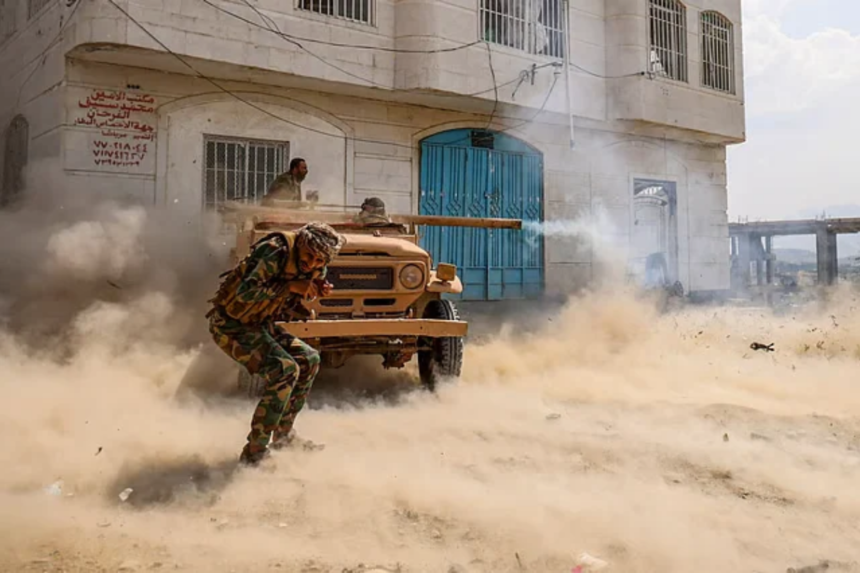
Saudi-backed Yemeni government fighters fire a truck-mounted recoilless rifle during battles against Yemen’s Iran-backed Houthis at the Jabal Han front west of the city of Taiz on October 21, 2026.
AFP/ source: Gulf News