


The Abu Dhabi Crown Prince and the Iranian President discussed regional issues. They pursued measures to ease tensions and foster peace. They then reinforced regional stability.
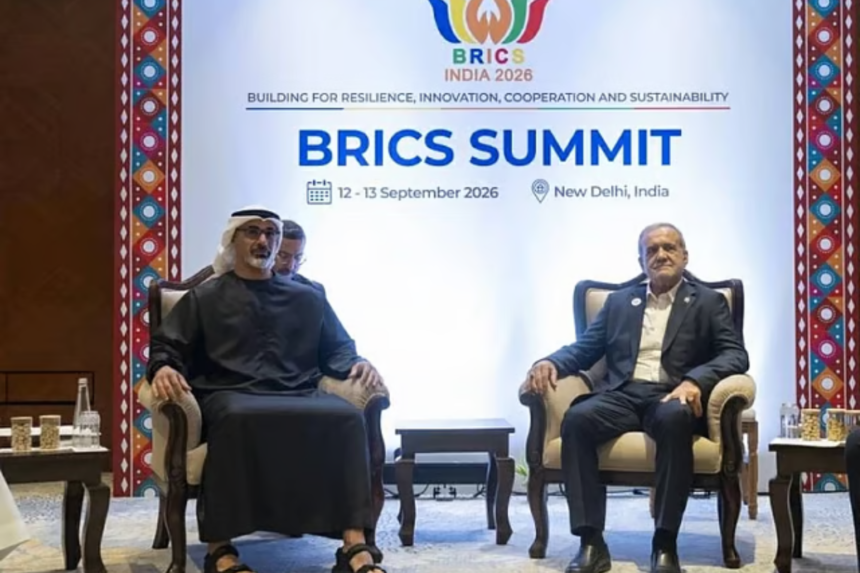
Abu Dhabi Crown Prince Sheikh Khaled bin Mohamed bin Zayed Al Nahyan met Iranian President Masoud Pezeshkian on the sidelines of the 18th BRICS Leaders Summit in New Delhi, with the two sides discussing regional and international issues and the need for greater calm and stability.
The meeting comes as the wider Middle East remains under severe geopolitical pressure, with the ongoing conflict involving Iran adding urgency to diplomatic efforts aimed at containing further escalation.
According to the UAE’s official account, Sheikh Khaled and Pezeshkian discussed issues of mutual interest and stressed the importance of supporting efforts towards calm, de-escalation and regional stability, while improving prospects for peace and development.
UAE and Iran Meet Amid Regional Tensions
The meeting carries particular significance because both the UAE and Iran are members of BRICS while being on different sides of the current regional crisis.
The 18th BRICS summit is taking place in New Delhi on September 12 and 13, with India hosting the gathering under its 2026 chairmanship. Iran is represented by President Pezeshkian, while the UAE delegation is being led by Sheikh Khaled on behalf of UAE President Sheikh Mohamed bin Zayed Al Nahyan.
The summit is taking place against the backdrop of continued hostilities involving Iran, the United States and Israel, making discussions between regional members particularly sensitive.
Reuters reported ahead of the summit that tensions between Iran and the UAE were among the factors complicating negotiations over a common BRICS statement. The bloc nevertheless reached agreement on a joint declaration on Saturday.
Focus on De-escalation and Stability
The UAE said the discussions between Sheikh Khaled and Pezeshkian focused on supporting efforts that can reduce tensions and promote stability.
The emphasis on de-escalation comes as regional instability has affected security, trade, energy markets and transport routes across the Gulf and wider Middle East.
For the UAE, maintaining regional stability is closely connected to its broader economic and diplomatic interests. The country has increasingly sought to use dialogue and multilateral platforms to support economic cooperation while managing relationships with competing regional powers.
The meeting with Iran therefore provides another channel for communication at a time when direct diplomatic engagement has become particularly important.
India Hosts BRICS Summit Under New Theme
India’s 2026 BRICS chairship is guided by the theme “Building for Resilience, Innovation, Cooperation and Sustainability”.
The summit’s agenda includes political and security cooperation, economic and financial issues, sustainability, innovation and people-to-people engagement. India has described the BRICS platform as an avenue for practical cooperation and solutions to shared challenges across the Global South.
The grouping now includes 11 members: Brazil, China, Egypt, Ethiopia, India, Indonesia, Iran, Russia, Saudi Arabia, South Africa and the UAE. Together, they represent roughly 49.5% of the world’s population, 40% of global GDP and 26% of global trade, according to India’s government.
UAE Has Been a BRICS Member Since 2024
The UAE became a full BRICS member in January 2024, joining the expanded grouping as it sought a larger role in multilateral economic and political cooperation.
For Abu Dhabi, BRICS provides another platform for discussions around trade, investment, energy, finance and global governance.
The UAE has also emphasised the bloc’s economic potential and the importance of strengthening links among emerging economies. Its participation comes alongside its broader strategy of maintaining relationships across different geopolitical blocs rather than relying on a single international partnership network.
BRICS Faces a Test of Unity
The meeting between the UAE and Iranian leaders comes at a particularly important moment for BRICS itself.
The expansion of the bloc has brought together countries with increasingly different geopolitical positions. The presence of both Iran and the UAE has become especially significant during the current Middle East crisis.
Reuters reported that negotiations over the summit declaration were complicated by differences between member states over how to address the conflict. The final declaration expressed concern about the Middle East crisis while avoiding direct attribution to individual countries.
That makes bilateral meetings on the sidelines of the summit particularly important, as members seek to maintain dialogue despite their differences.
UAE and Iran Seek Space for Dialogue
The meeting does not necessarily signal a broader change in the relationship between Abu Dhabi and Tehran.
Instead, it demonstrates that channels for diplomatic communication remain open even during periods of serious regional tension.
For Sheikh Khaled, the BRICS summit provides an opportunity to represent the UAE’s position while engaging directly with leaders whose countries have major implications for Gulf security and economic stability.
For Pezeshkian, engagement with the UAE also provides an important regional channel at a summit where Iran is seeking support for de-escalation and greater international engagement.
A Broader Diplomatic Role for the UAE
The meeting also highlights the UAE’s expanding role in international diplomacy.
Abu Dhabi has increasingly positioned itself as a partner capable of maintaining dialogue with a wide range of governments, while simultaneously pursuing trade, investment and economic partnerships.
Participation in BRICS strengthens that strategy by giving the UAE a seat at discussions involving major emerging economies and global powers.
As the Middle East remains unsettled, keeping diplomatic channels open could become increasingly important for the UAE’s efforts to protect regional stability and its position as a global trade and investment hub.
For now, the meeting between Sheikh Khaled and Pezeshkian sends a straightforward message: despite deep regional tensions, dialogue, de-escalation and stability remain priorities for the UAE.
The 18th BRICS Leaders Summit is being held in New Delhi under India’s 2026 chairmanship of the group.
Image: Social Media
Source: Gulf News