



According to the Head of Claude Code, the future of startup hiring depends less on job titles and more on versatile employee archetypes.
Boris Cherny says startups should hire for adaptable roles instead of traditional job titles.
As artificial intelligence reshapes how products are designed and built, traditional job titles are becoming less useful for startups. Boris Cherny, Head of Claude Code at Anthropic, believes founders should rethink hiring by focusing on the kind of work people naturally excel at rather than the title on their résumé.
In a recent post on X, Cherny argued that the boundaries between engineering, product management, design, and data science are rapidly disappearing. Instead of organising teams around conventional roles, he outlined five employee archetypes that better reflect how modern startups operate.
According to Cherny, understanding these archetypes can help founders build teams that match the needs of their business at every stage of growth.
The Prototyper generates bold ideas.
The first archetype is the Prototyper, whose primary strength is creating new ideas and rapidly testing possibilities.
Cherny describes this person as someone who constantly experiments, knowing that most ideas will never reach customers. Their value lies in producing a large number of concepts until one proves worth developing.
For startups in their earliest stages, prototypers create the momentum needed to discover new products and opportunities. However, they also require clear direction from leadership to ensure promising ideas move forward while weaker ones are discarded.
The Builder turns ideas into products.
Once a promising concept emerges, the Builder transforms it into a reliable product.
According to Cherny, builders quickly convert prototypes into production-ready software or infrastructure. They focus on execution, ensuring ideas move beyond early experiments and become products customers can use.
Although the role is often associated with software startups, the principle applies to any business. Every organisation benefits from people who can move efficiently from concept to implementation.
The Sweeper improves quality.
The Sweeper focuses on refinement rather than creation.
Cherny describes this role as responsible for improving user interfaces, simplifying systems, removing unnecessary features, and optimising performance.
Sweepers ensure products remain intuitive, efficient, and maintainable as they evolve. By identifying complexity and eliminating weak ideas early, they prevent technical debt and improve the overall customer experience.
Their work often receives less attention than product launches, yet it plays an essential role in maintaining quality.
The Grower strengthens product-market fit
After a product reaches the market, the Grower works to improve how customers use and value it.
Growers analyse customer feedback, product usage data, support tickets, behavioural insights, and other performance indicators to identify opportunities for improvement.
Their objective is not simply to attract users but to strengthen product-market fit by making products increasingly valuable and engaging over time.
This role becomes especially important as startups move beyond experimentation and begin scaling their customer base.
The Maintainer keeps systems reliable.le
The final archetype is the Maintainer, who ensures mature systems remain secure, stable, and efficient as organisations grow.
According to Cherny, maintainers oversee the operational work that allows products to scale successfully. They improve reliability, strengthen security, optimise performance, and manage long-term infrastructure.
Although customers rarely notice their contributions directly, their work becomes critical as products grow in complexity and user numbers increase.
Without maintainers, successful products often become difficult to operate and expensive to maintain.
Different stages require different archetypes.pes
Cherny argues that startup hiring should evolve alongside the business itself.
Companies still searching for product-market fit should prioritise prototypers, builders, and sweepers. At this stage, speed, experimentation, and continuous refinement matter more than long-term optimisation.
Once startups begin finding consistent demand, growers become increasingly valuable because they help improve customer retention and strengthen product-market fit. Maintainers can also contribute at this stage, often on a freelance or part-time basis.
For mature companies with established products, the emphasis shifts towards sweepers, growers, and maintainers, while builders continue supporting new initiatives where necessary.
Hiring should focus on capability, not titles.
One of Cherny’s central arguments is that these archetypes exist independently of formal job functions.
A designer may naturally think like a prototyper, while an engineer may excel as a sweeper or maintainer. Previous job titles often reveal little about how someone contributes within a modern product team.
Anthropic reflects this philosophy by giving technical employees the shared title of Member of Technical Staff, encouraging people to contribute across product, design, research, and engineering rather than working within rigid departmental boundaries.
For founders, the lesson is straightforward. Instead of asking whether the company needs another engineer, designer, or product manager, they should first identify the type of contributor their business requires at its current stage. Hiring for capability rather than title may prove to be the more effective strategy as startups continue adapting to an AI-driven future.
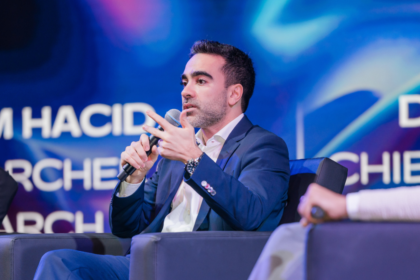
Boris Cherny, head of Claude Code at Anthropic. Photo: Getty Images
Source: Inc