

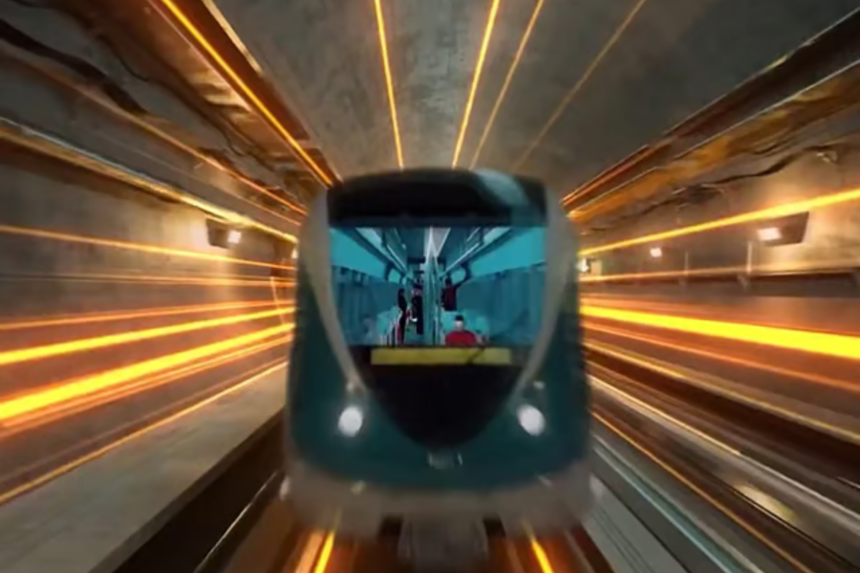
Dubai has announced its most ambitious transport upgrade with the Dubai Metro Gold Line, a Dh34 billion project set to reshape urban mobility.
Announcing the project, Sheikh Mohammed bin Rashid Al Maktoum said the line will serve around 1.5 million residents and expand the metro network by 35%.
More importantly, this is not just an extension; it marks a structural upgrade in how the city moves.
A 42 km Underground Network Built for Scale
The Dubai Metro Gold Line will span 42 kilometres and become the emirate’s first fully integrated underground metro route.
To support this, the project will deploy an advanced tunnel system that doubles the scale of existing metro tunnels. At the same time, engineers will use high-precision tunnelling technology to minimise disruption to traffic and daily life.
As a result, the project shifts infrastructure from visible expansion to seamless, largely invisible integration.
18 Stations Across Strategic Growth Corridors
In addition, the line will feature 18 stations across 15 key areas, stretching from Al Ghubaiba to Jumeirah Golf Estates.
Importantly, the route introduces looped connectivity, enabling more efficient movement across both short and long distances.
Together, these elements enhance network flexibility and improve overall travel efficiency across the city.
Key interchanges define the system:
- Al Ghubaiba connects with the existing Green Line
- Business Bay links with the Red Line
- Meydan integrates with the future Etihad Rail
- Jumeirah Golf Estates connects with both the Red Line and Etihad Rail
This creates a layered transport system rather than isolated routes.
Communities Set to Gain Direct Connectivity
The Dubai Metro Gold Line is designed to serve more than 20 communities and support 55 major real estate developments.
Areas expected to benefit include:
- Bur Dubai
- Dubai Maritime City
- Port Rashid
- City Walk
- Jumeirah
- Satwa
- Zabeel
- Business Bay
- Mohammed Bin Rashid City
- Meydan
- Ras Al Khor
- Dubai Hills Estate
- Al Barsha South
- Jumeirah Village Circle and Jumeirah Village Triangle
- Dubai Sports City
- Dubai Production City
- Dubai Studio City
- Tilal Al Ghaf
- Al Barari
- Arabian Ranches
The network aligns with population density and future development zones rather than existing congestion alone.
Integration with Etihad Rail Expands Reach
A defining feature of the Dubai Metro Gold Line is its integration with the wider national rail system.
Specifically, connections at Meydan and Jumeirah Golf Estates link urban transit with intercity rail. As a result, the system creates continuity between local commuting and regional travel.
In turn, it moves beyond city-level mobility and delivers true network-level connectivity.
Infrastructure Designed for Future Demand
More importantly, the Dubai Metro Gold Line reflects a shift in planning logic.
Rather than reacting to congestion, planners anticipate growth. They connect emerging residential hubs, commercial zones, and future developments before pressure peaks.
This approach reduces the lag between expansion and demand.
A Network Built for Movement, Not Just Access
At the same time, the Gold Line reshapes how movement works across Dubai.
It reduces dependence on single corridors. It distributes passenger flow across multiple routes. It integrates metro, rail, and urban planning into one coordinated system.
Ultimately, the network prioritises movement, not just access. The outcome is not just faster travel. It is a city structured for continuous movement at scale.
The Dubai Metro Gold Line is a newly announced Dh34 billion public transport project designed to expand the emirate’s rail network significantly.
Dubai Media Office
source: Gulf News