



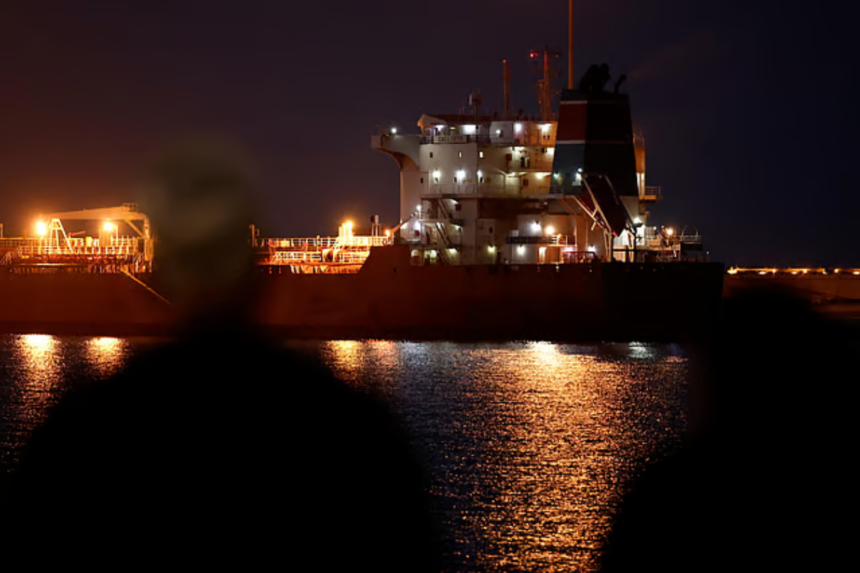
Tankers are switching off tracking signals and using safer routes near Oman, helping keep millions of barrels of Gulf oil moving despite the crisis.
Something unusual is happening in the Strait of Hormuz.
Tankers carrying millions of barrels of Gulf oil are disappearing from public tracking systems as they approach the world’s most important oil chokepoint, only to reappear hours later on the other side.
They are not missing.
They are deliberately going “dark.”
According to shipping analytics firm Kpler, around 80% of traffic through Hormuz has operated this way over the past two weeks, with tankers switching off their Automatic Identification System, or AIS, transponders and sailing closer to Oman’s side of the strait.
The strategy is helping keep Gulf oil moving despite the conflict and concerns over Iranian attacks on commercial shipping.
How the “dark” tanker system works
The journey of the Greek-owned supertanker Kiku illustrates the method.
After loading crude at Qatar’s Mesaieed terminal, the vessel crossed the Strait of Hormuz and was sailing off Dubai on July 31 when its AIS signal disappeared.
It reappeared the following morning on the other side of the strait.
The tanker had completed what has become known as a “dark” transit, with vessels using southern routes and, in some cases, operating under US military protection.
The objective is to reduce exposure to Iranian drones and other threats while maintaining the flow of energy exports.
Some Gulf oil producers have also chartered vessels to move crude through Hormuz before transferring cargo to other tankers waiting in the Gulf of Oman. The oil can then continue toward international markets.
Hormuz’s invisible oil highway
| Measure | Current estimate |
|---|---|
| Traffic operating “dark” | Around 80% |
| Oil traffic through Hormuz | 8-9 million barrels per day |
| Oil moved on US-protected routes in July | About 5 million barrels per day |
| Ships assisted by US forces | More than 1,000 |
| Ships hit on southern routes since June | At least 15 |
| Estimated inventory depletion during war | Up to 1.9 billion barrels |
The tactic has created an unusual irony.
Iran has long relied on a “dark fleet” to move oil while attempting to evade sanctions. Now, similar methods are being used to move Gulf oil through the same chokepoint, although the purpose is different.
The current “dark” voyages are primarily intended to reduce the risk of attacks and maintain global supply.
Why tracking data may be misleading
Switching off AIS has another consequence.
Traditional ship-tracking systems can make it appear that far less oil is moving through Hormuz than is actually passing through the strait.
The US Department of Energy estimates that 8 million to 9 million barrels of oil move through Hormuz each day, while some tracking services relying heavily on transponder data have produced substantially lower estimates.
Satellite and radar imagery can reveal some of the missing vessels.
Images taken on August 14, for example, showed ships operating around the Omani side of Hormuz that were not simultaneously visible in MarineTraffic data.
The ships were physically there.
They were simply not broadcasting their positions publicly.
Why the oil is still flowing
The continued movement of crude matters because a complete closure of Hormuz would create a much larger global supply shock.
Before the war, roughly 15 million barrels of crude passed through the strait each day.
Since then, producers and traders have developed several alternative routes.
Saudi Arabia has been moving about 5 million barrels per day through its East-West pipeline toward Yanbu on the Red Sea.
Another roughly 2 million barrels per day has reportedly been rerouted around Hormuz.
Additional production from Brazil, Guyana and Venezuela, combined with higher US output, has also helped offset some of the disruption.
The protected tanker routes provide another layer of supply.
Together, these measures have helped prevent the complete shutdown of Hormuz from becoming an even larger shock to global oil markets.
The US is paying a price for keeping the corridor open
Maintaining the southern corridor requires a substantial military operation.
US Central Command has deployed ships, helicopters and aircraft, including systems capable of intercepting Iranian drones and missiles.
CENTCOM says US forces have helped more than 1,000 vessels transit the strait.
But the protection is not foolproof.
At least 15 vessels using southern routes have reportedly been hit since the beginning of June, according to an analysis of International Maritime Organization data cited by The New York Times.
Iran also retains the ability to target commercial shipping and energy infrastructure across the region.
The US military faces its own logistical constraints. With its Bahrain naval base damaged by Iranian attacks, supply ships have had to travel to Diego Garcia in the Indian Ocean, adding more than five days each way to the journey.
Around 20 US warships are operating in the Gulf of Oman, placing additional demands on an already stretched deployment.
A workaround, not a permanent solution
The “dark” tanker network has bought the oil market something valuable: time.
But it cannot permanently substitute for a freely navigable Strait of Hormuz.
Oil inventories have already been heavily depleted during the war. If reserves continue falling while supply remains constrained, the market could eventually face much higher prices.
For now, however, one of the strangest consequences of the Hormuz crisis is also one of the most important.
Ships are disappearing from tracking screens so their oil can keep appearing in global markets.
Read more news and follow us on Instagarm.
An oil tanker sails at night. Tankers are increasingly switching off tracking signals while transiting the Strait of Hormuz as part of efforts to keep Gulf oil flowing despite Iranian attacks.
Gulf News Archives