



Likud’s claims come as early projections suggest Netanyahu’s political bloc has failed to secure enough seats for a parliamentary majority.
Jerusalem: Israeli Prime Minister Benjamin Netanyahu’s Likud party has claimed that Arab-led parties “stole” the country’s parliamentary election, alleging possible foreign interference without presenting evidence of widespread electoral fraud. The accusations have drawn pushback from Israeli police and election officials, who say there is no substantiated basis for claims that the vote was systematically manipulated.
The dispute comes after Israel’s October 27 election produced no clear parliamentary majority for either Netanyahu’s governing bloc or the opposition led by former military chief Gadi Eisenkot. The completed vote count on Thursday, October 29, put Netanyahu’s bloc at 53 seats, the opposition bloc at 48, and Arab-led parties at 19 in the 120-member Knesset. A government needs the support of at least 61 lawmakers.
The results have left coalition negotiations uncertain, with Arab-led parties potentially playing a decisive role in efforts to form a government. Likud’s allegations have also raised concerns that the election dispute could deepen tensions between Jewish and Arab citizens.
Israeli Police Reject Likud’s Claims of a Stolen Election
On Thursday, Israeli police said they had found no investigative or intelligence evidence to support Likud’s allegations of widespread election fraud.
According to a report by The Jerusalem Post, police said election day had passed with relatively few unusual incidents involving electoral integrity, even compared with previous elections. The allegations of systematic fraud had not been substantiated by the available evidence.
The controversy escalated after Noam Sohlberg, the Supreme Court justice heading Israel’s Central Elections Committee, referred suspicions of possible foreign interference to the Shin Bet security agency for investigation.
In his communication, Sohlberg said the allegations were serious but could not be verified at that stage. The request for an investigation did not establish that electoral fraud had occurred.
Acting Central Elections Committee Director General Dean Livne subsequently rejected claims of widespread violations, saying the election had been conducted lawfully and that there was no known basis for allegations of systematic breaches of electoral integrity.
Shin Bet Says Investigation Does Not Implicate Arab Voters as a Group
The Shin Bet has sought to distinguish the investigation into possible foreign interference from the broader accusations directed at Arab-led parties and their voters.
According to The Times of Israel, the agency said its inquiry was limited in scope and was not based on information supplied by a political actor. It also stressed that the investigation should not cast suspicion on an entire community that had exercised its right to vote lawfully.
The distinction is significant because Likud’s public statement went beyond calling for an investigation. The party declared that Israel’s election had been stolen and alleged, without publicly established evidence, that the interference was intended to facilitate a foreign takeover of the Knesset and undermine the right-wing government.
Israeli media also reported accusations involving Qatar. Qatar rejected the allegations, describing them as “ridiculous and dangerous.”
The investigation into possible foreign involvement remains separate from the question of whether the election results themselves were unlawfully manipulated. As of October 29, police and election officials had rejected claims of systematic fraud.
Gadi Eisenkot Accuses Netanyahu of Trying to Undermine the Results
Gadi Eisenkot, Netanyahu’s principal rival in the election, accused Likud of attempting to delegitimize the results after failing to secure a parliamentary majority.
Eisenkot said the allegations were being raised because Netanyahu’s bloc had lost ground. He also argued that an investigation into possible foreign interference should not be used to challenge the legitimacy of the vote or delay the formation of the next Knesset.
Yair Golan, leader of the Democrats party, similarly accused Netanyahu of running a campaign to undermine the election results, particularly the votes cast by Arab citizens.
The Arab-led Joint List also accused Netanyahu of trying to steal the election. Mansour Abbas, leader of the Ra’am party, welcomed an investigation into possible interference while denying that his party was involved.
President Isaac Herzog called for a full investigation but cautioned against stigmatizing an entire community for exercising its democratic rights.
Netanyahu’s Bloc Falls Short of a Knesset Majority
The completed count has confirmed that no political grouping has enough seats to govern independently.
| Political grouping | Seats |
|---|---|
| Netanyahu’s governing bloc | 53 |
| Opposition bloc led by Eisenkot | 48 |
| Arab-led parties | 19 |
| Total Knesset seats | 120 |
Likud emerged as the largest individual party with 27 seats, while Eisenkot’s Yashar party won 21. The Joint List secured 11 seats, and Ra’am won eight, giving the Arab-led parties a combined 19 seats.
The distribution leaves both major blocs short of the 61 seats required for a majority. If the opposition can reach an agreement with Arab-led parties, it could potentially assemble a governing coalition. However, such an arrangement would require negotiations among parties with different political priorities and positions.
The election dispute adds another complication to those negotiations, as the parties consider whether to cooperate, remain outside a coalition, or pursue alternative arrangements.
Arab Parties Gain Seats After Strong Election Turnout
Arab-led parties increased their representation in the Knesset, securing 19 seats combined. Their performance has made them an important factor in the post-election negotiations.
Arab citizens of Israel, many of whom are of Palestinian descent, make up roughly one-fifth of the country’s population. Their political participation has frequently been a subject of debate, particularly during campaigns in which Netanyahu and Likud have criticized Arab-led parties and questioned their suitability as coalition partners.
The election result has renewed that debate. Netanyahu has previously argued that cooperation with Arab-led parties would threaten Israel’s security and political identity. His opponents say such rhetoric risks marginalizing Arab citizens and casting doubt on their legitimate participation in elections.
Whether Arab-led parties formally join a coalition or support opposition initiatives from outside government could influence the next stage of the political process.
What Happens Next in Israel’s Election Process?
Although the vote count was completed on Thursday, the election process is not entirely finished. Further checks remain, and official results are scheduled for publication by November 4.
The Central Elections Committee has called for the Shin Bet’s findings on the alleged interference within the week. The investigation and the certification of the results are related to the same election but address different questions: whether specific interference occurred and whether there is evidence to challenge the integrity of the vote as a whole.
After certification, coalition negotiations will determine whether Netanyahu can remain in power, whether Eisenkot can assemble an alternative majority, or whether the political deadlock leads to another election.
Herzog has said he wants parties to reach an agreement rather than force another vote. If no government can be formed after the available attempts, Israel could face another election early next year.
For now, Netanyahu remains prime minister, but his bloc’s 53 seats leave it short of a parliamentary majority. Meanwhile, police and election officials have said the allegations of systematic electoral fraud are not supported by the publicly available evidence as of October 29.
Read more news and follow us on Instagram.
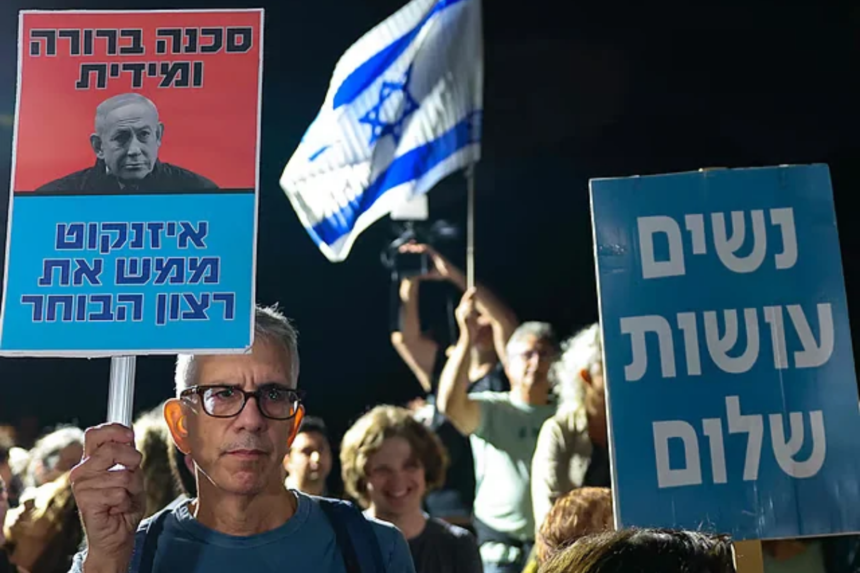
Israeli left-wing activists hold placards during a demonstration outside the home of Gadi Eisenkot, leader of the Yashar party, in Herzliya on October 29, 2026, calling for the formation of a government that includes Arab parties.
AFP / Gulf News