



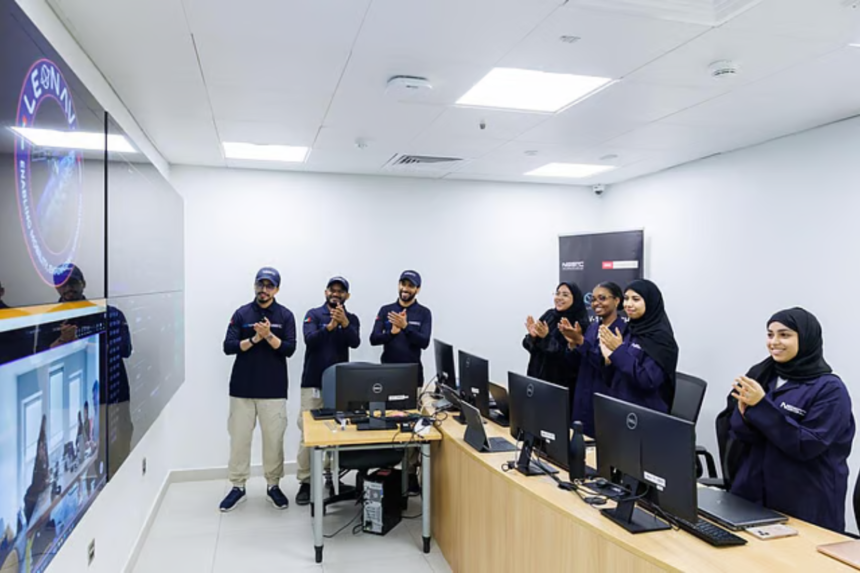
LEONAV-1 will test next-generation navigation technologies in low Earth orbit, supporting the UAE’s growing ambitions in space research.
First Emirati navigation research satellite begins mission to test advanced technologies in low Earth orbit
The United Arab Emirates has successfully launched LEONAV-1, the country’s first satellite dedicated to researching next-generation satellite navigation technologies, marking a significant step in the nation’s expanding space programme.
The National Space Science and Technology Center (NSSTC) at the United Arab Emirates University announced the successful launch, describing the mission as an important milestone in advancing the UAE’s scientific research and technological capabilities in space.
Supported and funded by the UAE Space Agency, LEONAV-1 is designed to test innovative navigation technologies that could contribute to future space-based positioning systems and strengthen the country’s expertise in satellite engineering.
Mission enters critical early operations phase
Following its successful launch, LEONAV-1 has entered the Launch and Early Orbit Phase (LEOP), one of the most important stages of any satellite mission.
During this phase, engineers will establish communication with the spacecraft, verify the health and performance of its onboard systems, and conduct a series of operational tests to confirm that all mission components are functioning as expected.
Completing these procedures will prepare the satellite for its scientific experiments and technology demonstrations in low Earth orbit.
Testing future navigation technologies
LEONAV-1 has been developed as a CubeSat technology demonstrator and represents the first phase of the UAE’s long-term vision to build a satellite navigation system based on low Earth orbit (LEO).
The mission will evaluate several advanced navigation concepts, including transmitting Global Navigation Satellite System (GNSS)-like signals in the L5/E5 and S frequency bands, while ensuring they do not interfere with existing navigation services.
Researchers will also verify signal transmission and reception through ground stations and assess the performance of the satellite’s onboard Orbit Determination and Time Synchronisation (ODTS) software.
These experiments are expected to provide valuable data for future satellite navigation systems designed and developed in the UAE.
Why low Earth orbit matters
Unlike traditional navigation satellites that operate in much higher orbits, low Earth orbit satellites travel much closer to the planet’s surface.
Their proximity enables them to transmit stronger signals, improve positioning accuracy, and enhance the reliability of navigation services, particularly in environments where conventional satellite signals may be weak.
Through LEONAV-1, researchers will study how LEO-based navigation systems can complement existing global navigation networks and improve future positioning, timing, and communication services.
Strengthening the UAE’s space ambitions
The LEONAV-1 mission reflects the National Space Science and Technology Center’s broader commitment to advancing space research while developing national expertise in science and engineering.
By leading innovative satellite projects, the centre aims to strengthen the UAE’s capabilities in space technology and support the country’s long-term ambitions to become a global leader in advanced scientific research.
The mission also provides valuable opportunities for Emirati engineers and researchers to develop practical experience in designing, operating, and testing cutting-edge satellite systems.
A foundation for future space innovation
The launch of LEONAV-1 represents more than a successful satellite mission. It establishes an important platform for developing the next generation of navigation technologies that could shape future space infrastructure.
As the mission progresses, the data collected will support research into more accurate, resilient, and efficient satellite navigation systems while contributing to the UAE’s growing role in the global space sector.
By combining scientific research, technological innovation, and national talent development, LEONAV-1 reinforces the UAE’s long-term vision of transforming advanced space research into practical technologies that support future exploration and economic growth.
Source: Gulf News
Landmark mission empowers Emirati researchers while testing future satellite navigation technologies.