


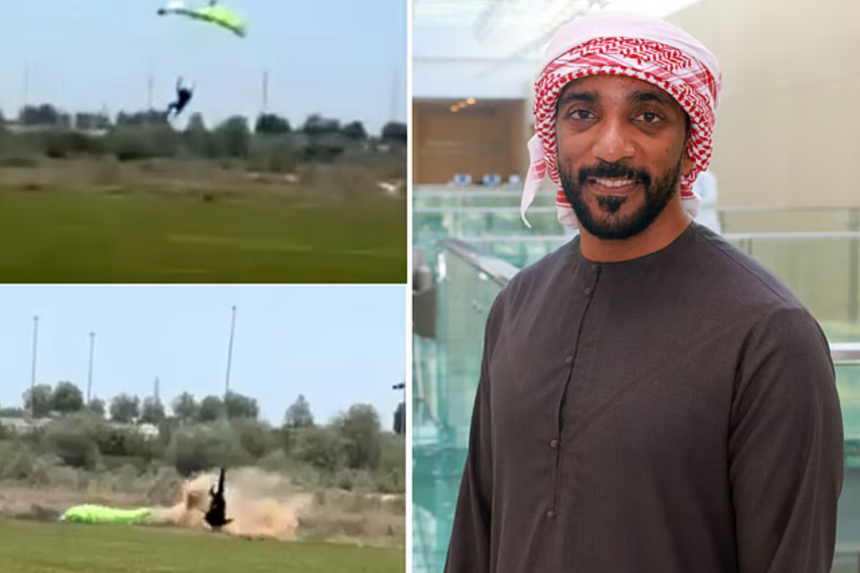
A 43-year-old Emirati skydiver in Abu Dhabi has made a rare and remarkable recovery after a high-speed parachuting accident left him with multiple fractures to his legs, pelvis, and spine.
Nawaf Al Awadhi, a military serviceman with more than 6,000 jumps to his name, was rushed to Sheikh Shakhbout Medical City seven months ago after his canopy descended at high velocity and struck the ground during a skydive.
Doctors described his survival odds as less than 50 percent.
The Moment of Impact
The accident occurred during canopy flight while Al Awadhi was performing manoeuvres and turns. As the sequence ended, the canopy entered a rapid dive.
“When I put my legs down, I broke both my legs, my hip, and my spine,” he said.
He lost consciousness at the scene and was transported by ambulance to the hospital, where emergency teams began immediate resuscitation.
The Moment of Impact
The accident occurred during canopy flight while Al Awadhi was performing manoeuvres and turns. As the sequence ended, the canopy entered a rapid dive.
“When I put my legs down, I broke both my legs, my hip, and my spine,” he said.
He lost consciousness at the scene and was transported by ambulance to the hospital, where emergency teams began immediate resuscitation.
Catastrophic Injuries
Medical teams confirmed multiple life-threatening injuries consistent with a high-velocity impact.
He sustained a severe vertical shear pelvic fracture, an injury known for causing massive internal bleeding. There was an open ankle fracture contaminated with soil and debris, vertebral fractures along the spine, and extensive open wounds to both legs.
Doctors initiated trauma protocols during the critical golden hour. A multidisciplinary team, including emergency specialists, orthopaedic surgeons, spine experts, anaesthetists, and plastic surgeons, coordinated immediate intervention.
Several surgeries followed over days and weeks. Stabilising the pelvis and spine took priority. Open fractures required further procedures and skin grafting.
Months of Rehabilitation
After stabilisation, recovery shifted from survival to mobility.
Initially confined to a wheelchair, Al Awadhi progressed to crutches before walking independently.
“It took about three to four months. When I first started walking, I felt very happy, but it took time to walk normally again,” he said.
The psychological toll was significant.
“You start thinking about how your life is going to change. But you can’t let one accident change everything.”
Rare Survival
Doctors at Sheikh Shakhbout Medical City described the outcome as unusual given the severity of the trauma. Falling under a malfunctioning or diving canopy at high speed often proves fatal.
They credited early intervention, coordinated trauma care, and structured rehabilitation for the result. They also noted that Al Awadhi’s experience and reaction in the final seconds before impact may have reduced descent speed.
A Measured Return
Now walking again, Al Awadhi remains reflective rather than reckless.
“Skydiving is a beautiful sport, but you have to be very careful. Your equipment, your training,g and the people you jump with all matter. If something happens in the air, no one can help you.”
The UAE skydiver crash recovery stands as a case study in trauma response, medical coordination, and the thin margin between fatality and survival in extreme sport.
A combination photo shows Nawaf Al Awadhi’s devastating skydiving crash and his full recovery at Sheikh Shakhbout Medical City.
Photo: Ahmad Alotbi/ Gulf News