


Trump said any US-Saudi nuclear agreement would require Saudi Arabia to normalize ties with Israel and rule out uranium enrichment.
President Donald Trump said any future US-Saudi civilian nuclear agreement will depend on Saudi Arabia establishing diplomatic relations with Israel under the Abraham Accords, adding that the deal will not permit uranium enrichment.
The proposed US-Saudi civilian nuclear agreement has become closely tied to one of President Donald Trump’s biggest foreign policy goals: expanding the Abraham Accords.
In a social media post on Thursday, Trump said the agreement would move forward only if Saudi Arabia agrees to normalize diplomatic relations with Israel. He also stressed that the proposed nuclear programme would be limited to peaceful civilian purposes and would not allow uranium enrichment.
Trump Makes Israel Normalisation a Condition
Trump described the agreement as being “totally subject” to Saudi Arabia joining the Abraham Accords, the US-brokered agreements that established diplomatic ties between Israel and several Arab countries during his first term.
He added that the United States supports civilian nuclear energy but opposes uranium enrichment, a technology that can produce fuel for nuclear power plants but can also be used to develop weapons-grade material if enriched further.
The White House views Saudi Arabia joining the accords as a key step toward strengthening long-term regional stability.
Saudi Arabia Maintains Position on Palestinian Statehood
Saudi Arabia has consistently maintained that normalizing relations with Israel requires a credible pathway toward the creation of an independent Palestinian state.
Israeli Prime Minister Benjamin Netanyahu has repeatedly rejected Palestinian statehood on security grounds, leaving a significant gap between the positions of both governments.
The Saudi Embassy in Washington declined to comment on Trump’s latest remarks.
Israel welcomed the possibility of Saudi participation in the Abraham Accords, with Netanyahu’s office describing it as a historic opportunity for regional peace.
Nuclear Deal Faces Questions Over Uranium Enrichment
The agreement announced this week is expected to establish a 30-year framework for cooperation between the United States and Saudi Arabia on civilian nuclear energy projects.
According to people familiar with the negotiations, the programme could involve US companies helping develop Saudi Arabia’s nuclear infrastructure.
However, reports that the agreement may not include the International Atomic Energy Agency’s Additional Protocol, which provides expanded inspection and verification powers, have drawn criticism from nuclear experts and lawmakers.
Some analysts have also questioned whether future studies could eventually allow uranium enrichment inside Saudi Arabia despite Trump’s public assurances.
Rubio Says US Wants American Companies to Lead
US Secretary of State Marco Rubio defended the agreement during a visit to the Philippines, arguing that Saudi Arabia would pursue a civilian nuclear programme regardless of which international partner it chose.
Rubio said the United States wanted American companies, rather than competitors such as China, Russia, France, or South Korea, to help build Saudi Arabia’s nuclear industry.
“We’re not the only show in town, but we’re the best show in town,” Rubio said.
Congress Expected to Closely Review the Agreement
The proposed agreement will now be submitted to the US Congress for review.
Lawmakers from both Republican and Democratic parties have already expressed concerns about the safeguards included in the deal and the broader implications of expanding nuclear cooperation in the Middle East.
Some members of Congress have argued that any agreement with Saudi Arabia should receive explicit congressional approval before taking effect.
Questions have also been raised about whether the administration secured sufficient commitments from Riyadh in exchange for US nuclear cooperation.
Abraham Accords Remain Central to Trump’s Middle East Strategy
Trump has continued promoting the Abraham Accords as a cornerstone of his Middle East policy.
The agreements, first signed in 2020, established diplomatic relations between Israel and several Arab nations, including the United Arab Emirates, Bahrain, Morocco, and Sudan.
Bringing Saudi Arabia into the accords has long been viewed as the most significant remaining objective because of the kingdom’s political, religious, and economic influence across the region.
However, the war in Gaza and continuing regional tensions have complicated diplomatic efforts.
Despite those challenges, the Trump administration says it remains optimistic that Saudi Arabia could eventually join the Abraham Accords before the end of Trump’s second term.
Source: Gulf News
Read more news and follow us on Instagram
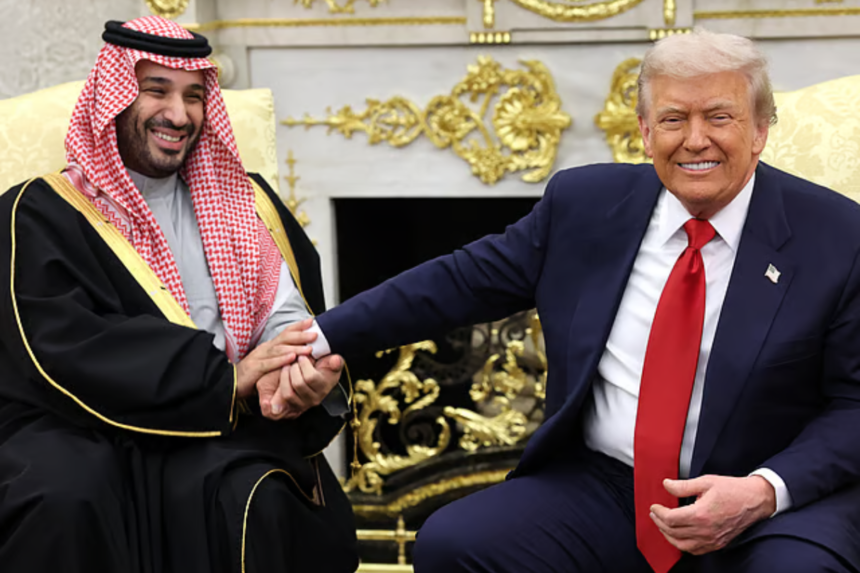
File photo of US President Donald Trump and Saudi Crown Prince Mohammed bin Salman.
AFP