


The emirate highlighted its people-first approach to sustainable urban development, positioning its city-building model as a global benchmark.
Abu Dhabi presented its people-first approach to urban planning at the World Cities Summit in Singapore, highlighting how the emirate is building sustainable, resilient, and liveable communities for the future.
Abu Dhabi has showcased its Livability Strategy as a global model for sustainable urban development at the World Cities Summit (WCS) 2026 in Singapore, sharing how the emirate is creating people-centric communities while managing rapid population growth.
Government leaders, mayors, and urban planning experts gathered at the summit to discuss the future of cities, with Abu Dhabi highlighting its integrated approach to planning, transport, infrastructure, and community development.
Abu Dhabi’s People-First Approach to City Building
Speaking during the Future Cities Leadership Plenary titled How Do We Build New Cities?, Abdullah Mohammed Al Blooshi, Director General of the Urban Planning and Permits Centre (UPPC) at the Department of Municipalities and Transport (DMT), outlined the emirate’s vision for creating resilient and liveable neighbourhoods.
He explained that Abu Dhabi measures success not only through infrastructure development but also by tracking how easily residents can move around their communities, access essential services, enjoy public spaces, and maintain a high quality of life.
The emirate also uses resident feedback and real-time data to guide planning decisions, ensuring that rapid urban expansion supports community wellbeing rather than compromising it.
Managing Growth Through Integrated Planning
According to the DMT, Abu Dhabi’s centralised planning model has enabled the emirate to manage 51% population growth over the past decade successfully.
By bringing urban planning, transport, and municipal services under a single authority, the government has streamlined decision-making while adapting development plans to changing demographic needs.
This integrated approach allows investments in parks, public facilities, transport networks, and community infrastructure to be directed where they can deliver the greatest benefit for residents.
Learning From Global Urban Innovation
The World Cities Summit formed part of a wider visit to Singapore focused on strengthening international collaboration in sustainable urban development.
Abu Dhabi’s delegation met officials from Singapore’s Ministry of National Development to exchange ideas on land-use planning, development regulations, and government coordination.
Meetings were also held with the Building and Construction Authority (BCA) to study Singapore’s Green Building Masterplan and Green Mark certification framework, exploring how sustainability standards can be embedded into future building approvals and urban development policies.
The delegation also engaged with Arup, the Temasek Foundation, and the Shenzhen Urban Planning and Land Resource Research Centre to discuss climate resilience, digital urban systems, smart city technologies, and innovative funding models.
Strategic Partnership With SJ Group
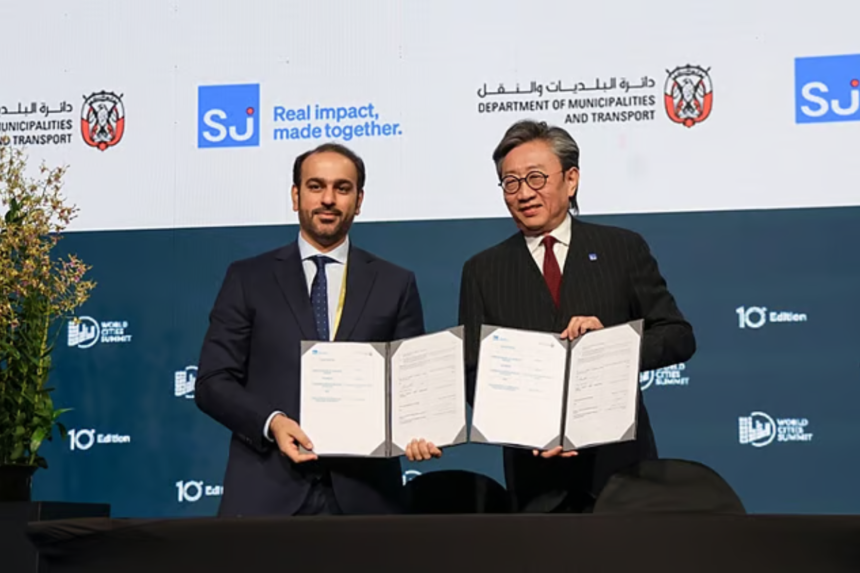
A key outcome of the visit was the signing of a strategic partnership between the Department of Municipalities and Transport and Singapore-based SJ Group, a leading urban and infrastructure consultancy.
The agreement aims to strengthen Abu Dhabi’s future city planning by introducing advanced digital tools to improve municipal services, streamline planning approvals, and enhance customer experiences.
The partnership will also support the development of public-private partnership (PPP) models to attract investment into smart city projects, housing initiatives, and future infrastructure.
In addition, SJ Group will provide strategic expertise in urban decarbonisation, green housing policies, and energy transition planning to help shape Abu Dhabi’s future regulatory framework.
Strengthening UAE-Singapore Cooperation
Al Blooshi said the collaboration reflects Abu Dhabi’s commitment to developing next-generation urban solutions while learning from international best practices.
He added that partnerships such as this will help ensure the emirate remains adaptable, sustainable, and competitive as it continues to grow.
The agreement builds on more than four decades of cooperation between the UAE and Singapore, strengthening an already established relationship in urban development, innovation, and economic collaboration.
Building Cities for the Future
As cities around the world face growing challenges related to population growth, sustainability, and climate resilience, Abu Dhabi is positioning its livability strategy as a model for long-term urban development.
By combining integrated planning, digital innovation, environmental sustainability, and community-focused design, the emirate aims to create neighbourhoods that are not only efficient but also improve the everyday lives of residents while supporting future economic growth.
Source: Gulf News
Read more news and follow us on Instagram
New Dh200b projects, parks and cycling tracks anchor Abu Dhabi’s quality-of-life push