



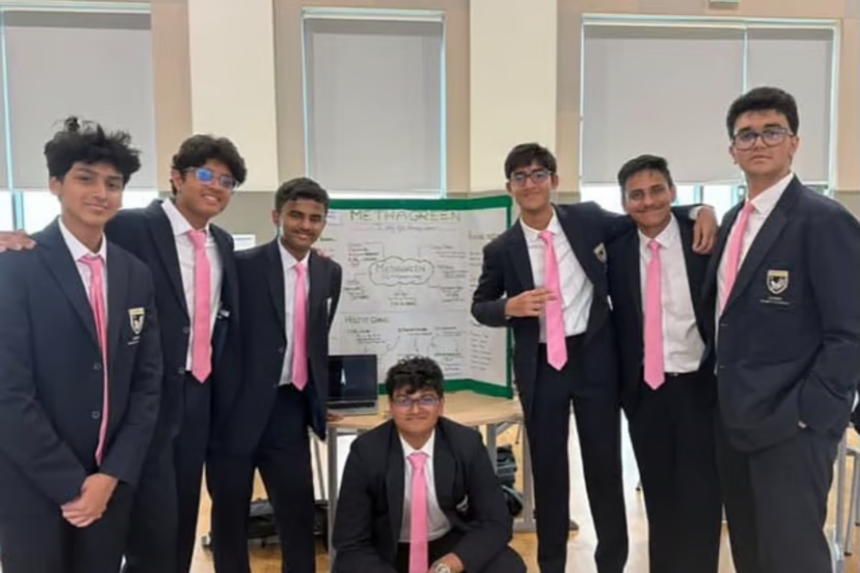
The students are working on a project that aims to convert plastic waste into usable fuel, with plans to build a prototype after their board exams.
Dubai: A team of seven Indian students in Dubai is developing a project that aims to convert plastic waste into usable fuel, with plans to build a working prototype after their Grade 12 board examinations.
Named “Methagreen,” the project focuses on converting high-density polyethylene (HDPE), a common plastic used in bottles, containers, and packaging, into dimethyl ether (DME), a fuel that could be used for cooking or electricity generation.
Kiaan Bijin, a 17-year-old Grade 12 student at GEMS Modern Academy and co-founder of the project, said the idea came from the team’s desire to develop something with a positive impact on society.
“Our journey started when all of us joined a group with one vision. Making a product that has a positive impact on society,” Bijin told Gulf News.
Rather than developing another conventional application or website, the students wanted to address issues they believe will become increasingly important, including plastic pollution and the future availability of energy.
After several brainstorming sessions, the team focused on the growing volume of plastic waste, the finite supply of fossil fuels, and the challenges of accessing energy in the future.
From a School Competition to International Platforms
Methagreen began as a school competition project. The students researched the concept, worked on the design, and made several changes before winning the competition.
The recognition gave the project wider exposure. Since then, the team has presented it at platforms including GITEX North Star 2025 and the Zayed Sustainability Prize.
The seven members bring different skills to the project:
- Rushabh Yadav, 17: Founder.
- Kiaan Bijin, 17: Co-founder.
- Advait Patil, 18: Lead developer and chief technology officer.
- Vihaan Bhaskar, 16: Design and chemistry.
- Ibrahim Khan, 17: Design and chemistry.
- Vihaan Chatterjee, 17: Economics and costing.
- Rayyaan Hashmat, 17: 3D simulations and marketing.
All seven students are from India and have lived in the UAE for more than 10 years.
Bijin said the team continued refining the project after presenting it at competitions, incorporating feedback from people who reviewed the concept.
Their aim, he explained, was to make the product financially viable, sustainable, and accessible.
How Methagreen Aims to Convert Plastic Into Fuel
The proposed process uses heat and chemical reactions to convert HDPE plastic into dimethyl ether, or DME.
According to the team’s explanation, the process involves several stages:
- Plastic processing: HDPE plastic is heated and processed to produce methane.
- Syngas production: The methane reacts with carbon dioxide to create synthesis gas, commonly known as syngas, which contains hydrogen and carbon monoxide.
- DME production: The syngas is processed using catalysts to produce dimethyl ether.
The resulting fuel could potentially be used for cooking with a suitably adapted system or for generating electricity through a compatible generator.
One part of the proposed design involves reusing carbon dioxide in the process rather than simply releasing it. Bijin said the team intends to create a cycle in which carbon dioxide produced during combustion can be fed back into the reaction involving methane.
The students have also proposed treating other by-products through a process intended to produce solid carbon and metal oxides.
However, Methagreen remains under development. The proposed process and its environmental benefits have not yet been established through a working prototype. Its energy efficiency, emissions, by-products, and overall performance will need to be assessed through practical testing.
Students Explore the Possibility of Generating Electricity
The team believes Methagreen could eventually help reduce the volume of plastic waste sent to landfills or entering waterways while creating another possible source of energy.
Its preliminary calculations suggest that a facility processing around one tonne of HDPE plastic per day could generate a substantial amount of electricity.
“We aim to bring light into every home by making this electricity accessible and sustainable,” Bijin said.
The students hope the project can address multiple challenges through the use of discarded plastic, the proposed reuse of carbon dioxide, and the production of fuel.
These outcomes remain ambitions rather than demonstrated results, with further testing needed to establish how much usable energy the process can produce.
Prototype Planned After Grade 12 Board Exams
The team’s next major step is to build a smaller prototype capable of processing approximately 100 kg of HDPE plastic per day.
“After our exams, we aim to build a small-sized prototype that can process about 100 kg of HDPE per day,” Bijin said.
The prototype will allow the students to collect operational data, assess how the proposed process performs, and identify changes that could improve its efficiency.
The team also plans to publish a research paper on the concept and aims to obtain a patent by mid-2027.
As the students move on to university, they intend to continue developing different parts of the project alongside their studies.
Bijin said the immediate priority is to build the prototype, gather data from its operation, and make further adjustments based on the results.
A Long-Term Vision for Turning Plastic Waste Into Energy
For the seven students, Methagreen is an attempt to move beyond an idea developed for a school competition and test whether it can work in practice.
Their immediate focus is on building the prototype and understanding the technical and environmental challenges involved in converting plastic waste into fuel.
“If this prototype works as intended, it can change what the future of energy will look like,” Bijin said.
The project’s wider ambition is to turn discarded plastic into a useful energy resource. Whether that ambition can be achieved will depend on the results of the team’s upcoming testing, including the system’s efficiency, emissions, operating costs, and ability to function reliably at a larger scale.
Read more news and follow us on Instagram.
From left to right: Rayyaan Hashmat, Kiaan Bijin, Rushabh Yadav, Advait Patil, Vihaan Bhaskar, Vihaan Chatterjee, and Ibrahim Ausaf Khan
Supplied / Gulf News