


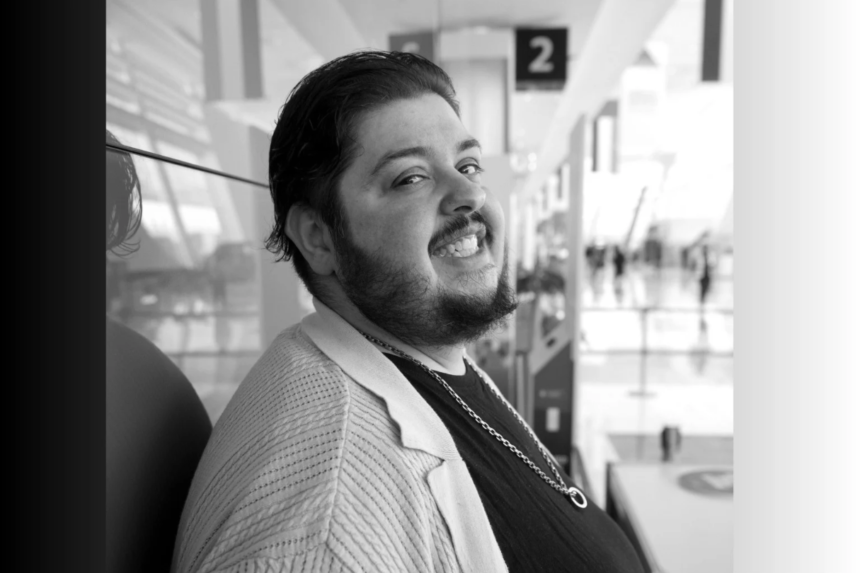
Syrian-Australian digital artist Kode Abdo, known as BossLogic, has worked with Marvel, Disney, Warner Bros., and Sony Pictures, and has created commissions for stars including Dwayne Johnson and Ryan Reynolds. Now, he is looking to the UAE as he plans the next stage of his career.
Kode Abdo, the Syrian-Australian digital artist known worldwide as BossLogic, has built a career collaborating with some of Hollywood’s biggest names, including Marvel, Disney, Warner Bros., and Sony Pictures. Now, he is looking to the UAE to build his studio, develop original intellectual property, and take the next step in his career.
Abdo’s rise began online, long before he became a familiar name in the entertainment industry. By late 2011 or mid-2012, his digital artwork had already attracted a dedicated following on Twitter, now known as X. In 2018, when he revealed his identity as the artist behind BossLogic, thousands of followers watched as the anonymous creator finally put a face to his work.
His audience has continued to grow. His Instagram account has nearly two million followers, while his X account has more than half a million. His portfolio now includes work connected to some of the biggest franchises in entertainment, alongside commissions for Hollywood stars Dwayne “The Rock” Johnson and Ryan Reynolds.
Yet Abdo says revealing his identity was one of the most difficult decisions of his career.
How BossLogic Became a Hollywood Name
For years, Abdo built his reputation through his artwork rather than his public identity. That began to change in 2018, when he decided to show his face and connect with his audience beyond the images he created.
“If you’ve been following me since the 2010s, you know I’ve been a ghost. I didn’t show my face, so putting a face to the work and holding that face to the work, while being me and trying to stay true to myself, has been a big challenge,” Abdo says.
He believes the reveal helped people connect with the person behind the artwork, allowing him to share more of his creative process, personal challenges, and life outside his work.
“I’ll be honest with you: the day I posted my face and did my reveal, it took 12 hours,” he says. “I wouldn’t press the button because I was too hesitant. I feared the world. But it was probably the greatest thing I did now.”
The decision coincided with a major shift in his career. In 2019, an unofficial Avengers artwork caught the attention of directors Joe and Anthony Russo, widely known as the Russo Brothers for their work on films including Captain America: The Winter Soldier, Captain America: Civil War, Avengers: Infinity War, and Avengers: Endgame.
The brothers commissioned Abdo to create artwork for their social media channels. Joe Russo later connected him with Disney’s creative team, leading to an opportunity to produce official artwork for Avengers: Endgame in 2019.
Other collaborations followed. Dwayne Johnson commissioned Abdo for a project that eventually led to a collaboration with comic-book artist Jim Lee. Ryan Reynolds also commissioned him for work that included official artwork for the film 6 Underground.
Abdo’s work has received recognition from actors Robert Downey Jr. and Jake Gyllenhaal. His professional credits have expanded across studios and streaming platforms, including Disney, Warner Bros., Netflix, Paramount, and Sony, as well as comic-book publishers such as Marvel, DC, BOOM! Studios, and IDW Publishing.
Why Abdo Says Artists Should Keep Creating
Despite the scale of his professional work, Abdo says his career grew from a simple habit: drawing and sharing what he made.
“I always used to draw. I always used to put stuff in front of my family, in front of my friends. They loved it. But social media gave my artwork new eyes,” he says.
He adds that getting noticed by major companies was never the original goal. Instead, he focused on improving his work until the right people began reaching out.
That experience shapes his advice to young artists and creative entrepreneurs who want to turn their talent into a business.
“I keep telling artists, even young ones, just keep putting your work out there and building your portfolio,” he says. “Right now, the social media sphere is huge. You put your work out there, people love it, people follow you, and companies will come. You’re going to get at least one eye seeing your work, and that one eye will lead to others.”
Abdo warns artists against limiting their opportunities by focusing too narrowly on a particular publisher or company. While working with Marvel or DC may be an ambition, he encourages creators to develop projects independently and remain open to opportunities across the industry.
“And if monetization is your only motivation, it’s never going to work out,” he says.
His own career reflects that approach. Having fallen in love with drawing at the age of six, Abdo developed his skills over decades before social media helped turn his work into an internationally recognized brand.
BossLogic Plans to Build a Studio in the UAE
Abdo now wants to take that experience into a new market. He is planning to establish his studio and brand in the Middle East, with the UAE at the center of his next chapter.
The move has presented challenges, despite his personal connection to the region.
“Taking it all from Australia to the Middle East, I thought it was going to be easy because I’m from here. But it’s been a hard transition,” he says. “This is my ambition. This is what I want to do. It’s a tough challenge, but I want to make it work.”
Abdo sees an opportunity to contribute to the region’s growing interest in comics, entertainment, and original creative properties. His ambitions extend beyond bringing his existing business to the UAE. He wants to develop intellectual property that can stand on its own.
At the center of that plan is Frequency, an original project set in a dystopian future in 2175. In its world, humanity is divided by sound, with different music genres providing havens for factions living among neon ruins. The story explores a society where law, order, and chaos are, as Abdo describes them, “a mirrored image only justified by perspective.”
He hopes to bring Frequency to the Middle East and build it into a property that can compete with established entertainment franchises.
“I have my own IP that I want to release in the Middle East to compete with Marvel, the Avengers, and all that sort of stuff. I want to do that,” he says.
Abdo believes the UAE, particularly Dubai, has ambitions that align with his plans, although he is still working out how to turn the opportunity into a concrete project.
“I would love to be part of it on the foundation floor, and I’d love to help build it. So if they want to, I’m like, ‘Let’s do it,’” he says.
From Creating Other Worlds to Building His Own
Abdo’s plans mark a shift in how he sees his career. For years, he has created artwork connected to worlds developed by major studios and publishers. His next ambition is to build a world of his own.
In a post published in February, he described the change in direction: his first chapter had been about being part of worlds others created, while the next would focus on building one of his own.
The accompanying video traced his journey and outlined a broader ambition to create opportunities for other people, rather than concentrating only on his artwork.
“It’s not about just making visuals anymore,” he wrote. “It’s about building spaces. Creating platforms. Opening doors. Something bigger than me. I’m growing into the next purpose of my life and career.”
The move also reflects his interest in helping develop the region’s creative industry. Rather than simply relocating his existing business, Abdo wants to contribute to the foundations of a market where original comic-book properties and related entertainment projects can grow.
BossLogic on Generative AI and Human Creativity
Abdo’s next chapter comes as generative AI becomes more common across illustration, design, and entertainment. For digital artists, the technology raises questions about originality, creative ownership, and the value of human-made work.
Abdo says it is difficult to predict how the industry will change over the next five or ten years. However, he believes human emotion and personal experience remain central to creative work.
“Right now, there’s already this phrase: ‘made by humans for humans.’ If you’re passionate about it, you know what the right thing is to do,” he says.
He argues that AI-generated images can struggle to convey genuine feeling, even when they attempt to portray emotion.
“One day, we’ll have robots creating their own artwork. Let them have that. As humans, we’ve got to create with our hearts and our minds,” he says.
For Abdo, that belief connects his early years as an artist with his plans for the future. His work with Hollywood studios brought his creations to a global audience, but he says the underlying motivation has remained the same: to keep drawing, experiment with new ideas, and improve his craft.
Now, with Frequency and his planned UAE studio, he wants to move beyond contributing to established fictional worlds and create one that audiences can call his own.