



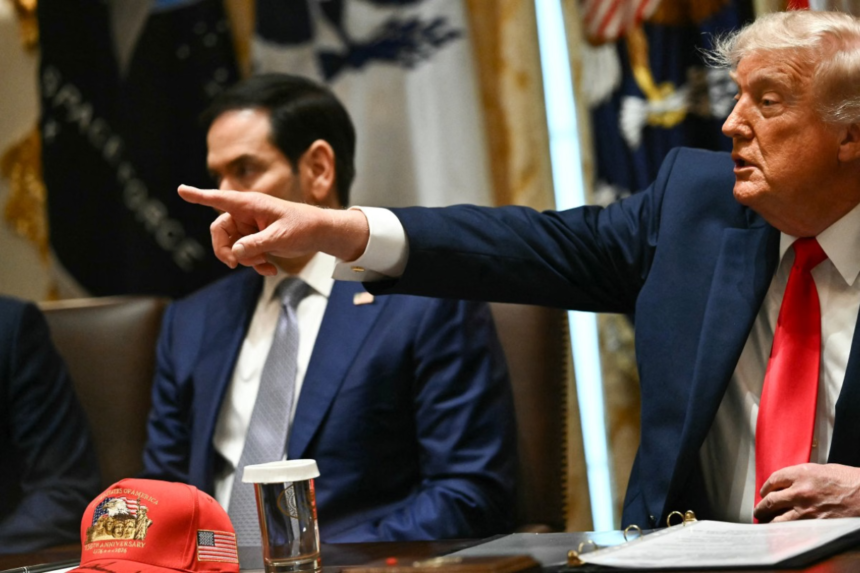
Washington reacted sharply after reports suggested Tehran and Muscat were discussing shipping fees and long-term oversight mechanisms for the Strait of Hormuz.
For decades, Oman occupied a unique position in Gulf politics.
It was the quiet intermediary trusted by both Washington and Tehran. When tensions escalated, Oman hosted backchannel negotiations, carried sensitive diplomatic messages, and helped prevent crises from spiraling into confrontation.
That reputation made US President Donald Trump’s recent remarks particularly striking.
Speaking during a White House Cabinet meeting, Trump rejected any suggestion that Iran and Oman could play a controlling role in the future management of the Strait of Hormuz.
“The strait’s going to be open to everybody,” he said. “It’s international waters. Nobody’s going to control it. We’re going to watch over it.”
The comments came after reports suggested Tehran and Muscat had discussed possible frameworks tied to shipping management, maritime security services, and fee structures connected to the strategically critical waterway.
What initially appeared to be a diplomatic outburst now looks increasingly like a much larger geopolitical signal.
Why the Strait of Hormuz Matters So Much
The Strait of Hormuz is one of the world’s most important energy corridors.
A major portion of global oil and liquefied natural gas exports passes through the narrow shipping route connecting Gulf producers to international markets. Any disruption there immediately affects energy prices, shipping insurance costs, and global trade flows.
For decades, the United States maintained a strong naval presence in the region, largely to guarantee freedom of navigation through Hormuz.
That status quo became increasingly fragile after months of regional conflict, shipping disruptions, naval incidents, and rising geopolitical tension linked to the Iran war.
Now, the battle appears to be shifting from military confrontation toward something more structural: who gets to shape the future rules governing the strait itself.
Why Oman Suddenly Entered the Spotlight
Oman’s importance is both geographic and diplomatic.
The Gulf of Oman forms the maritime approach to Hormuz from the Arabian Sea, placing Muscat at the center of regional shipping dynamics. At the same time, Oman has historically maintained balanced relations with both Western powers and Iran.
That neutrality allowed it to become one of the Gulf’s most trusted mediators.
According to reports by Bloomberg News and The New York Times, Iranian officials discussed possible maritime systems involving shipping management services and fee mechanisms tied to Hormuz operations.
Iranian representatives reportedly framed the proposal not as direct transit tolls but as service-related charges linked to navigation support and regional maritime security responsibilities.
That distinction matters legally and politically.
But for Washington, even indirect regional control over Hormuz appears unacceptable.
Why the Proposal Triggered Concern
Under international maritime law, including principles tied to the UN Convention on the Law of the Sea, international straits generally remain open to transit passage without obstruction.
Directly charging vessels for crossing Hormuz would likely trigger enormous international backlash.
However, service-related maritime fees occupy a more legally ambiguous space.
Iranian officials reportedly argued that any future system would involve transparent operational services rather than outright toll collection.
Critics remain deeply skeptical.
Some analysts argue such arrangements could effectively become disguised leverage over one of the world’s most strategically sensitive waterways. One maritime law expert reportedly compared the concept to “protection money.”
That concern explains why several Gulf states reacted sharply.
Why Gulf Countries Are Worried
The United Arab Emirates has already publicly opposed any framework involving charges or politically conditional access tied to Hormuz transit.
At the United Nations, UAE representatives argued that international waterways must not become tools of political coercion or economic pressure.
For Gulf governments, the fear extends beyond temporary wartime disruption.
The deeper concern is that emergency arrangements created during conflict could slowly evolve into permanent regional governance structures where Iran gains indirect influence over shipping coordination, security management, or maritime costs.
That possibility would fundamentally reshape the balance of power in Gulf energy logistics.
Trump’s Remarks Reveal Washington’s Real Fear
Trump’s comments suggest the United States sees these discussions as more than technical maritime negotiations.
Washington appears concerned that regional powers could gradually replace traditional US-led security oversight with locally managed systems centered around Gulf actors and Iranian participation.
That would represent a major geopolitical shift.
For decades, American naval dominance guaranteed open shipping access across the Gulf. A future framework built around regional management could dilute that influence while increasing Iran’s strategic leverage.
Trump’s response effectively drew a red line against that possibility.
By publicly insisting that Hormuz remains an international waterway open to everyone, the administration signaled that any attempt to regionalize oversight structures would face direct opposition.
The Bigger Battle Behind the Shipping Crisis
What makes this moment significant is that the Hormuz issue no longer appears limited to reopening trade routes after conflict.
The real battle now concerns governance.
Who controls maritime security?
Who defines shipping rules?
Who manages future navigation systems?
Who benefits financially from regional energy flows?
These questions are becoming increasingly important as global powers compete for influence over critical trade corridors.
For Iran, greater regional involvement in Hormuz management could strengthen strategic influence after years of sanctions and geopolitical isolation.
For Gulf states, maintaining open international access remains essential for economic stability.
For the United States, preserving freedom of navigation also means preserving geopolitical influence in one of the world’s most critical energy regions.
Oman’s Delicate Position
That leaves Oman in an unusually sensitive position.
For years, Muscat benefited from being the region’s trusted mediator, able to communicate quietly with all sides while avoiding confrontation.
Now, the country risks being pulled into a much larger strategic contest.
Trump’s unusually direct warning toward Oman suggests Washington wants to ensure that Gulf mediation does not evolve into shared oversight structures involving Tehran.
Whether Oman intended such an outcome or was merely exploring diplomatic frameworks remains unclear.
But one reality is increasingly obvious: the future of Hormuz is becoming about much more than ships and oil.
It is becoming a battle over who shapes the next geopolitical order in the Gulf.
Source: Gulf News
Read more news, and follow us on Instagram
US President Donald Trump speaks during a cabinet meeting in the Cabinet Room of the White House in Washington, DC, on May 27, 2026.
AFP