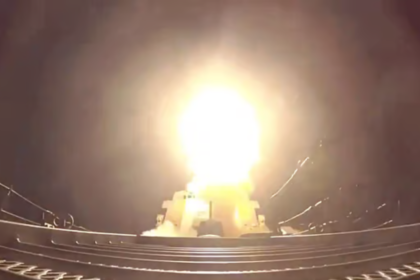




A dispute over control of the Strait of Hormuz, one of the world’s most critical energy chokepoints, has reignited military confrontation between the United States and Iran, pushing the region back toward a broader conflict.
The strategic waterway lies at the heart of the latest US-Iran confrontation, with major implications for global energy security and regional stability.
The Strait of Hormuz has once again emerged as the focal point of rising tensions between the United States and Iran, highlighting how a narrow stretch of water continues to shape global security, energy markets, and international diplomacy.
The latest escalation began after Iran struck a commercial vessel transiting the Strait of Hormuz, triggering the largest US military response since the collapse of the June ceasefire. American forces launched strikes on approximately 140 Iranian military targets, while Iran retaliated with missile and drone attacks aimed at US-linked facilities across several Gulf countries, including Oman, Bahrain, Kuwait, Qatar, and Jordan.
The renewed confrontation has raised fresh concerns over the security of one of the world’s most important maritime trade routes and the risk of a broader regional conflict.
Why the Strait of Hormuz matters
The Strait of Hormuz connects the Arabian Gulf with the Gulf of Oman and the Arabian Sea, making it one of the world’s most strategically important shipping corridors.
A significant share of global crude oil and liquefied natural gas exports passes through the narrow waterway every day. Any disruption to commercial shipping can quickly affect energy markets, shipping costs, and global supply chains.
Because of its strategic importance, the strait has long been a source of geopolitical tension, particularly between Iran and the United States.
The immediate trigger
The latest military escalation followed Iran’s reported attack on a Cyprus-flagged commercial container vessel passing through the Strait of Hormuz.
Iran said the vessel failed to comply with navigation instructions and entered what it described as an approved shipping corridor without authorisation. The attack caused significant damage to the ship, forced its crew to abandon the vessel, and prompted the United States to launch retaliatory military strikes.
Washington rejected Iran’s justification, describing the incident as an attack on civilian maritime traffic and a direct threat to international freedom of navigation.
A dispute that never disappeared
Although the interim agreement signed in June temporarily reduced hostilities, it did not resolve the central disagreement over control of the Strait of Hormuz.
Iran maintains that, as a coastal state, it has the authority to regulate vessel movements through the waterway and has argued that commercial ships should comply with navigation procedures established by Tehran.
The United States and its allies reject that position, insisting the Strait of Hormuz is an international waterway where commercial vessels have the right to unrestricted passage under international law.
As long as those competing interpretations remain unresolved, every maritime incident carries the potential to develop into a broader military confrontation.
Diplomatic efforts collapsed within hours.
Only a day before the latest attacks, Iranian and Omani officials met in Muscat to discuss proposals aimed at restoring normal commercial shipping through the Strait of Hormuz.
Oman proposed allowing vessels to use both the southern shipping lane through Omani waters and the northern route near Iran without requiring additional approvals. Iranian officials agreed to study the proposal further before reporting back to Tehran.
Those diplomatic efforts ended abruptly when the latest confrontation unfolded, demonstrating how fragile negotiations have become.
Military responses widened the conflict.
Following the attack on the commercial vessel, the United States launched strikes against Iranian missile launchers, drone facilities, naval infrastructure, ammunition depots, and command centres.
American officials said the operation aimed not only to respond to the vessel attack but also to reduce Iran’s ability to threaten commercial shipping in the future.
Iran responded by expanding its retaliation beyond US military assets, launching missile and drone attacks toward several Gulf states that host American forces.
The broader response increased regional tensions and highlighted how quickly any confrontation involving the Strait of Hormuz can affect multiple countries across the Gulf.
Regional concerns continue to grow
Several Gulf countries activated air defence systems following the Iranian attacks.
The UAE’s National Emergency Crisis and Disasters Management Authority (NCEMA) said the situation remained stable and confirmed that missile threats detected during the latest escalation did not enter UAE territory. Meanwhile, Qatar reported injuries caused by debris from intercepted missiles, and Kuwait activated its air defence network as a precaution.
India also confirmed that one of its nationals was reported missing after the commercial vessel attack near the Strait of Hormuz.
Diplomacy faces an uncertain future.
The latest exchanges have placed renewed diplomatic efforts under significant strain.
Iran has again declared the Strait of Hormuz closed until what it describes as American interference ends, while the United States maintains that international shipping should continue without restriction and says commercial traffic through the waterway remains open under US protection.
Although both governments have indicated they remain open to future negotiations, neither side has shown any willingness to compromise on the central issue of control over the Strait of Hormuz.
As a result, the strategic waterway has once again become the defining issue in US-Iran relations. Until a lasting agreement addresses both freedom of navigation and regional security, the Strait of Hormuz is likely to remain one of the world’s most volatile geopolitical flashpoints.
Source: Gulf News
In this frame grab made from UGC video footage posted on social media on July 9, 2026, fishing boats are seen engulfed in flames at Banud pier in Iran’s southern Bushehr province. Iranian state media on July 9 reported a US-Israeli attack on a military headquarters near Bushehr, where Iran’s only civilian nuclear plant is located.
AFP