



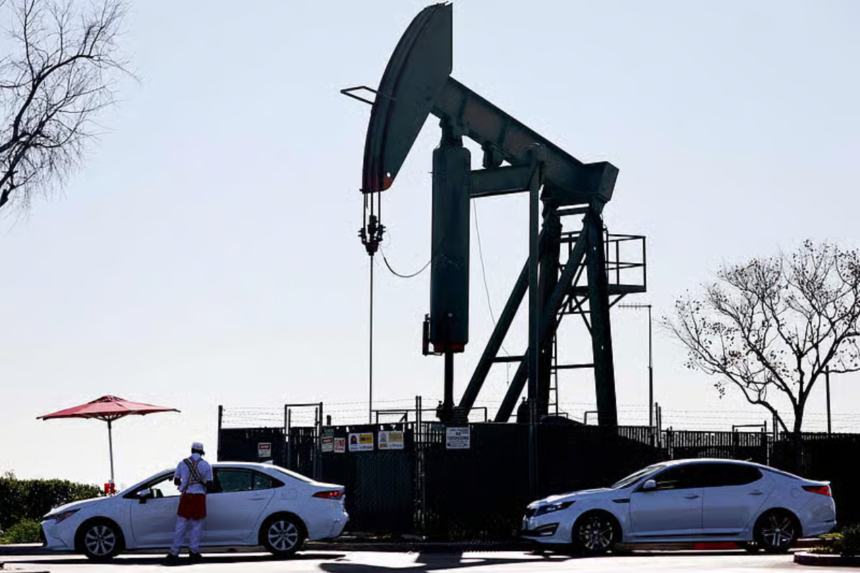
Crude prices remained under pressure after the weekend ceasefire eased concerns over Middle East supply risks.
Oil prices remained under pressure on Monday as a pause in military strikes between the United States and Iran eased immediate concerns over disruptions to global crude supplies.
Although traders welcomed signs of de-escalation after nearly two weeks of conflict, analysts cautioned that the absence of a formal agreement means supply risks across the Middle East remain unresolved.
Crude Extends Recent Decline
Brent crude futures fell 5.85 dollars, or about 6%, to 90.93 dollars a barrel, after briefly dropping as low as 87.55 dollars during trading.
US West Texas Intermediate (WTI) crude also declined, falling 4.98 dollars, or around 5.6%, to 84.33 dollars a barrel, having touched an intraday low of 82.12 dollars.
Both benchmarks reached their weakest levels since 20 July, reversing part of the sharp gains seen during the conflict, when Brent briefly climbed to 100 dollars a barrel.
Diplomacy Brings Temporary Relief
Market sentiment improved after US Ambassador to the United Nations Mike Waltz said President Donald Trump had decided to pause military strikes to allow more time for diplomatic efforts.
The announcement raised hopes that tensions could ease and that shipping through the Strait of Hormuz, one of the world’s most important energy corridors, could gradually recover.
However, traders remain cautious as neither Washington nor Tehran has announced a formal ceasefire or long-term agreement.
Supply Risks Have Not Disappeared
Despite the decline in prices, disruptions to regional energy supplies continue.
According to shipping data from Kpler, fewer than 10 commodity vessels passed through the Strait of Hormuz each day over the weekend, compared with normal flows of roughly 20 million barrels per day of crude oil, condensate and petroleum products.
Traffic through the Bab el-Mandeb Strait also remained under pressure after Yemen’s Iran-backed Houthi movement claimed attacks on Saudi oil infrastructure linked to the Red Sea export route.
Saudi Arabia said its air defence systems intercepted drones targeting oil facilities in the kingdom’s Eastern Province and Riyadh, adding that it reserved the right to respond.
These developments suggest that while direct fighting has slowed, the region’s energy infrastructure remains vulnerable.
Analysts Urge Caution
Market analysts warned against assuming the recent pause marks the end of the crisis.
John Evans, an analyst at PVM, said markets continue searching for positive developments despite ongoing uncertainty.
He noted that while the suspension of military action is encouraging, it does not guarantee that oil exports through the region will quickly return to normal.
Ole Hvalbye, an analyst at SEB Research, echoed that view, saying the current situation lacks a signed framework, verification mechanism or agreed timeline.
He added that a political pause does not immediately restore disrupted oil supplies.
Other Supply Challenges Remain
Beyond the Middle East, oil markets are also monitoring production disruptions elsewhere.
Kazakhstan temporarily reduced crude production after drone attacks affected operations at the Caspian Pipeline Consortium’s export terminal on Russia’s Black Sea coast. Although the country’s Energy Ministry later confirmed that oil loadings had resumed, the incident highlighted broader geopolitical risks affecting global energy markets.
Conclusion
The pause in US-Iran hostilities has eased immediate fears of a wider supply shock, helping push oil prices to their lowest levels in nearly a week.
However, shipping through the Strait of Hormuz remains well below normal levels, attacks on regional energy infrastructure continue, and no formal diplomatic agreement has been reached.
For now, oil markets are likely to remain highly sensitive to developments in the Middle East, with any renewed escalation capable of quickly reversing the recent decline in crude prices.
Source: KT