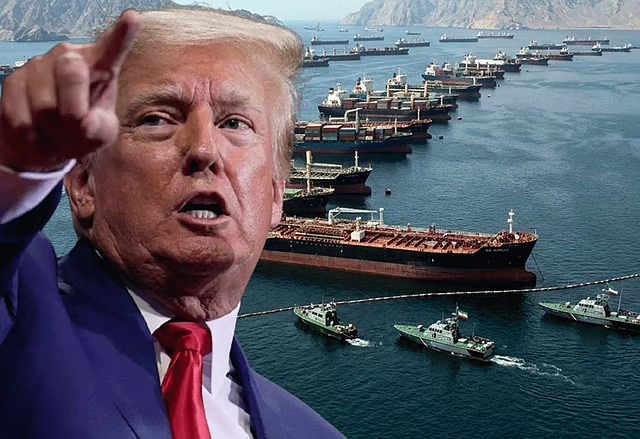




Analysts warn that tanker backlogs, higher insurance premiums, and supply chain disruptions could delay any drop in crude prices.
Tanker Backlogs, Insurance Costs, and Supply Chain Delays Could Keep Energy Markets on Edge
The reopening of the Strait of Hormuz would remove one of the biggest immediate threats to global energy supplies, but it is unlikely to bring instant relief to oil markets or consumers.
While Brent crude has already fallen from wartime highs of nearly $120 a barrel to around $80 as traders priced in a potential US-Iran agreement and the expected reopening of the strategic shipping route, analysts believe the path back to normality could take weeks. Tanker congestion, elevated insurance costs, depleted inventories, and lingering geopolitical concerns are expected to keep a risk premium embedded in energy markets even after vessels begin moving through the strait again.
For consumers, the impact could take even longer to fade. Petrol and diesel prices typically respond with a delay because refiners, distributors, and retailers must work through existing inventories and procurement contracts before lower crude costs reach fuel pumps.
Why the Strait of Hormuz Matters
The Strait of Hormuz remains one of the world’s most important energy corridors, carrying roughly 20% of global oil and liquefied natural gas trade.
Any disruption to shipping through the waterway immediately affects global energy markets because major Gulf producers depend on the route to export crude oil and gas to customers around the world. Although reopening the strait removes a major bottleneck, analysts caution that markets will need evidence of sustained and secure shipping activity before fully removing the geopolitical premium currently supporting prices.
Financial markets can react quickly to changing expectations, but physical energy markets operate on a different timeline. Oil must still be transported, stored, refined, and distributed before conditions normalize.
Markets Need Proof Before Prices Fully Stabilize
According to Vijay Valecha, Chief Investment Officer at Century Financial, oil prices may settle into an initial trading range soon after reopening, but a more sustainable decline is likely only later in the third quarter if the ceasefire holds and OPEC+ gradually increases production.
The challenge is not simply reopening the route. Shipping companies, insurers, refiners, and commodity traders all need confidence that traffic can move safely and consistently before market conditions return to normal.
Analysts estimate that roughly 20 tankers per day would need to pass through the strait before export flows can be considered largely restored.
Tanker Congestion Could Delay Recovery
Even if vessels are cleared to sail, a significant backlog remains.
Ship-tracking data indicates that more than 250 tankers and over 330 cargo vessels have accumulated inside the Gulf during the disruption. Clearing that congestion will take time, limiting the speed at which oil exports can return to pre-conflict levels.
Any additional inspections, security procedures, or clearance operations could further slow the recovery process.
As a result, physical supply chains are expected to remain constrained long after the first ships begin moving through the waterway again.
Insurance Costs Remain a Major Obstacle
One of the biggest barriers to a rapid recovery is the sharp increase in shipping insurance costs.
War-risk insurance premiums for tankers have surged from approximately 0.125% of a vessel’s value before the conflict to between 2.5% and 5%. For large tankers, that translates into millions of dollars in additional costs for a single voyage.
Shipping operators are unlikely to resume full-scale operations until insurance costs begin falling and safe passage through the strait is consistently demonstrated. Until then, higher transportation costs will continue supporting elevated oil prices.
Low Inventories Could Keep a Floor Under Prices
Global oil inventories may also prevent crude prices from returning to pre-conflict levels in the near term.
OECD oil stockpiles are approaching their lowest levels since 2003, while the US Strategic Petroleum Reserve remains near levels not seen since 1983. According to International Energy Agency data, global inventories declined sharply in both March and April.
As shipping resumes, governments, refiners, and traders are expected to rebuild these inventories, creating additional demand that could support crude prices even as supply routes reopen.
This suggests oil prices may stabilize below wartime highs while remaining above the levels seen before the conflict.
Why Fuel Prices May Stay Elevated
Consumers should not expect immediate relief at petrol stations, even if crude prices continue falling.
Fuel pricing operates on a delay because existing inventories were often purchased at higher costs. Refiners and distributors must first work through those supplies before lower crude prices can be reflected in retail markets.
Refining margins, transportation expenses, and local pricing mechanisms can further extend the adjustment period.
In markets such as the UAE, where fuel prices are revised monthly, any reduction in crude oil costs is likely to filter through gradually over multiple pricing cycles rather than appearing immediately.
Shipping Costs Could Affect Other Goods
The impact of the disruption extends beyond energy markets.
Freight and logistics costs often take longer to normalize than crude prices, meaning the effects could continue to influence consumer goods for several months. Products that rely on international shipping, including packaged foods, household goods, and retail merchandise, may remain expensive even as oil prices retreat.
Fresh produce could see faster price adjustments because of shorter inventory cycles and quicker turnover within supply chains.
What Markets Are Watching
Analysts are closely monitoring several indicators that will determine how quickly energy markets stabilize:
- Tanker traffic through the Strait of Hormuz
- Shipping insurance premiums
- Global oil inventory levels
- OPEC+ production decisions
- Regional diplomatic and security developments
These factors will provide the clearest indication of whether the market is moving toward lasting stability or remains vulnerable to renewed disruptions.
Outlook
A reopening of the Strait of Hormuz would represent a major step toward restoring normal energy flows, but it is unlikely to eliminate market pressures overnight.
The oil market now faces a different challenge: clearing shipping backlogs, rebuilding inventories, reducing insurance costs, and restoring confidence throughout the supply chain. Until those issues are resolved, oil prices are likely to remain sensitive to both physical constraints and geopolitical developments.
For consumers, lower crude prices may eventually translate into cheaper fuel and transportation costs, but the benefits will arrive gradually. Physical markets move far more slowly than financial markets, meaning the road back to normality could take several weeks, and in some cases months, even after the strait fully reopens.
Unsplash
Source: Gulf News