


Broadcasters and commentators have also raised concerns about interruptions to match coverage.
If recent FIFA World Cup matches have felt slightly different, many fans are pointing to one reason: mandatory hydration breaks.
Introduced as a player welfare measure, the pauses are now a standard feature of every match, regardless of weather conditions. While FIFA says the rule is designed to protect players and promote consistency, critics argue that it is changing the rhythm of football in ways that are becoming increasingly noticeable.
The debate has quickly grown beyond sports science. Coaches, broadcasters, commentators, and fans are now discussing whether the breaks are helping the game, disrupting it, or doing both at the same time.
FIFA’s New Approach to Hydration Breaks
Historically, hydration breaks were used only in extreme heat.
During previous World Cups and major tournaments, referees would pause matches when temperatures reached dangerous levels, allowing players to cool down and rehydrate.
At the 2026 FIFA World Cup, however, FIFA introduced a more standardized approach.
Matches are now paused twice per game, usually around the 22nd minute of each half, regardless of temperature, stadium design, or local weather conditions.
This means hydration breaks are taking place not only in hot outdoor venues but also in cooler environments and climate-controlled stadiums.
FIFA’s objective is straightforward: create a uniform player welfare policy across all matches and reduce the risk of heat-related illnesses during a demanding tournament schedule.
Why Some Coaches Are Concerned
One of the most prominent voices questioning the new system has been England manager Thomas Tuchel.
While acknowledging the health benefits of hydration breaks, Tuchel has suggested that their universal application changes the nature of football matches.
His concern is not the concept itself but the frequency and predictability of the interruptions.
Football has traditionally been valued for its continuous flow, where momentum can build gradually over long stretches of play. According to Tuchel, mandatory stoppages break that rhythm and divide matches into shorter segments.
Teams that are dominating possession or building attacking pressure can lose momentum when play is paused. Conversely, struggling teams gain an opportunity to regroup, reorganize defensively, and receive tactical instructions from coaches.
The result is a subtle but significant shift in how matches unfold.
At the same time, Tuchel acknowledged that the breaks offer coaches a valuable chance to communicate directly with players, something that is often difficult during open play.
The Medical Case for Hydration Breaks
From a sports science perspective, the argument for hydration breaks remains strong.
Medical experts have consistently warned about the risks associated with dehydration during high-intensity athletic competition.
While muscle cramps are the most visible symptom, the greater concern is preventing heat exhaustion and heat stroke, both of which can become serious medical emergencies.
Modern football demands exceptional physical output. Elite players routinely cover 10 to 13 kilometers during a match while performing repeated high-intensity sprints.
In tournaments where teams may play multiple matches within short periods, recovery becomes increasingly important.
Supporters of the rule argue that formal hydration breaks simply provide a structured version of what players often do informally during injuries, substitutions, or other stoppages.
From this perspective, the breaks are a preventative measure designed to reduce health risks rather than a fundamental change to the sport.
Fans Are Split Over the Change
Among supporters, reactions have been mixed.
Many understand the player welfare argument and accept the need for modern safety measures.
Others believe the breaks interrupt some of football’s most exciting moments.
One of the most common criticisms is timing.
Because the pauses occur at predictable intervals, fans often feel that matches lose momentum just as the pace begins to intensify.
In a sport where emotional swings and continuous pressure are central to the viewing experience, even brief interruptions can alter the atmosphere.
The debate reflects a broader tension within modern sports: balancing athlete welfare with the entertainment value that fans expect.
Broadcasters Have Found New Commercial Opportunities
The hydration breaks have created opportunities beyond the field.
For television networks, the scheduled stoppages provide predictable advertising windows during live broadcasts.
Unlike traditional football broadcasts, where uninterrupted play limits commercial opportunities, hydration breaks offer broadcasters guaranteed moments to insert sponsored content.
Some networks initially used full-screen advertisements during the pauses, prompting criticism from viewers who felt they were missing on-field activity.
In response, certain broadcasters began experimenting with split-screen formats that allow fans to continue watching stadium coverage while advertisements run alongside.
The approach remains inconsistent across markets, but the commercial value of these breaks is becoming increasingly clear.
For broadcasters investing billions of dollars in sports rights, every additional advertising opportunity carries significant financial value.
A Reflection of Football’s Evolution
The controversy surrounding hydration breaks highlights a larger reality about modern football.
The sport is constantly adapting.
Technology, player welfare initiatives, scheduling demands, commercial considerations, and broadcasting innovations are all influencing how the game is played and consumed.
Hydration breaks sit at the center of several of these trends.
They are simultaneously a medical safeguard, a coaching tool, a broadcast asset, and a source of debate among supporters.
That combination explains why such a seemingly simple rule has generated so much discussion.
Will FIFA Keep the Rule?
At present, FIFA appears committed to the policy.
Player welfare remains a priority, particularly as major tournaments are staged across increasingly diverse climates and environmental conditions.
However, football authorities will continue monitoring feedback from players, coaches, broadcasters, and fans.
Future adjustments may focus on timing, duration, or conditions under which the breaks are required.
For now, hydration breaks have become one of the defining features of this World Cup.
Whether they are ultimately remembered as a necessary evolution in player safety or an unnecessary disruption to football’s natural rhythm will depend on how the game, and its audience, adapt in the years ahead.
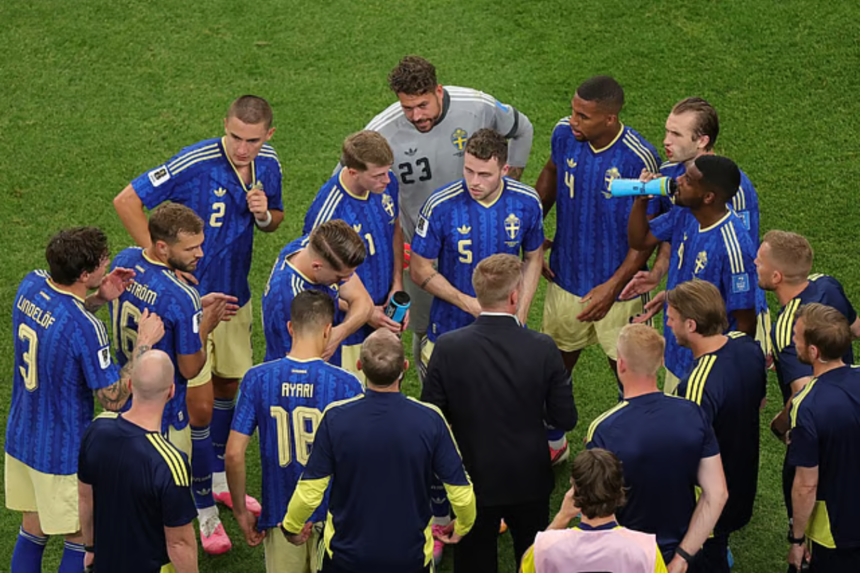
Graham Potter, Head Coach of Sweden, speaks to players at the hydration break during the FIFA World Cup 2026 Group F match between the Netherlands and Sweden at Houston Stadium on June 20, 2026, in Houston, Texas. AFP-ALEX SLITZ
Source: Gulf News