


Dubai RTA is working with leading Chinese tech companies to make the city’s metro network smarter, faster, and more efficient.
Dubai has never viewed public transport as simply a way to move people from one place to another. Over the past two decades, the emirate has consistently invested in transport infrastructure that supports economic growth, sustainability, and quality of life.
Now, Dubai is preparing for the next phase of that journey.
The Roads and Transport Authority (RTA) has signed strategic partnerships with two of China’s leading technology companies, Huawei Technologies and CASCO SIGNAL LTD., to integrate artificial intelligence, digital infrastructure, and advanced railway technologies into the Dubai Metro Blue Line and future rail projects.
Rather than focusing only on expanding the metro network, Dubai is aiming to make its transport system more intelligent, connected, and capable of anticipating future mobility needs.
Why China Has Become a Strategic Partner
China has emerged as one of the world’s leaders in urban transportation, operating some of the largest metro systems and the fastest commercial rail services anywhere.
Cities such as Shanghai manage millions of passenger journeys every day using artificial intelligence, automation, and integrated transport platforms that connect roads, buses, railways, airports, and logistics networks.
Recognizing this expertise, an RTA delegation led by Director-General and Chairman Mattar Al Tayer visited China to study how these technologies are being deployed at scale.
The visit went beyond signing agreements. Officials met with government agencies, explored advanced transport control centres, and examined how Chinese cities use digital technologies to improve traffic flow, passenger experience, and operational efficiency.
For Dubai, the objective is clear. Rather than developing every solution independently, the city wants to learn from global best practices while adapting proven technologies to its own growing transport network.
Building an AI Innovation Hub for the Dubai Metro
One of the most significant outcomes of the visit was the partnership with CASCO SIGNAL LTD., a company specializing in railway signaling, communications, and control systems.
Under the agreement, CASCO will establish an advanced research and development centre and innovation laboratory in Dubai.
The facility will support the development of the Dubai Metro Blue Line while also preparing technologies for future rail expansions.
Instead of deploying new systems directly into live operations, engineers will be able to simulate real-world operating conditions inside the laboratory before introducing them across the metro network.
This testing environment is expected to reduce operational risks while improving reliability and long-term performance.
Artificial Intelligence Will Power Everyday Operations
The innovation centre will focus on several technologies that are expected to shape the future of railway operations.
Researchers will develop AI-powered scheduling systems capable of improving train frequency based on passenger demand.
Predictive maintenance tools will continuously monitor railway assets, identifying potential equipment failures before they interrupt service.
Artificial intelligence will also assist with asset management, helping operators extend the lifespan of critical infrastructure while reducing maintenance costs.
By shifting from reactive maintenance to predictive maintenance, Dubai hopes to improve service reliability while minimizing disruptions for passengers.
Huawei Will Help Build a Smarter Transport Ecosystem
Dubai’s second agreement, signed with Huawei Technologies, reaches far beyond metro operations.
The partnership covers multiple aspects of the city’s future transport ecosystem, including digital infrastructure, information security, artificial intelligence, intelligent transport systems, and smart city technologies.
One major objective is the development of unified data platforms capable of connecting different transport services into a single digital ecosystem.
Instead of individual systems operating independently, roads, metro services, buses, traffic management, and transport control centres will increasingly communicate with one another through integrated digital platforms.
Artificial intelligence will also be used to improve incident detection, allowing operators to identify disruptions more quickly and respond before they escalate into larger problems.
Passenger services, station management, and metro monitoring are also expected to benefit from AI-enabled automation.
Learning From One of the World’s Most Advanced Cities
During their visit, the RTA delegation toured Shanghai’s Municipal Transportation Commission command centre.
The facility manages one of the world’s largest urban transport systems through centralized digital platforms that coordinate roads, metro networks, airports, taxis, buses, and freight operations.
Officials also explored China’s implementation of the “15-minute city” concept.
The planning model focuses on ensuring that essential services, workplaces, shopping, healthcare, education, and recreation remain within a short journey from residential communities.
The goal is to reduce dependence on private vehicles while encouraging more sustainable and accessible urban mobility.
Dubai has already incorporated similar principles into parts of its long-term urban planning strategy, making China’s experience particularly relevant.
High-Speed Rail and Future Infrastructure
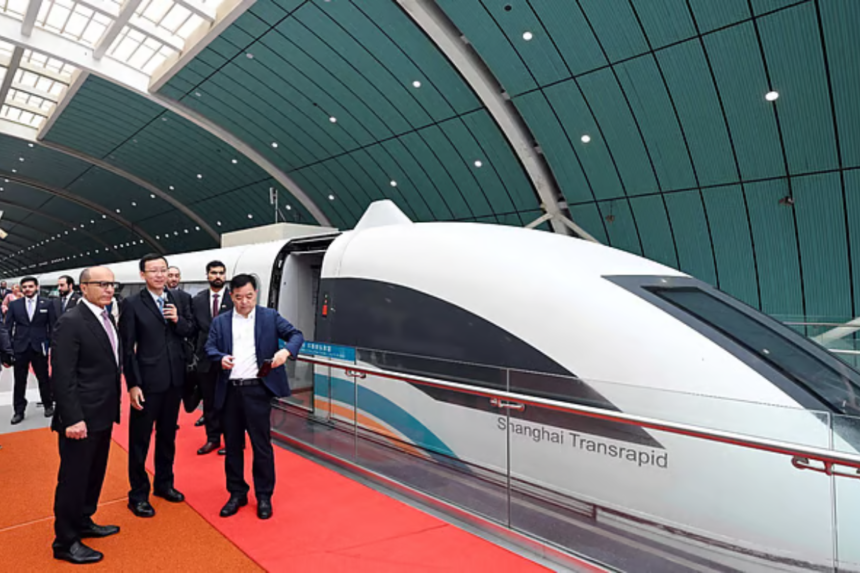
The delegation also experienced the Shanghai Maglev, one of the fastest commercial trains currently operating anywhere in the world.
In addition, officials inspected large-scale bridge projects, tunnels, multimodal transport hubs, and railway construction techniques.
These visits provided valuable insights into modern engineering methods, integrated mobility planning, and advanced construction technologies that could influence future transport projects across Dubai.
While not every technology will be directly replicated, the experience helps Dubai evaluate solutions that could improve future infrastructure development.
More Than Infrastructure. Building Local Expertise
The partnerships are designed to deliver more than imported technology.
By establishing research facilities inside Dubai, RTA aims to strengthen local technical expertise while encouraging knowledge transfer between international specialists and local engineers.
The innovation centre will also support joint research, technical workshops, pilot programmes, and technology testing.
Over time, this could position Dubai as a regional centre for railway innovation, allowing expertise developed locally to contribute to future transport projects across the Middle East.
Supporting Dubai’s Smart City Vision
The agreements align closely with Dubai’s broader ambition to become one of the world’s leading smart cities.
Artificial intelligence is already being introduced across government services, healthcare, education, public safety, and urban planning.
Transport represents one of the most significant opportunities for AI because modern mobility depends on analysing enormous volumes of real-time data.
Smarter metro systems can predict passenger demand, optimise train frequency, improve emergency response, reduce maintenance costs, and deliver a more seamless travel experience.
For residents, many of these improvements may happen quietly behind the scenes, but together they can significantly improve reliability, convenience, and efficiency.
Building the Next Generation of Urban Mobility
Dubai’s partnership with Huawei and CASCO SIGNAL reflects a broader shift in how cities approach infrastructure development.
Instead of focusing solely on expanding physical networks, leading cities are investing equally in the intelligence that powers those networks.
Artificial intelligence, predictive analytics, automation, and connected digital platforms are becoming as important as tracks, trains, and stations.
By combining international expertise with local innovation, Dubai is positioning its metro system for the next generation of urban mobility.
As projects such as the Dubai Metro Blue Line move forward, these collaborations demonstrate that the future of public transport will not simply be faster or larger. It will be smarter, more connected, and increasingly capable of adapting to the needs of a rapidly evolving global city.
Read more news, and follow us on Instagram.
To explore next-generation rail technologies, the RTA delegation experienced the Shanghai Maglev, one of the world’s fastest commercial train services.
RTA
Source: Gulf News