



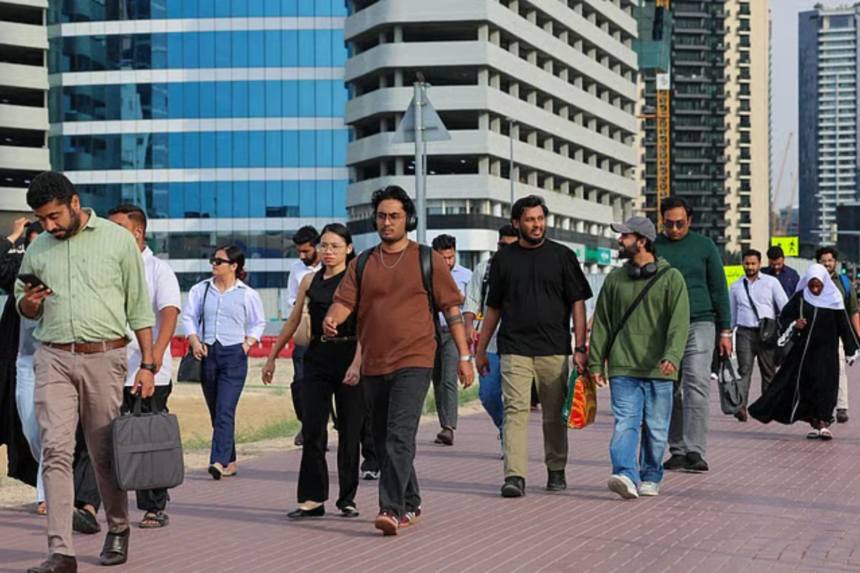
The updated requirements set separate housing arrangements for families and individuals while outlining new responsibilities for landlords and shared accommodation operators.
Dubai has introduced new rules for shared accommodation, banning families and individuals from living in the same residential unit and restricting shared housing for individuals in designated areas.
Dubai Municipality introduced the requirements under Law No. 4 of 2026, which came into force in August. Property owners and establishments have one year to bring existing shared accommodation into compliance with the new regulations.
Under the rules, each shared residential unit must be designated exclusively for either families or individuals. Bedrooms must provide at least five square metres of space per occupant, while one complete bathroom must be available for every four residents.
In family accommodation, each family must have a separate bedroom with its own private bathroom.
Shared Housing Restricted on Major Roads
Dubai Municipality has also prohibited shared accommodation for individuals along major roads with tourism or commercial activity, including Baniyas Road, Sheikh Zayed Road, Jumeirah Road and Al Wasl Road.
Shared accommodation in these locations will be restricted to families.
The requirements are detailed in Dubai Municipality Circular No. 1-3-1 of 2026, which outlines 10 obligations for property owners, engineering consultancy offices and contracting companies.
One-Year Compliance Period for Existing Properties
Buildings and villas currently used for shared accommodation must comply with the new law within one year of its implementation and meet applicable planning and construction standards.
The grace period does not apply to building violations or unauthorised changes of use. Such violations must be removed to protect residents and property.
A building permit is required for new shared accommodation as well as modifications to existing buildings and villas being converted for shared housing. Licence, completion and shared-housing permit applications must be submitted through the Dubai Building Platform by the engineering consultancy appointed by the property owner.
Applications must include details of buildings, apartments and rooms, including their sizes, occupant categories and permitted occupancy rates.
Shared-housing permits will be issued after a completion certificate is granted and will include information required by the Dubai Land Department for tenancy contracts.
The municipality also requires an entire residential building or villa to be designated for shared accommodation. A property cannot have some units allocated to individuals and others to families.
Minimum Space and Bathroom Requirements
The regulations require at least five square metres of bedroom space per occupant.
In family accommodation, multiple families may occupy the same residential unit provided each family has its own bedroom and private bathroom. Individual accommodation may allow several occupants to share a bedroom, subject to approved occupancy, health and technical requirements.
A complete bathroom, including a washbasin, toilet and shower, must be provided for every four occupants.
Where toilet and shower facilities are separated, accommodation for individuals must have at least one toilet for every four occupants and one shower for every six residents.
Buildings housing individuals must also provide multipurpose areas for dining and recreation, along with adequate laundry and drying facilities.
Parking and Transport Requirements
Shared accommodation is exempt from minimum car-parking requirements under the applicable regulations. However, operators must provide suitable areas for minibuses to pick up and drop off residents, subject to approval from Dubai’s Roads and Transport Authority and compliance with the Dubai Building Code.
Bicycle parking must also be provided at a capacity equivalent to at least 10% of the building’s total occupants.
Private residential villas and villas in approved areas can be used for shared accommodation if they comply with the relevant planning and construction requirements.
The rules apply to new buildings as well as existing properties being modified or converted for shared accommodation in authorised areas. Fees will apply when requesting the conversion of a building or part of a building into a designated shared-accommodation property unit.
The new law is aimed at regulating shared housing, protecting the rights of owners and residents, improving accommodation standards and addressing overcrowding and unregulated occupancy in residential neighbourhoods.
Read more news and follow us on Instagram
Dubai Municipality set out the requirements under Law No. 4 of 2026 regulating the occupancy and management of shared housing, which came into force in August. Owners and establishments have been given one year to bring existing properties into compliance.
Virendra Saklani/Gulf News