


A new proposal explores how diplomacy and cooperation in the Strait of Hormuz could help reduce tensions and avoid a wider conflict.
Wars rarely end because one side achieves total victory.
More often, they end when the cost of continuing the fight becomes greater than the benefits of carrying it on.
That reality is becoming increasingly apparent in the US-Iran conflict, where months of military strikes, drone attacks, and disruptions to global shipping have left both sides facing mounting economic, political, and strategic costs.
At the centre of the conflict lies the Strait of Hormuz, the narrow waterway connecting the Persian Gulf to the Gulf of Oman. Around one-fifth of the world’s oil passes through this strategic corridor, making it one of the most important maritime routes on the planet.
As attacks on commercial shipping have intensified, insurance costs have surged, oil markets have become increasingly volatile, and fears of a wider regional conflict have grown.
Yet amid the military escalation, two diplomatic ideas are emerging that could help reduce tensions while protecting one of the world’s most critical trade routes.
The Strait of Hormuz Has Become the Conflict’s Pressure Point
The fighting has spread well beyond isolated military exchanges.
Commercial vessels have faced repeated threats, energy exports have been disrupted, and attacks have expanded into neighbouring countries including Iraq and Jordan, while security concerns have also affected routes linked to the Red Sea and the Suez Canal.
The result has been a growing recognition that prolonged instability around Hormuz benefits no one.
Every disruption threatens global energy supplies, raises shipping costs, fuels inflation, and increases the risk of a broader regional war.
Option One. A Shared Framework for Hormuz
One proposal receiving renewed attention would replace confrontation with regional cooperation.
Rather than allowing the Strait of Hormuz to remain a geopolitical flashpoint, Gulf countries, including Iran and Oman, could jointly oversee navigation services, maritime safety, environmental protection, and emergency response through a cooperative regional framework.
The concept is not entirely new.
A previously negotiated Islamabad Memorandum of Understanding (MoU) outlined discussions between Iran and Oman on the future administration of maritime services in the Strait, while consulting other Gulf coastal states and respecting international law.
Instead of transferring sovereignty, such a framework would focus on practical cooperation, including:
- Navigation safety.
- Search-and-rescue coordination.
- Environmental protection.
- Maritime traffic management.
- Emergency response services.
Comparable arrangements already exist in other strategically important waterways around the world, where neighbouring countries cooperate on operational matters while retaining full sovereignty over their territories.
Supporters argue that this approach could reduce military tensions while ensuring uninterrupted energy supplies.
Critics contend that it risks rewarding aggressive behaviour.
Nevertheless, proponents argue that the alternative, repeated military crises disrupting global trade, carries even greater economic costs.
Option Two. Broader International Involvement
A second proposal centres on expanding diplomatic participation beyond Washington and Tehran.
Major energy importers, including European countries, India, Japan, South Korea, and other Asian economies, all depend heavily on uninterrupted Gulf energy supplies.
Their shared economic interests create incentives to support broader diplomatic initiatives aimed at securing commercial shipping.
In recent months, Oman has emerged as the principal mediator, facilitating discussions with Iran over navigation arrangements and possible mechanisms for safely restoring commercial traffic through the Strait.
Many analysts believe a wider multinational framework could provide greater neutrality and long-term stability than bilateral negotiations alone.
The Debate Over Shipping Fees
One of the more technically complex issues concerns the question of payments by commercial vessels.
Iran has reportedly argued that ships using the Strait should contribute financially.
Oman has maintained that international law guarantees freedom of navigation through international straits and therefore opposes transit tolls.
A possible compromise has emerged.
Instead of charging vessels for passage, ships could voluntarily pay for services such as:
- Navigation assistance.
- Search-and-rescue operations.
- Environmental monitoring.
- Emergency response capabilities.
While seemingly a technical distinction, it could prove politically significant by allowing safety infrastructure to be funded without undermining established international maritime law.
Why Diplomacy Is Becoming More Attractive
Neither Washington nor Tehran has abandoned military options.
The United States continues to maintain a strong military presence in the region, while Iran insists on playing a larger role in managing security around Hormuz.
Despite these differences, economic realities are increasingly encouraging diplomatic engagement.
Oil prices have eased whenever reports of renewed maritime discussions have emerged, reflecting investor expectations that negotiations could eventually reduce supply risks.
Markets increasingly view diplomacy, rather than military escalation, as the more sustainable path to restoring stability.
Domestic Pressures Are Also Growing
Political considerations are adding further pressure for a negotiated solution.
In the United States, several recent opinion surveys suggest growing public concern over the financial and human costs of prolonged military involvement.
According to recent polling by AP-NORC, around two-thirds of Americans believe the conflict has not been worth fighting.
An Ipsos survey similarly found that only about one-quarter of respondents believed US military action had been worthwhile, while more than half said the conflict had negatively affected their personal finances through higher energy prices and inflation.
President Donald Trump has repeatedly described the campaign as a limited military operation rather than a large-scale war, reflecting the administration’s efforts to avoid a broader regional conflict.
Unlike previous conflicts that fundamentally reshaped American public opinion, the Iran confrontation has not involved a direct attack on the US homeland capable of generating overwhelming support for prolonged military escalation.
Can Shared Interests Create Lasting Stability?
No diplomatic proposal will erase decades of mistrust between Washington and Tehran.
Deep political, ideological, and security differences remain.
Nevertheless, history shows that durable peace is often built around shared economic interests rather than military victories.
Every country bordering the Strait of Hormuz depends, directly or indirectly, on secure maritime trade.
Every major energy importer benefits from uninterrupted shipping.
Those common interests may ultimately provide stronger incentives for cooperation than continued confrontation.
The Strait of Hormuz has long been one of the world’s most strategically sensitive waterways.
Today, advances in missile technology and long-range drones have made even limited disruptions capable of triggering global economic consequences.
That same strategic importance, however, also creates an opportunity.
If regional states, major energy consumers, and international maritime partners can develop cooperative mechanisms to safeguard navigation while respecting national sovereignty, Hormuz could evolve from a recurring source of conflict into a shared strategic asset.
Such an agreement would not resolve every dispute between the United States and Iran.
It could, however, reduce the risk of repeated military escalation, protect global energy supplies, and create the first meaningful foundation for broader regional stability.
Source: Gulf News
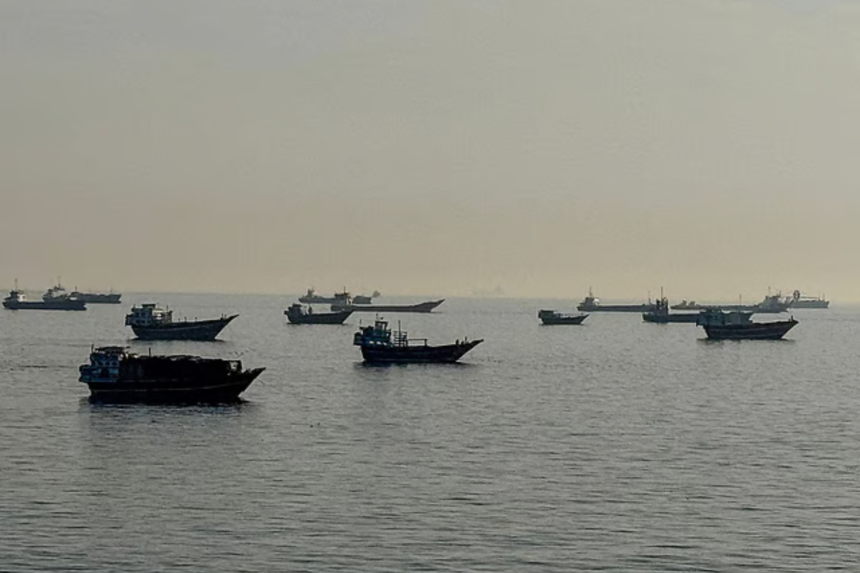
Vessels are seen anchored in the Strait of Hormuz, off the port city of Khasab on Oman’s northern Musandam Peninsula on May 17, 2026.
AFP