



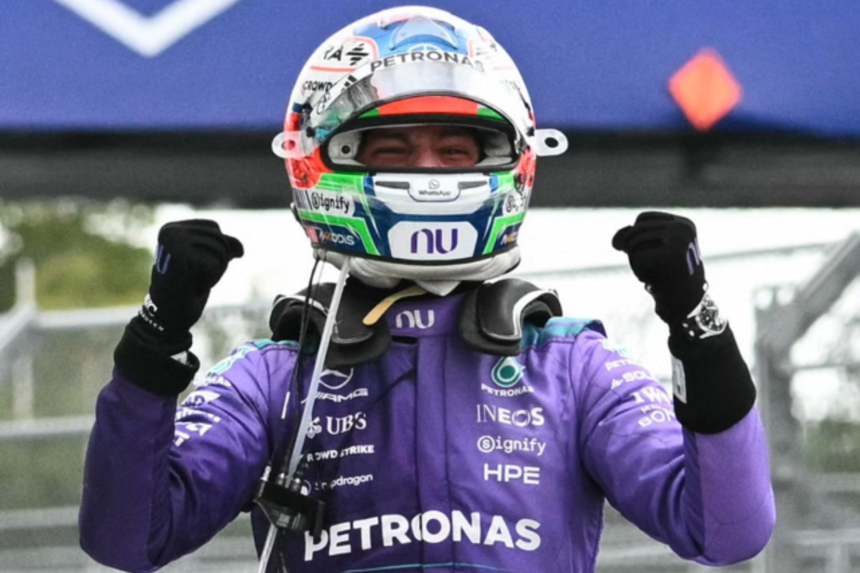
A third consecutive win gives the young driver growing control of the 2026 championship battle.
At 19, Kimi Antonelli is no longer operating within the limits of promise. His victory at the Miami Grand Prix marks a third consecutive win this season, positioning him as the central force in the 2026 Formula 1 title race.
Driving for Mercedes-AMG Petronas Formula One Team, Antonelli delivered a performance built on structure and control rather than outright dominance. The race demanded adaptability, and he responded with measured execution.
Strategy Over Speed
The race was shaped less by overtaking and more by decision-making. Lando Norris of McLaren initially held the advantage, controlling the early phases with pace and positioning.
Mercedes shifted the race through strategy. A well-timed undercut during the pit cycle allowed Antonelli to take track position, turning the contest into one of control rather than pursuit. From that moment, the outcome was dictated by precision, not aggression.
Antonelli crossed the line 3.264 seconds ahead, maintaining stability under pressure rather than extending risk.
The Rest of the Field
Oscar Piastri secured third place, though significantly behind the leading pair, highlighting the separation at the front.
Further back, George Russell finished fourth, followed by Max Verstappen and Charles Leclerc, whose late spin erased any remaining contention for a stronger finish.
The race’s early phase was marked by instability. Incidents, position changes, and a safety car compressed the field, creating a reset that shifted emphasis toward timing and tire management.
Composure Under Pressure
Antonelli’s performance was not defined by a flawless race. Early errors, including a lock-up and energy management inconsistencies, introduced risk. What followed was more important than the mistake itself.
He did not overcorrect. He stabilized, recalibrated, and executed. That ability to absorb disruption without compounding it reflects a level of maturity rarely seen at this stage of a career.
Mercedes’ Structural Advantage
Mercedes arrived without a major upgrade package, yet delivered a result that reinforces its position at the front of the grid. The advantage lies not only in machinery but in systems, coordination, and strategic clarity.
Execution has become its differentiator.
What This Means for the Championship
For Norris, the result reflects a narrow gap between contention and control. Pace was present, but the inability to counter the strategy defined the outcome.
For Antonelli, the pattern is becoming consistent. Wins are not isolated events. They are part of a controlled progression.
The championship is no longer an open contest shaped by unpredictability. It is being structured, race by race, by a driver who is not reacting to pressure but steadily removing it.
Read more news and follow us on Instagram
Mercedes’ Italian driver Kimi Antonelli celebrates after winning the 2026 Miami Formula One Grand Prix at Miami International Autodrome in Miami Gardens, Florida, on May 3, 2026.
AFP