


Years after stepping away from his passion, the Pakistani artist created a Quranic masterpiece in Dubai and hopes it finds a permanent public home.
At 83, the Dubai-based artist continues painting through fading eyesight, driven by passion, faith, and a lifelong devotion to art.
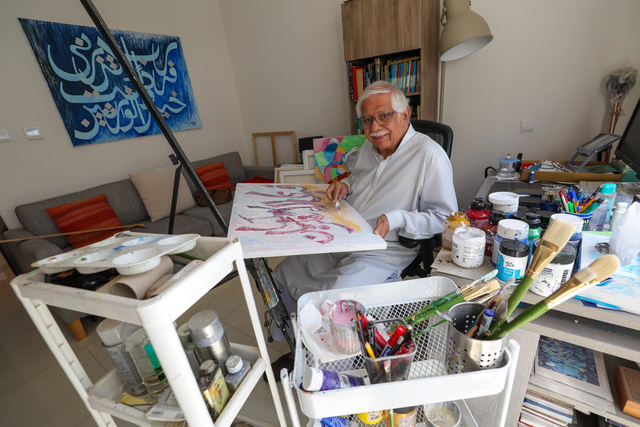
Inside a modest apartment in Dubai, Nazar Haidri carefully holds a canvas close to his face. His vision is no longer what it once was. The details that once came naturally now arrive slowly through softened outlines and dimmed light.
Yet the 83-year-old artist continues to paint. With deliberate movements, he presses a palette knife into thick layers of paint, shaping textured strokes across the canvas through feeling as much as sight.
For Nazar, stopping has never been an option.
“I can’t stop painting. It’s my passion,” he says.
When Fading Eyesight Changed Everything
Nazar’s relationship with art spans decades, but recent years have brought one of the hardest challenges of his life.
Doctors informed him that his optic nerves were deteriorating, causing his eyesight to weaken significantly.
“Before I was diagnosed, I felt a black dim closing in on me,” he recalled. “Darkness.”
For an artist whose work depends on observing subtle detail, the diagnosis could have ended his creative journey entirely.
Instead, it transformed it. Unable to rely on the precision techniques he once used, Nazar adapted his process. Brushes and fine sketches gradually gave way to palette knives, thick paint textures, and expressive impasto techniques that rely more on movement, emotion, and instinct than microscopic detail.
What initially felt like a limitation slowly became freedom.
A Quranic Artwork Closest to His Heart
Among all his works, one creation carries special meaning for Nazar.
Before his eyesight worsened, he completed a Quranic calligraphy piece based on Surah Al-Fatiha, the opening chapter of the Quran.
The piece remains one of the proudest achievements of his artistic life.
“I really hope something so significant can be placed in a public institution,” he said. “Somewhere it can truly be appreciated.”
For Nazar, art was never meant to remain hidden inside private collections alone.
“The goal of any artist is for their work to reach and inspire as many people as possible,” he says.
From Lucknow to Karachi
Nazar’s story began far from Dubai.
He was born in Lucknow, India, a city deeply connected to poetry, music, and artistic culture. Even as a child, he found himself constantly sketching despite growing up in a traditional family environment where art was viewed as unstable and impractical.
In 1958, he migrated to Karachi, Pakistan, beginning life again from scratch.
To survive, he worked at a petrol station while pursuing art studies through the Arts Council of Pakistan.
That period changed everything.
He eventually found himself working alongside legendary South Asian artists:
. Sadequain
. Zainul Abedin
Both artists had been commissioned for murals at the State Bank of Pakistan, and Nazar was selected as one of the young students assisting them.
“Just being near them still inspires me today,” he says.
His reputation gradually grew through annual exhibitions and recognition within Pakistan’s art circles.
In 1963, celebrated poet Faiz Ahmed Faiz purchased one of Nazar’s artworks, giving the young artist early validation that few receive.
Why He Left Art Behind for Decades
Life, however, demanded practicality.
Marriage, family responsibilities, and financial pressures pushed Nazar toward a career in advertising and marketing instead of full-time art.
For more than 40 years, he worked as a marketing executive in Saudi Arabia’s advertising industry.
Art remained present quietly in the background, but survival came first.
“My passion for art took a back burner,” he says.
Still, his professional career allowed him to travel internationally, visiting museums and galleries across Europe and the United States.
One visit proved especially important. While standing before Pablo Picasso’s Girl with a Mandolin at New York’s Museum of Modern Art, something reignited inside him.
He began imagining how Cubism could merge with South Asian themes, music, and Quranic calligraphy.
Dubai Became His Second Beginning
After retirement, Nazar moved to Dubai nearly a decade ago to live closer to his children.
Instead of slowing down, the city gave him a fresh artistic beginning.
“Dubai was the place where I could pursue my passion and be recognized for it,” he says.
The UAE’s openness toward artists and cultural diversity allowed him to return fully to painting.
Supported by Dubai Culture, Nazar later received the UAE Golden Visa in recognition of his contribution to the arts scene.
His work blends:
. Cubist geometry
. Quranic calligraphy
. Pointillism
. Rich color experimentation
The combination helped distinguish his style from traditional approaches.
“Quranic calligraphy is traditionally black and white, but I felt it could hold so much more through color,” he explains.
Art Beyond Galleries
Nazar’s paintings have since appeared across exhibitions in the UAE, Pakistan, the United States, Hong Kong, and the United Kingdom.
Collectors acquired several works for thousands of dollars, but commercial success was never the main goal.
“Art has been reserved for a few for too long,” he says. “People need it in their homes and lives.”
For him, art is emotional nourishment rather than luxury decoration.
“It’s a zero-sum game financially,” he says with a smile. “But it’s worth every penny for your soul.”
Still Painting Through Weak Vision
The pandemic reduced his public appearances and exhibitions, but it did not stop his practice.
Today, Nazar continues adapting.
Pencils became markers. Brushes became palette knives. Precision became expression.
His eyesight may have weakened, but his instinct to create remains untouched.
“At the end of the day, Allah blessed me with a good life and a family that pushes me to keep going,” he says. “I can’t complain. Ever.”
Source: Gulf News
Pakistani artist Nazar has been painting since the 1960s. Still, it is only in retirement that the Dubai resident, now in his 80s and a UAE Golden Visa holder recognised for his artistic contributions, has fully devoted himself to blending cubism, pointillism, and Quranic calligraphy in his work.
Photo: Virendra Saklani/Gulf News
Read more news, and follow us on Instagram