



In many urban markets today, interior design is increasingly equated with visual refinement, clean lines, premium materials, and curated aesthetics. Yet, according to Dubai-based entrepreneur Sameera Khuram, this approach often overlooks a more fundamental question: how a space actually makes people feel and function within it.
Sameera Khuram, who runs a boutique fit-out design company, has gradually shifted her focus from aesthetic execution to what she describes as “emotional infrastructure”, the idea that spaces should support clarity, calm, and continuity in everyday life.
“A visually impressive space can still feel uncomfortable or disconnected,” she says. “Design needs to go beyond appearance and consider how people experience the environment over time.”
This perspective did not emerge instantly. Like many founders, her early journey was shaped by external benchmarks, project scale, recognition, and visible output. Over time, however, she began to reassess what meaningful work looked like, both professionally and personally.
“The shift was subtle but important,” she explains. “It moved from asking ‘How does this look?’ to ‘How does this live?’”
That shift also introduced a different kind of discipline, one that is less visible but more demanding. Building a business while refining a personal philosophy required consistency through uncertainty, and the ability to make decisions that did not always deliver immediate validation.
“There are always moments where clarity is not immediate,” she says. “But long-term direction is often built by continuing through those phases, not waiting for perfect alignment.”
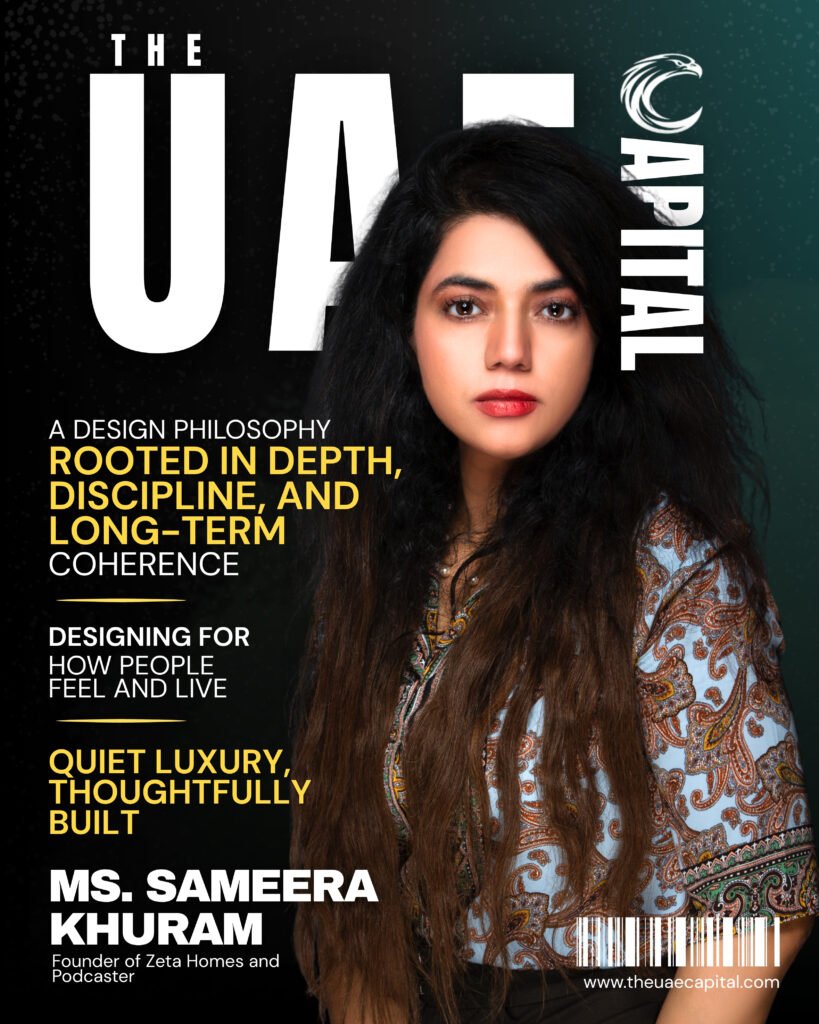
Alongside her design practice, Sameera Khuram has been developing a podcast platform centred on conversations around growth, mindset, and personal evolution. Rather than positioning it as a media extension, she sees it as part of a broader ecosystem, one that explores how individuals think, adapt, and navigate complexity.
Across both verticals, a common thread emerges: a preference for depth over visibility.
This is particularly relevant in the context of modern entrepreneurship, where visibility is often mistaken for progress. Sameera’s approach suggests a more measured model, one where internal alignment and long-term coherence take precedence over rapid external expansion.
It is also a perspective shaped by lived realities. As a founder balancing business responsibilities with family life, she describes an ongoing negotiation between ambition and presence, one that requires intentional boundaries rather than reactive decisions.
“There is no fixed formula,” she says. “It’s about continuously refining what matters and adjusting how you show up.”
In a region where design continues to play a central role in shaping lifestyle and identity, Sameera’s work points toward a broader evolution, one where the value of a space is not only defined by how it appears but by how it supports the people within it.