


EV demand is rising as drivers look to save on fuel costs, but limited charging infrastructure, repair concerns, and resale values remain challenges.
The Philippines is making a $1 billion bet on electric vehicles, hoping to attract automakers, expand domestic production, and persuade more consumers to switch from petrol and diesel cars.
President Ferdinand Marcos Jr. signed an executive order on July 29 creating the Electric Vehicle Incentive Strategy (EVIS), a ₱60 billion package designed to support EV manufacturing in the country.
Under the programme, up to four EV models can receive as much as ₱15 billion each in fiscal support. Companies must invest at least ₱5 billion or commit to producing 10,000 vehicles annually within three years to qualify.
The push comes as EV demand is already rising. Sales increased 132.7% year on year to 31,381 units in the first half of 2026, while conventional vehicle sales declined 11.4%.
Fuel Savings Are Driving EV Demand
For Filipino motorists, lower running costs are becoming one of the strongest reasons to consider an EV.
Electric vehicles generally require less energy and maintenance than conventional cars. Drivers can avoid expenses associated with engine oil, spark plugs, and other components found in internal-combustion vehicles.
However, the upfront price remains a concern. The government believes local production could eventually reduce EV prices by as much as ₱200,000 per vehicle, making them more accessible to consumers.
Three Concerns Still Hold Buyers Back
Despite rising sales, the Philippines’ EV market faces three major challenges.
1. Charging Infrastructure
Charging stations remain unevenly distributed, particularly outside major cities. Consumers without home charging can therefore face more inconvenience than petrol-car owners.
The country also faces relatively high electricity costs, adding another consideration for both consumers and manufacturers.
2. Battery Repairs
Battery replacement and repair remain significant concerns for potential buyers. Consumers are still uncertain about long-term battery costs, warranties, spare parts, and access to trained technicians.
Building local expertise in EV servicing will therefore be as important as expanding the charging network.
3. Resale Value
The used-car market in the Philippines is still dominated by conventional vehicles, giving buyers much less historical data on EV resale prices.
Rapid improvements in battery technology could also affect the value of older electric models, making depreciation harder to predict.
Can the Philippines Become an EV Manufacturing Hub?
The government is trying to address these concerns by building the industry from the supply side.
The Philippines currently trails regional automotive manufacturing hubs such as Thailand and Indonesia, which have established supply chains and larger production bases.
Thailand produced 70,914 battery-electric cars in 2025, while Indonesia is developing its EV industry around its substantial nickel resources.
The Philippines has an advantage in nickel production, which could help it play a larger role in battery materials and processing.
The opening of an EV battery plant in New Clark City is an early step in that direction.
Automakers Are Moving Carefully
Some manufacturers have already shown interest. Mitsubishi Motors Philippines has announced a ₱7 billion investment to assemble hybrid EVs at its Santa Rosa plant, with production targeted for 2028.
Other companies remain cautious. BYD has said local assembly is not currently part of its plans, while Toyota has indicated that it is open to the government’s programme.
For manufacturers, tax incentives are only one part of the equation. Reliable suppliers, skilled workers, electricity costs, logistics and sufficient consumer demand will determine whether local EV production becomes commercially viable.
A $1 Billion Test for the EV Market
The Philippines is trying to solve two problems at once: convincing consumers that EVs are practical and convincing automakers that the country is worth manufacturing in.
The early sales numbers suggest consumers are responding to the promise of lower running costs. But charging access, battery servicing and resale values remain unresolved.
The Philippines EV investment will therefore be judged by more than the amount of government money committed. Its real test will be whether that investment creates an EV ecosystem where electric cars become not just cheaper to run, but easier to buy, charge, repair and resell.
Source: Gulf News
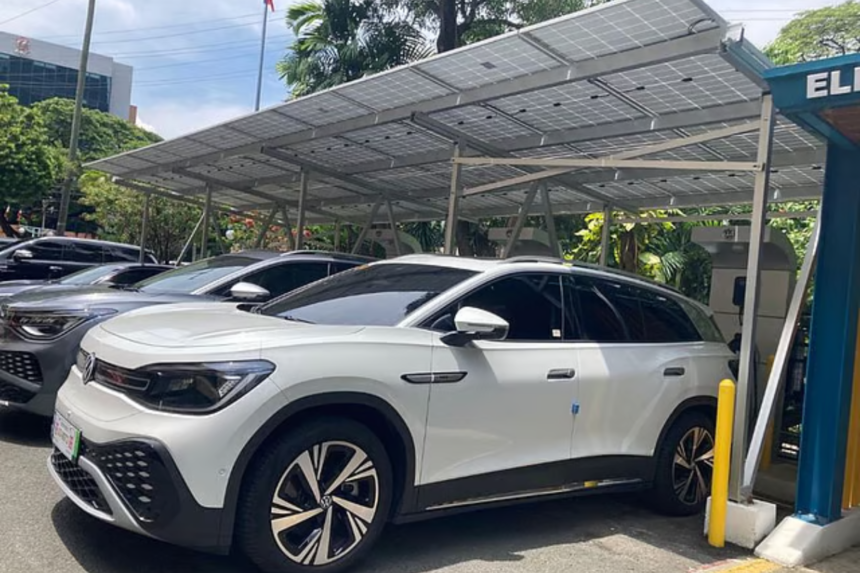
An EV charging station topped by solar panels inside the Department of Energy compound in Taguig, Manila.Jay Hilotin | Gulf News