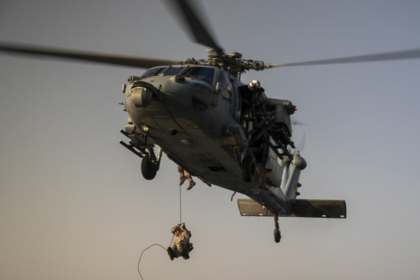




As American warships gather near Iran, reports suggest Moscow’s satellite capabilities could help Tehran monitor military movements and anticipate a possible US-Israeli attack.
The arrival of a third US aircraft carrier in the Middle East has intensified concerns over a possible resumption of American strikes on Iran. As Washington maintains a substantial naval presence in the region, questions are emerging over whether Russian satellite intelligence could help Tehran monitor US military movements and prepare its response.
The USS Theodore Roosevelt has arrived in the region, joining the USS George H.W. Bush and USS George Washington. The deployment was reported by The New York Times, citing a US military official, and subsequently confirmed by news agencies.
However, Washington has also signalled that it may avoid further military action unless tensions escalate. Reuters reported on November 14 that President Donald Trump was considering holding off on additional strikes unless Iran or its allies launched new provocations.
Amid these developments, investigations by the Associated Press and CNN have raised questions about possible Russian intelligence assistance to Iran-backed groups. A separate analysis published by Al Jazeera on November 16 warned that Moscow’s satellite surveillance capabilities could complicate any renewed US military campaign.
What Have Investigations Revealed About Russian Satellite Support?
An Associated Press investigation published on October 27 examined satellite activity linked to 40 missile and drone attacks carried out by Iran-backed groups between July and October.
Researchers from AURORAH, a geospatial intelligence project, tracked Russian reconnaissance satellites passing over Saudi oil and military installations before and after attacks by Yemen’s Houthis and Iraqi militias.
The targets included sections of Saudi Arabia’s East-West oil pipeline and military installations.
Saudi officials, a senior Houthi figure, and intelligence analysts told AP that Russian intelligence had assisted Iran-backed groups.
However, AURORAH acknowledged an important limitation: its researchers had not directly intercepted or independently verified the transfer of satellite intelligence to Iran or its allies.
The satellite movements therefore raise questions about possible intelligence sharing, but do not establish precisely what information was transferred or how it was used.
Did Russian Satellites Help Iran Attack a US Military Base?
A CNN investigation published on September 16 provided another account of possible Russian assistance.
According to the report, 14 Russian reconnaissance satellites passed over Prince Sultan Air Base in Saudi Arabia two days before an Iranian attack on March 27.
The strike injured 12 American personnel and damaged or destroyed important military equipment, including a US airborne warning and control aircraft.
CNN cited two US officials and other intelligence sources who said Russian satellite data had helped Iran carry out precision attacks.
Moscow rejected the allegations, describing the reporting as fake news.
The report added to concerns that Russian surveillance capabilities could provide Iran with information about the location and movement of American military assets in the region.
What Is the Latest Warning About Russia’s Satellite Capabilities?
In an opinion article published by Al Jazeera on November 16, Nawaf Obaid, a senior fellow at King’s College London’s Department of War Studies and founder of AURORAH, warned that Russian surveillance capabilities could give Tehran advance notice of another American offensive.
Obaid said his project had identified at least 20 Russian spacecraft in the Kosmos-2600 series. These satellites are capable of gathering imagery, radar information, and electronic signals.
He argued that such capabilities could help Iran monitor military deployments, identify changes in US force positions, and prepare retaliatory operations before an attack begins.
However, the assessment does not establish that Russia is currently providing Iran with intelligence specifically intended to prepare for another US strike. The extent of any ongoing intelligence-sharing arrangement remains unconfirmed.
Why Russian Satellite Support Matters for Gulf Countries
The implications of potential intelligence-sharing extend beyond American military installations.
Satellite surveillance could help identify vulnerable infrastructure, including oil facilities, export terminals, electricity networks, and desalination plants.
Saudi Arabia’s East-West pipeline is particularly important because it allows crude oil to reach export facilities on the Red Sea without passing through the Strait of Hormuz.
An attack on such infrastructure could disrupt regional energy supplies and affect international oil markets.
The Associated Press investigation also raised concerns about the role intelligence support could play in attacks by armed groups that lack advanced reconnaissance capabilities of their own.
If satellite information is being shared, it could give these groups a clearer picture of potential targets and improve their ability to plan operations.
Could Russian Intelligence Affect Trump’s Military Calculations?
The possibility that Iran could receive better intelligence about American deployments adds another complication to Washington’s military planning.
An Israeli security assessment published on November 15 described continued US force deployments alongside Iranian threats and reported attacks in the Gulf.
Whether Russian intelligence assistance is influencing Trump’s decisions, however, remains unknown.
Reuters reported on November 14 that the US president was considering restraint, with further strikes potentially dependent on new provocations by Iran or its allies, including the Houthis.
For now, the available reporting points to a potentially significant intelligence dimension in the conflict, rather than confirmed evidence that Moscow and Tehran are jointly preparing for an imminent confrontation.
The central concern is whether Russian satellite surveillance could make it harder for the United States to launch a surprise attack while giving Iran more time to assess military movements and organize a response.
Read more news and follow us on Instagram.
The USS Theodore Roosevelt has arrived in the region, joining the USS George H.W. Bush and USS George Washington as Washington maintains a substantial naval presence amid continuing tensions with Tehran.
AFP file
Source: Gulf News