



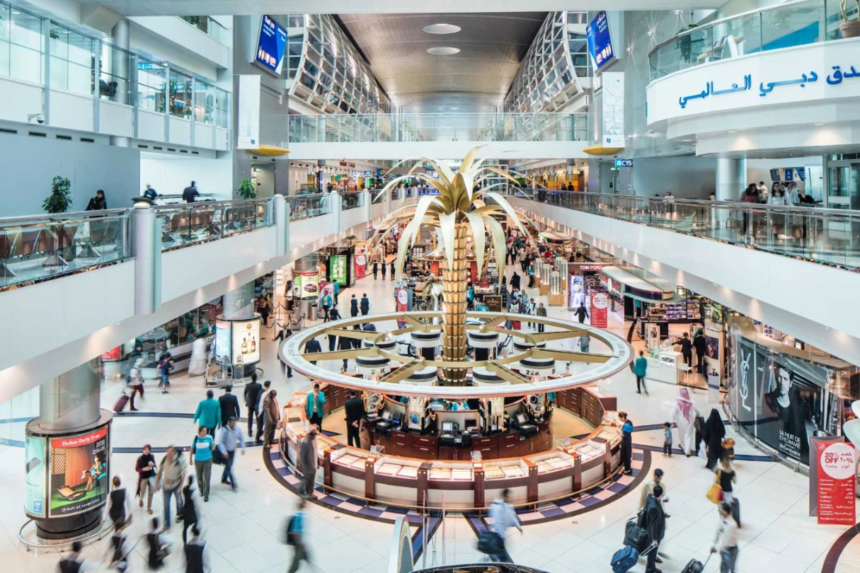
Dubai Holds Its Global Lead
Dubai International Airport has retained its position as the world’s busiest airport for international passenger traffic in 2025, reinforcing its role as a central hub for global travel.
According to the latest data from Airports Council International, the airport handled 95.2 million passengers during the year, maintaining its dominance in cross-border travel.
Global Rankings and Passenger Trends
International passenger traffic reached 4 billion globally in 2025, rising 5.9 percent compared to 2024 and exceeding pre-pandemic levels by 8.3 percent.
Dubai ranked first for international traffic, followed by London Heathrow Airport in second place and Incheon International Airport in third.
In terms of total passenger traffic, Dubai secured the second position globally, behind Hartsfield-Jackson Atlanta International Airport, while Tokyo Haneda Airport moved into third place.
Sustained Growth Over Consecutive Years
Dubai’s leadership is not a one-time outcome. The airport has consistently held the top position for international passengers over recent years, supported by strong long-haul demand and its strategic geographic position connecting East and West.
Passenger volumes have steadily increased, rising from 92.3 million in 2024 to 95.2 million in 2025, reflecting continued expansion in global travel flows through the Gulf region.
Broader Aviation Growth Patterns
Global passenger traffic reached an estimated 9.8 billion in 2025, marking a 3.6 percent increase from the previous year. Aircraft movements also rose to 101.5 million, with Chicago O’Hare International Airport leading in total movements, followed by Atlanta and Dallas/Fort Worth.
The recovery of Asia-Pacific markets, particularly following China’s reopening, contributed significantly to the rise in international travel demand and shifting airport rankings.
Economic Factors Supporting Demand
Air travel demand remained strong despite a mixed economic environment. Lower jet fuel prices, which declined by around 13 percent year-on-year, combined with easing inflation, supported higher consumer spending on travel.
International travel continued to drive most of the growth, reinforcing the importance of global hubs that can handle large-scale passenger movement efficiently.
Pressure on Infrastructure and Operations
Airports worldwide are facing increasing operational strain. Capacity limitations, aircraft delivery delays, and restricted air navigation slots are slowing expansion efforts.
Geopolitical tensions and airspace restrictions have added complexity, forcing airlines to reroute flights and absorb higher operating costs.
At the same time, air cargo demand has remained steady, supported by e-commerce growth and evolving global supply chains.
Closing Perspective
Dubai’s continued lead reflects more than passenger numbers. It highlights the airport’s ability to manage scale, maintain connectivity, and operate efficiently in a global aviation system that is becoming more complex and capacity-constrained.
Read more news and follow us on Instagram
Source: Gulf News