


Bridging Education With Industry
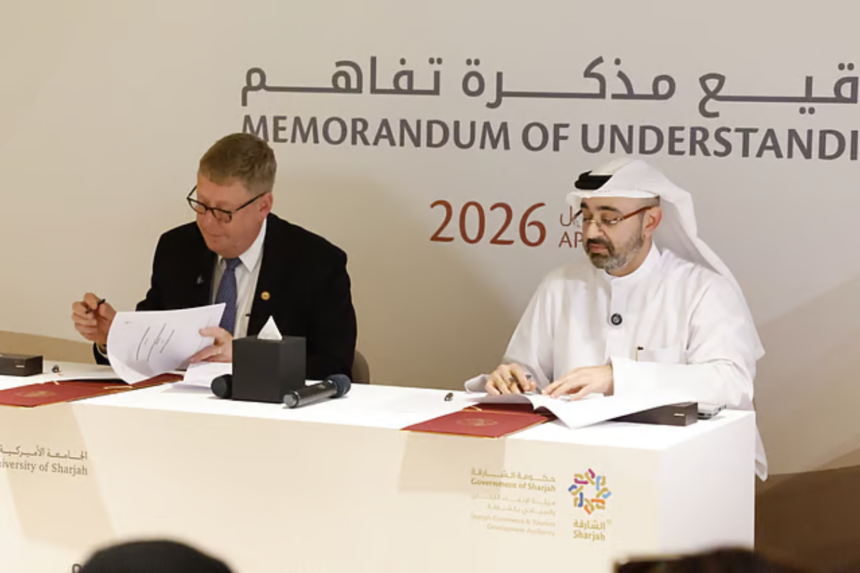
Sharjah Commerce and Tourism Development Authority and American University of Sharjah have formalised a partnership to align academic learning with the evolving needs of the tourism sector.
The agreement reflects a shift in approach. Tourism development is no longer limited to infrastructure and promotion. It now depends on talent, ideas, and the ability to translate them into practical solutions.
Turning Student Ideas Into Industry Input
The collaboration builds on earlier initiatives such as the Sharjah Tourism Innovation Hackathon, where student concepts were presented to industry stakeholders.
These ideas are not treated as academic exercises. They are evaluated for real-world application, with the potential to address emerging needs in tourism.
This approach creates a direct pipeline. Students contribute ideas. Authorities assess feasibility. The sector gains solutions shaped by the next generation of consumers and professionals.
Tourism as an Economic Driver
Tourism’s Growing Role in Sharjah’s Economy
Tourism now contributes around 10 percent of Sharjah’s GDP, making it one of the emirate’s most important economic sectors.
At the same time, Sharjah continues to expand its tourism offering across different regions. Along the coast, destinations such as Khorfakkan and Kalba attract visitors with beaches, nature, and outdoor activities.
Meanwhile, heritage and archaeological locations in Mleiha highlight the emirate’s history, while the desert landscapes of Al Badayer add another dimension to the tourism experience.
As Sharjah develops these destinations further, demand continues to rise for new visitor experiences, stronger services, and more innovative strategies. Consequently, the emirate increasingly views partnerships with universities as a necessary part of long-term growth rather than an optional initiative.
Preparing Students for Real-World Challenges
At the academic level, universities are focusing less on theory and more on direct exposure to the market.
Instead of studying only in classrooms, students now work on real challenges from the tourism and business sectors. As a result, they gain practical experience while still completing their studies.
Moreover, universities have integrated subjects such as marketing, design, and media studies into this approach. Cross-disciplinary teams can therefore work together to solve real problems and develop ideas that match the needs of the tourism industry.
This method brings education much closer to practice. By the time students graduate, they already understand how the market works and have experience that reflects real business conditions rather than simulated classroom exercises.
Technology as a Core Layer
The partnership also acknowledges the role of emerging tools. Artificial intelligence and digital systems are becoming central to how tourism operates, from customer experience to operational efficiency.
Familiarity with these tools is treated as a baseline skill. The objective is to ensure that graduates enter the workforce with both conceptual understanding and technical capability.
A Coordinated Growth Model
The collaboration represents a broader model where public institutions and academic bodies operate in alignment.
Knowledge flows in both directions. Industry defines challenges. Academia contributes research and ideas. Implementation follows through coordinated efforts.
This structure supports long-term development by linking policy, education, and execution within a single framework.
What’s the next
Sharjah’s approach positions tourism growth as a function of talent development and innovation, not just the expansion of destinations.
By integrating universities into the process, the emirate builds a system where future workforce capability and sector growth evolve together.
From left to right: Khalid Jasim Al Midfa and Tod Laursen,
Photo: Amna Alansaari / Gulf News