


Heavy reliance on desalination leaves supplies exposed amid rising tensions with Iran.
Middle East economies have long been defined by oil. That hierarchy is shifting.
Recent tensions have exposed a deeper, more immediate dependency. Water.
A drone strike on a desalination facility in Bahrain has brought attention to a structural risk that has existed for years but remained underexamined. In much of the Gulf, desalination is not supplementary infrastructure. It is the primary source of drinking water.
Dependence at Scale
Across the Gulf Cooperation Council, desalination supplies the majority of potable water. Countries such as Kuwait rely on it for around 90% of their drinking water, while Saudi Arabia and Oman also depend heavily on the process.
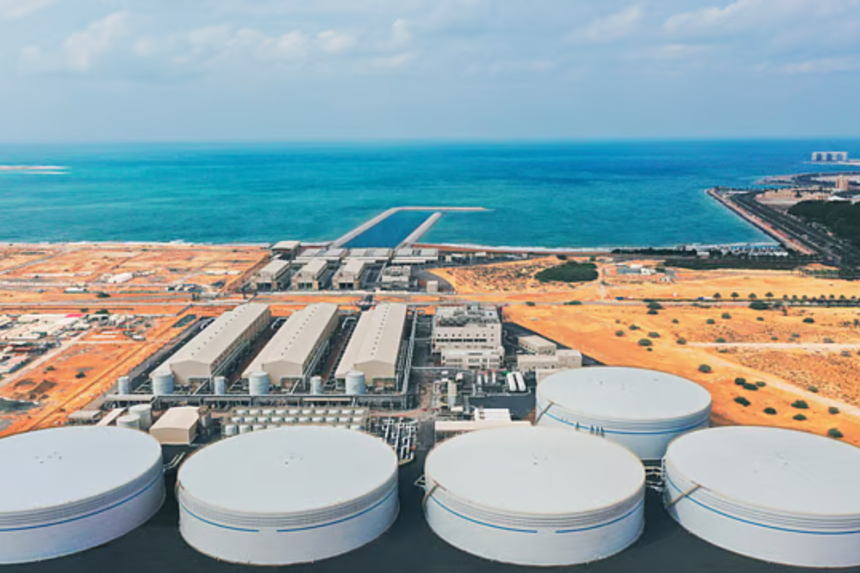
The scale is global. The region produces a significant share of the world’s desalinated water, supported by hundreds of large-scale plants concentrated along coastlines.
This concentration creates efficiency. It also creates exposure.
Infrastructure Built for Efficiency, Not Resilience
Desalination plants are typically located near coastal cities, industrial zones, and power infrastructure. This design reduces costs and improves distribution.
It also creates a centralized system with limited redundancy.
According to Moody’s, much of the region’s water production is concentrated in coastal facilities with few immediate alternatives at scale. If these sites are disrupted, replacement capacity cannot be deployed quickly.
Conflict Is Redefining Risk
The risk is no longer theoretical.
Water infrastructure is increasingly being drawn into geopolitical tensions. Iran has warned of potential strikes on desalination plants across the Gulf, while regional governments have raised concerns about retaliatory actions targeting both water and energy systems.
In several countries, water reserves may only last a matter of days. Any prolonged disruption could quickly affect households, healthcare systems, and industrial operations.
A System of Interdependence
Water does not operate in isolation. It is embedded within a tightly linked system.
Desalination requires electricity. Power generation depends on water. Industrial production relies on both.
This creates a chain reaction. A disruption in water supply can slow power generation, halt industrial output, and affect broader economic activity. Moody’s describes this as a system where water and power are mutually dependent, amplifying the impact of any disruption.
Economic and Social Consequences
The implications extend beyond infrastructure.
Governments would need to intervene rapidly to maintain supply, deploying emergency measures that could strain public finances. Countries with stronger fiscal positions, such as the United Arab Emirates, Qatar, and Saudi Arabia, have greater capacity to absorb shocks. Others, including Bahrain, face higher vulnerability due to weaker financial buffers.
If disruptions persist, the effects could cascade across sectors, impacting energy, manufacturing, and essential services.
Time as the Critical Constraint
Storage provides only a short-term buffer. Most Gulf countries can hold water reserves for a limited number of days. Beyond that, continuous production becomes essential. This makes time the defining factor in any crisis scenario.
A delay in restoring operations can quickly translate into widespread shortages.
From Resource to Strategic Priority
The shift is structural. Water in the Gulf is no longer a background utility. It has become a strategic resource, central to economic stability and daily life.
Oil remains critical for revenue. Water determines continuity.
As regional tensions evolve, the focus is expanding from energy security to include water security, a transition that reflects the realities of modern infrastructure and the vulnerabilities embedded within it.
Source: Gulf News