



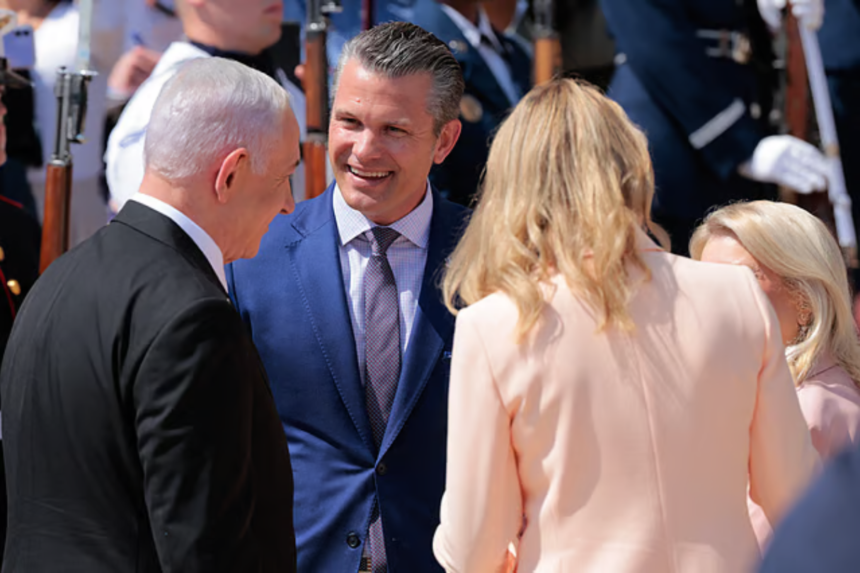
US Defense Secretary Pete Hegseth reportedly held an unannounced meeting with Israeli Prime Minister Benjamin Netanyahu at an airbase amid rising tensions over Iran, prompting questions about possible further military action.
DUBAI: An unannounced visit by US Defense Secretary Pete Hegseth to Israel and a lengthy meeting with Prime Minister Benjamin Netanyahu at an airbase hosting American warplanes have raised questions about Washington’s next move in the eight-month conflict with Iran.
The meeting took place on Monday at Ovda Air Base in southern Israel, where US fighter jets and aerial refueling aircraft are deployed, according to Axios, which cited two sources familiar with the visit. Reuters later reported, citing three Israeli officials, that the discussions included Iran. Neither government has disclosed the details or announced any decisions.
The timing has attracted attention. The meeting came eight days before Israel’s October 27 election and a day after US President Donald Trump endorsed Netanyahu, amid growing discussion about whether major military operations against Iran could resume.
It also followed increasingly forceful remarks from Netanyahu, who told Trump that the two allies still had unfinished business.
Here are five key questions about the meeting and what it could mean for the conflict.
Why Did Hegseth Make an Unannounced Visit?
Hegseth did not publicly announce his trip in advance, and the Pentagon declined to comment on reports of his meeting with Netanyahu.
The defense secretary later acknowledged visiting American troops in the region but did not identify Israel or disclose details of his meeting with the Israeli prime minister. In a post on X, he described the troops as taking part in a historic mission.
The visit came amid sensitive discussions over Iran, but the lack of advance notice does not, by itself, establish that Washington was preparing a new military operation.
No public confirmation indicates the meeting was deliberately kept secret to facilitate a fresh attack.
Why Did They Meet at an Airbase Hosting US Warplanes?
According to Axios, Hegseth and Netanyahu met at Ovda Air Base in southern Israel, where American fighter jets and aerial refueling aircraft are stationed.
Aerial refueling allows combat aircraft to remain airborne longer and travel greater distances, making it an important capability for long-range military operations.
Israeli outlet Ynet reported that Netanyahu travelled from Ben Gurion Airport to Ovda aboard a private aircraft rather than a helicopter, which is more commonly used for such journeys. The outlet also described the meeting as unusually lengthy.
The military setting has prompted speculation about the purpose of the discussions. However, the presence of US aircraft and the choice of venue do not establish that officials approved a new strike operation.
What Did Netanyahu Mean by ‘We Have a Job to Finish’?
Netanyahu’s own remarks added to questions about the next phase of the conflict.
In a video of a telephone conversation with Trump released on Monday, the Israeli prime minister thanked the US president for endorsing him ahead of the election.
“Donald, we have a job to finish. You said it, and we’ll finish it together,” Netanyahu told Trump.
The remarks followed Trump’s warning that Washington and Israel could finish their military campaign against Iran unless Tehran changed course.
Earlier on Monday, Netanyahu visited Ramat David Air Base in northern Israel, where he highlighted the Israeli Air Force’s readiness and its ability to strike adversaries when required.
Together, the statements indicate that military options remain part of the discussion. Neither leader, however, announced a decision to resume large-scale attacks.
Are the US and Israel Preparing Another Major Attack on Iran?
The possibility has been discussed, but the timing and likelihood of renewed major operations remain uncertain.
Axios has reported that Washington and Israel have considered resuming major combat operations as diplomatic efforts struggle to resolve disputes over Iran’s nuclear programme, US sanctions and the Strait of Hormuz.
The two countries launched joint strikes against Iran in February, triggering a wider regional conflict.
Netanyahu has previously indicated that he does not intend to launch another major attack before Israel’s October 27 election. Trump has also said he would not attack Iran before the November 3 US midterm elections.
On Monday, Trump said the United States was in a position to leave the war. He argued that Iran’s military capabilities had been severely weakened and that Tehran would not obtain a nuclear weapon.
The statements leave open two possibilities: Washington could continue pursuing a negotiated settlement, or it could retain the option of further military action if talks fail. The meeting at Ovda has not publicly resolved which course the allies intend to pursue.
Why Does the Meeting Matter for the Gulf?
Any renewed US-Israeli campaign against Iran could affect Gulf security, energy supplies and commercial shipping through the Strait of Hormuz.
The waterway remains central to the dispute between Washington and Tehran. Iran is seeking relief from US restrictions and sanctions, while the United States is demanding substantial limits on Iran’s nuclear activities.
Regional concerns have also grown amid renewed Houthi attacks on Saudi Arabia, raising the risk of a wider confrontation involving countries beyond Iran and Israel.
Diplomatic efforts continue alongside the military discussions. Pakistan has sought to mediate, while Russian Foreign Minister Sergei Lavrov held talks with Iranian leaders in Tehran on Monday.
For Gulf countries, the key question is whether the latest consultations reflect preparations for renewed fighting or an attempt to strengthen Washington’s position in negotiations.
For now, the purpose and outcome of Hegseth’s meeting remain only partly known. The discussions took place as diplomatic efforts continued and military action remained an option, but neither government has confirmed plans for a new offensive.
Pete Hegseth with Netanyahu as they arrive for an honour cordon at the Pentagon on July 09, 2025 in Arlington, Virginia. AFP