


Airspace disruptions and safety concerns dent travel demand across key destinations.
The conflict involving the United States, Israel, and Iran is costing the Middle East’s tourism industry at least $600 million per day, according to the World Travel & Tourism Council.
Airspace restrictions, flight cancellations, and safety concerns have weakened travel demand across the region.
The disruption affects a broad network of businesses, including airlines, airports, hotels, cruise operators, and car rental companies.
Regional Aviation Hubs Under Pressure
The Middle East serves as a major global aviation transit hub.
The region accounts for about 5 percent of international tourist arrivals worldwide and 14 percent of global transit passengers.
Airports in Dubai, Abu Dhabi, Doha, and Bahrain normally handle around 526,000 passengers daily, meaning any disruption quickly spreads through global aviation networks.
Thousands of Flights Cancelled
Flight cancellations across the region have surged sharply. According to aviation consultancy Cirium, airlines scheduled more than 92,000 flights between February 28 and March 12. However, carriers have already cancelled over 49,000 of those flights.
As a result, several airports experienced near-total disruption. In Doha, airlines cancelled 288 out of 308 departures, while Bahrain recorded 92 cancellations out of 93 scheduled flights.
UAE Airports Continue Operating
Meanwhile, the UAE’s major aviation hubs continue operating, although airlines have reduced flight schedules.
At Dubai International Airport, airlines cancelled 87 out of 387 flights, while many others continued operating as planned.
Similarly, at Zayed International Airport in Abu Dhabi, airlines cancelled only 23 out of 101 scheduled departures, allowing most flights to proceed despite regional disruptions. ✈️
Tourism Sector Remains Resilient
WTTC says the tourism sector has historically recovered quickly from security-related disruptions.
Research by the organization shows that tourism demand can recover within two months if governments and industry groups work together to restore traveler confidence.
Recovery Depends on Stability
The Middle East tourism sector had entered 2026 with strong momentum.
Dubai recorded 19.59 million international visitors in 2025, with hotel occupancy exceeding 80 percent.
Industry leaders say recovery will depend on restoring stable air travel and reassuring visitors that the region remains safe to visit.
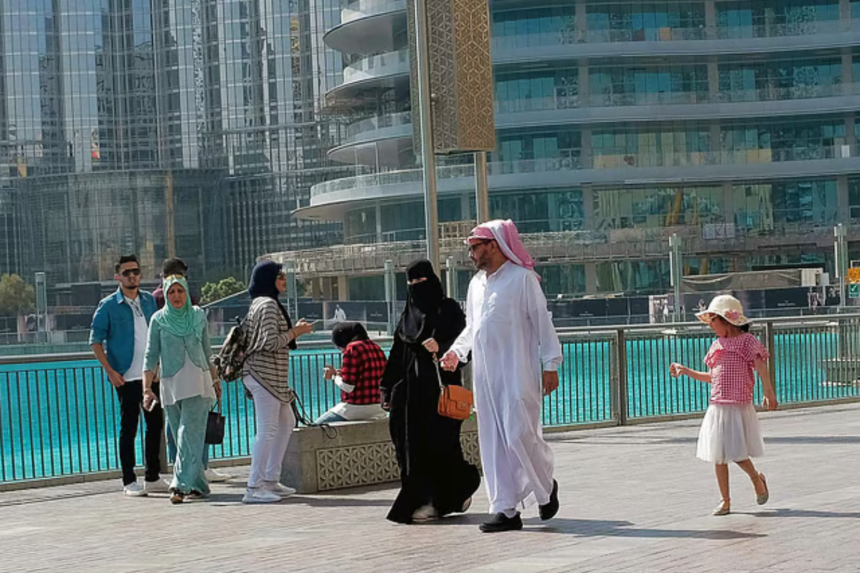
Despite the regional disruption, the UAE’s two largest aviation gateways, Dubai International Airport and Zayed International Airport, continue to operate a reduced but functioning schedule. Pictured above are Saudi and Arab tourists in Dubai for illustrative purposes.
Source: GN