



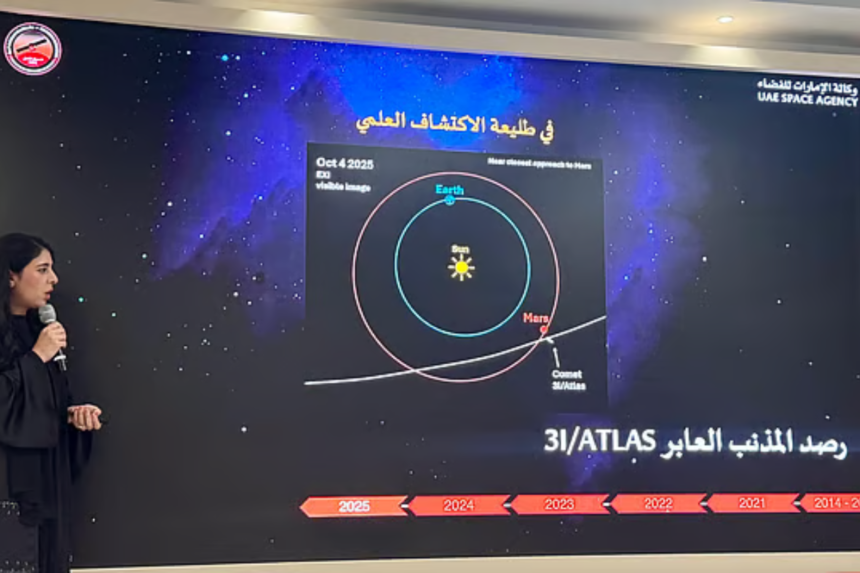
Dubai: The UAE’s Hope Probe has captured rare observations of interstellar comet 3I/ATLAS during a moment when Earth-based telescopes were unable to see it, offering scientists an unusual glimpse into the chemistry of another star system.
The findings were released by the UAE Space Agency as part of the Emirates Mars Mission (EMM) update, alongside the announcement that the mission will continue operations until 2028. The observations provide new scientific insight into only the third confirmed interstellar object ever detected passing through the solar system.
A Rare Visitor From Beyond the Solar System
Comet 3I/ATLAS was discovered on July 1, 2025, and quickly identified as an interstellar object travelling on a steep hyperbolic path through the solar system. Moving at speeds of up to 153,000 miles per hour, the comet originated outside the Sun’s gravitational influence and posed no threat to Earth.
It follows two previously confirmed interstellar visitors. ‘Oumuamua in 2017 and 2I/Borisov in 2019.
Scientists consider such objects especially valuable because their chemical composition can reveal clues about the formation of planetary systems beyond our own.
Why Earth Telescopes Lost Sight
When 3I/ATLAS reached its closest point to the Sun in October 2025, the comet moved behind the Sun from Earth’s perspective. This made direct observation from ground-based and orbital telescopes nearly impossible.
The Hope Probe, orbiting Mars on the other side of the solar system, maintained a clear line of sight.
This unique positioning allowed the spacecraft to continue monitoring the comet while it remained invisible to observers on Earth.
Dr. Nora Al Saeed, principal investigator of the Emirates Mars Mission, explained that only Mars-orbiting spacecraft were able to capture images at that stage.
The spacecraft observed the comet when it passed within about 0.2 astronomical units, roughly 30 million kilometres, of Mars on October 3, 2025.
A Planned Scientific Opportunity
Scientists within the Mars research community had anticipated the comet’s passage months in advance. The UAE Space Agency decided early to redirect the Hope Probe instruments temporarily away from Mars to observe the event.
Mohsen Al Awadhi, director of the Space Missions Department at the UAE Space Agency, said the decision expanded the scientific role of the mission beyond its original atmospheric focus.
The observations produced a data set that differs from those collected by other space missions because of the Hope Probe’s instrument configuration and viewing geometry.
The mission used its Emirates Exploration Imager and Emirates Ultraviolet Spectrometer instruments to capture visible and ultraviolet measurements during a dedicated observation campaign.
Observing a Comet Breaking Apart
The Hope Probe detected hydrogen and oxygen extending hundreds of millions of kilometres from the comet’s nucleus. The instruments also recorded carbon monoxide emissions at the precise moment the comet was disintegrating near the Sun.
Scientists say this phase of observation is particularly significant because it captured the comet during its closest solar approach, when its structure began to break apart.
According to mission researchers, this level of detail has not been observed before for an interstellar object.
Scientific Importance of the Discovery
Because 3I/ATLAS originated outside the solar system, its composition offers rare insight into the materials present in distant planetary systems.
Researchers say the data could help scientists better understand how stars and planets form in environments different from our own.
Full scientific papers based on the observations are expected to be published in the coming months.
Originally designed to study Mars’ atmosphere, the Hope Probe has now expanded its scientific scope during its extended mission phase. The spacecraft’s unexpected role in observing 3I/ATLAS highlights how strategic planning and spacecraft positioning can enable discoveries far beyond a mission’s original objectives.
Dr. Nora Al Saeed is explaining the vantage point from where the Emirates Mars Mission’s Hope Probe explored the alien comet 3I/ATLAS in Dubai on Tuesday.
Photo: Sajila Saseendran/ Gulf News