



Rebellions has raised $400 million in a pre-IPO funding round, lifting its valuation to $2.34 billion as the company accelerates its expansion strategy and moves closer to a public listing.
The round was led by Mirae Asset Financial Group and the Korea National Growth Fund, highlighting strong institutional backing for South Korea’s ambitions to build a globally competitive AI semiconductor industry.
Expansion Strategy Focused on the US
Looking ahead, Rebellion plans to use the fresh capital to expand its presence in the United States.
The company is focusing specifically on winning enterprise clients and AI research labs.
At the same time, Rebellions is taking a targeted approach. Rather than competing immediately for hyperscaler customers such as Amazon and Microsoft, it is prioritizing partnerships with advanced AI developers, including Meta Platforms and xAI.
As a result, the strategy centers on high-performance use cases and early adoption within some of the most advanced AI environments.
Betting on AI Inference Chips
Meanwhile, Rebellions continues to focus on AI inference, which involves running AI models efficiently after training is complete.
While Nvidia dominates the training market through its GPUs, demand for inference chips is increasing rapidly.
As AI adoption expands, companies need processors that can handle workloads faster while using less energy.
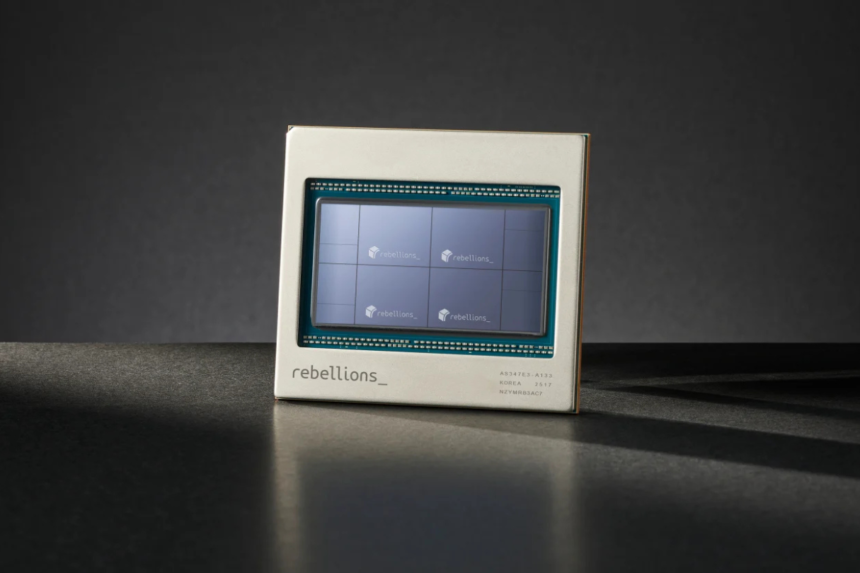
To meet that need, Rebellions has developed its Rebel100 NPU chips.
These processors are designed to balance performance and efficiency—an increasingly important combination as AI applications scale across industries.
Competitive Landscape Intensifies
Even so, Rebellions operates in a highly competitive market.
The company competes not only with Nvidia, but also with newer rivals such as Cerebras Systems and Groq.
However, Rebellions sets itself apart by emphasizing energy efficiency and optimizing performance specifically for inference workloads.
That advantage could become increasingly important because the inference market is expected to expand rapidly as AI moves from experimentation to widespread commercial deployment.
Supply Chain Challenges and Strategic Advantage
Nevertheless, the company still faces a major challenge: securing memory chips in a market where supply remains constrained worldwide.
Even so, Rebellions holds an important advantage.
The company counts major memory manufacturers, including Samsung Electronics, SK Hynix, and Micron Technology, among its backers.
Because of those relationships, Rebellions is better positioned than many competitors to secure the critical components it needs.
South Korea’s Push to Build an AI Chip Champion
More broadly, Rebellions plays a central role in South Korea’s effort to strengthen its domestic semiconductor ecosystem.
To advance that ambition, the government has introduced initiatives such as the “K-Nvidia” strategy, which supports companies developing advanced AI chips.
The objective is straightforward: reduce reliance on global technology leaders and position South Korea as a leader in next-generation computing infrastructure.
Consistent with that strategy, the Korea National Growth Fund contributed a significant share of Rebellions’ latest funding round.
As a result, the investment highlights the government’s strong commitment to building a national AI chip champion.
Market Direction
Ultimately, Rebellions’ latest funding round reflects a broader shift across the semiconductor industry.
Until recently, companies focused primarily on training large AI models. Now, however, the industry is placing greater emphasis on deploying AI efficiently and at scale.
As demand for inference chips accelerates and competition intensifies, companies that can combine performance, energy efficiency, and reliable access to critical components are likely to shape the next phase of the AI hardware market.
Source: CNBC
Read more news and follow us on Instagram.
The Rebel-Quad is the second-generation product from Rebellions and is made up of four Rebel AI chips. Rebellions, a South Korean firm, is looking to rival companies like Nvidia in AI chips.
Rebellions