


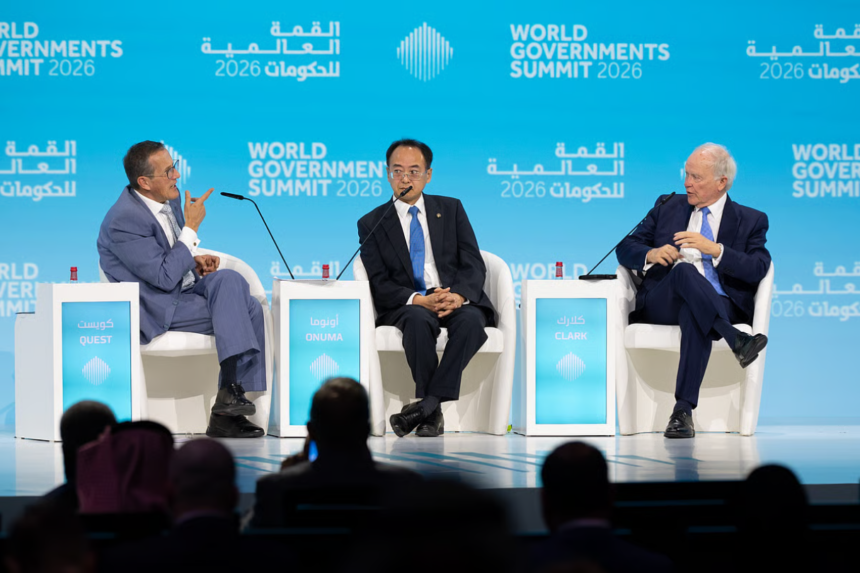
Emirates President Sir Tim Clark said the EU was late to adopt similar travel tech, calling its recent digitisation push overdue.
Dubai is fast emerging as the global reference point for next-generation aviation, combining biometric technology, seamless passenger journeys, and advanced airspace management in ways few regions have matched. According to Tim Clark, President of Emirates Airlines, the emirate is already operating in an “Aviation 2.0” era while much of the world is still catching up.
Speaking at the World Government Summit, Sir Tim outlined how Dubai’s airports are setting a new global standard for efficiency, security, and passenger experience. He was joined by Toshiyuki Onuma, head of the International Civil Aviation Organization, in a session focused on the future direction of global aviation.
A Contactless Vision Years Ahead of the World
At the heart of Dubai’s advantage is its early and sustained investment in biometric and contactless travel systems. Sir Tim said the emirate has been testing and refining these technologies for years, allowing passengers to move through airports with minimal physical checks.
“We’re advancing the pace so people can move into and out of Dubai without any physical interdiction at all,” he said.
Unlike traditional checkpoints reliant on documents and manual inspection, Dubai’s model integrates biometric identity across the passenger journey, reducing friction while maintaining security.
Sir Tim contrasted this with the European Union, which has only recently accelerated its own digitisation efforts.
“The technology has been there for a long time. It should have been done much earlier,” he said, describing the EU’s progress as overdue.
While the United Kingdom and the United States adopted parts of biometric travel earlier, Europe’s fragmented governance has slowed implementation. According to Sir Tim, the real obstacle is not technology, but the lack of harmonised ground systems and competing national priorities.
Commercial Space Is Now an Aviation Issue
The discussion also highlighted a rapidly emerging challenge: the collision of civil aviation and commercial space activity.
Sir Tim warned that private space launches, particularly those conducted by companies such as SpaceX, are increasingly disrupting global air traffic when missions go off-plan.
“When something goes wrong, it can completely disrupt civil aviation across enormous distances,” he said.
Onuma agreed that regulators must carefully assess the risks posed by new technologies, noting that objective analysis is essential as space activity scales up.
Both leaders stressed that aviation should not stand in the way of innovation. However, they underlined the need for tighter coordination as more players enter low Earth orbit, including ventures backed by Blue Origin.
Sir Tim said current air traffic control systems are capable of handling the complexity, but only if countries align policies and share data across borders.
Middle East Airspace Moves Faster Than Europe
Airspace congestion and management remain a major pressure point for global aviation. Here again, Sir Tim pointed to a stark contrast between regions.
He described the Middle East’s progress in modernising airspace systems as “Herculean,” citing rapid upgrades across the UAE, Qatar, and neighbouring hubs to cope with rising traffic volumes.
“In this region, systems have advanced very quickly to deal with real-world demand,” he said.
Europe, by comparison, faces entrenched inefficiencies. Sir Tim argued that incremental reforms are no longer sufficient and that the continent needs a fundamental rethink of how its airspace is managed.
Both speakers agreed that coordinating multiple sovereign stakeholders remains one of aviation’s hardest challenges, but also one of the most urgent.
Why Dubai Has Pulled Ahead
Dubai’s edge lies in alignment. Infrastructure investment, regulation, and technology adoption move together, allowing ideas to move from concept to execution without years of delay.
Rather than waiting for global consensus, the emirate has positioned its airports as real-world testbeds for future aviation systems. That approach, Sir Tim suggested, is why Dubai increasingly serves as a model for the rest of the world.
As aviation grapples with biometric borders, autonomous systems, and the growing influence of commercial space, Dubai is not preparing for the future. It is already operating in it.
Photo: Shihab/Khaleej Times