


Public Transport Crosses 802 Million Riders
Dubai Roads and Transport Authority reported that public transport, taxis, and shared mobility services recorded 802.1 million riders in 2025, up from 747.1 million in 2024. The 7.4 percent increase pushed average daily ridership to 2.2 million, compared with 2 million the previous year.
Total trips across all mobility modes reached 167.3 million, including 120 million taxi trips and more than 41 million shared mobility trips.
October recorded the highest monthly passenger volume at 72.8 million riders, followed by November at 72.6 million and December at 71.4 million.
Dubai Metro Leads All Mobility Modes
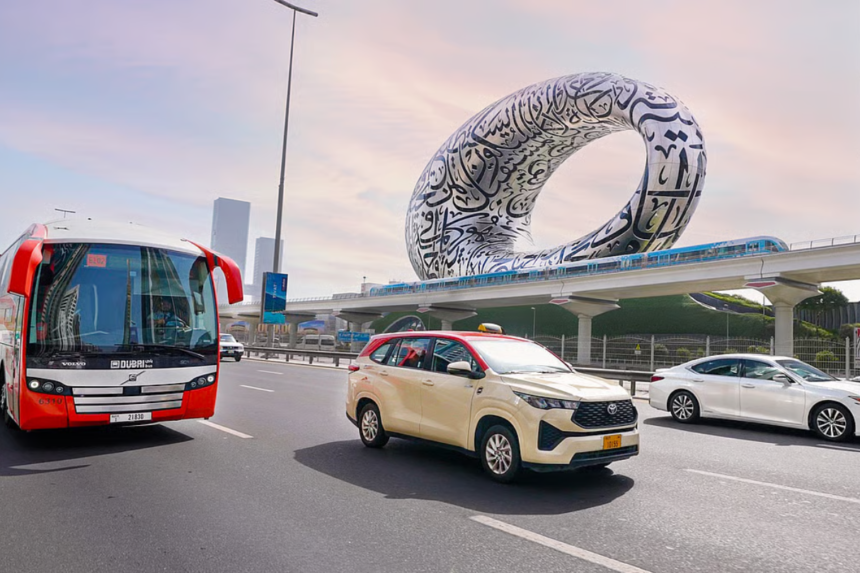
Dubai Metro remained the backbone of the city’s transport network. The driverless system carried 294.7 million riders across the Red and Green lines in 2025, reflecting 7 percent growth year-on-year.
Metro passengers accounted for 37 percent of all public transport users, maintaining its position as the most used mode in Dubai.
BurJuman Metro Station, serving as an interchange between both lines, recorded the highest footfall at 17.8 million riders. Al Rigga followed with 13.8 million.
On the Red Line, Union Station handled 13.6 million riders, while Mall of the Emirates and Burj Khalifa/Dubai Mall stations recorded 11.2 million and 10.9 million, respectively.
On the Green Line, Sharaf DG led with 10.5 million riders, followed by Baniyas Square at 8.4 million and Stadium station at 7.5 million.
Buses and Taxis Maintain Strong Demand
Public buses carried 197.2 million riders in 2025, marking a 5 percent increase from 2024. As a result, buses accounted for 25 percent of total users across mobility services.
Meanwhile, taxis transported 209 million riders, reflecting 4 percent growth year-on-year. However, their share of total users declined slightly to 26 percent. This drop marked the third consecutive year of shrinking share despite rising overall trip volumes.
In addition, premium limousine services, which are not included in the main public transport total, recorded 23.6 million riders. Notably, this segment posted a sharp 22 percent increase compared with 2024.
Shared Mobility Gains Momentum
At the same time, shared mobility services, including app-based rides, hourly rentals, and on-demand buses, carried 72.9 million riders in 2025. The segment registered a strong 30 percent year-on-year growth.
Consequently, its share of total users rose steadily, climbing from 6.2 percent in 2023 to 7.5 percent in 2024 and reaching 9 percent in 2025.
Beyond road transport, marine modes such as abras, water taxis, and the Dubai Ferry served 18.4 million riders, up 3 percent year-on-year. Similarly, Dubai Tram transported 9.9 million riders, reflecting a 5 percent growth.
A Structural Shift in Urban Mobility
Dubai Metro ridership 2025 data shows a city leaning increasingly toward mass transit and shared mobility solutions. While taxis remain widely used, sustained growth in metro and shared services signals a broader shift toward integrated, high-capacity transport networks.
With average daily ridership crossing 2.2 million, Dubai’s transport ecosystem continues to scale alongside population growth and economic expansion.
Photo: RTA, Source: KT