


Profits Slide as Costs Rise and Sales Slow
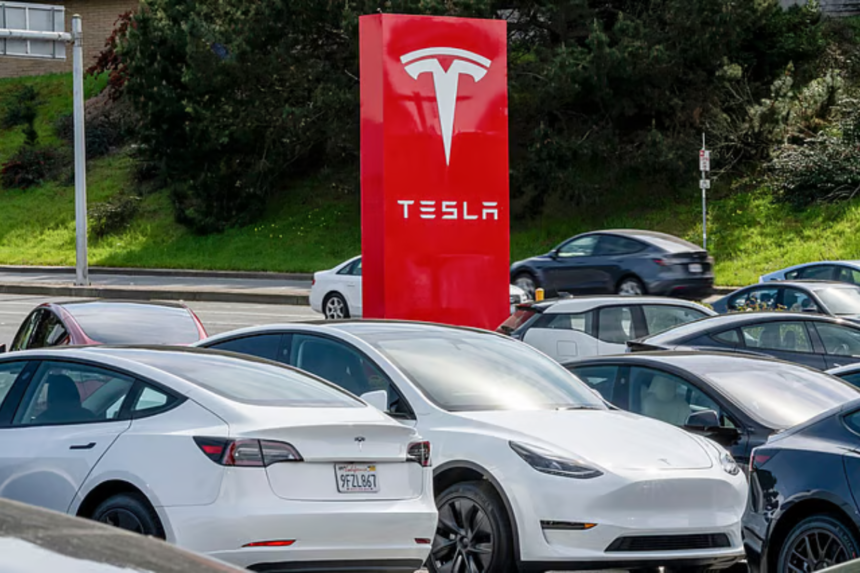
Tesla reported a sharp 61% drop in fourth-quarter profits on Wednesday, closing a turbulent year for the electric vehicle maker. Net profit fell to $840 million for the quarter ended December 31, down from $2.1 billion a year earlier.
Revenue declined 3.1% year-on-year to $24.9 billion, reflecting weaker auto sales and rising costs. The decline followed Tesla’s earlier disclosure of lower fourth-quarter and full-year vehicle deliveries, signalling pressure on its core business well before earnings were released.
A Volatile Year for Tesla and Musk
The results cap a year marked by controversy and strategic uncertainty. Tesla faced growing competition in the EV market, political backlash linked to CEO Elon Musk’s alignment with Donald Trump and far-right figures, and a shareholder vote in November approving a potential pay package for Musk worth up to $1 trillion.
That compensation framework is tied to expectations of massive technological breakthroughs, placing future innovation at the centre of Tesla’s valuation story.
Multiple Pressures Hit the Bottom Line
Tesla pointed to several factors behind the profit slump. These included higher restructuring costs, increased research and development spending on artificial intelligence, and the impact of higher tariffs.
The company also cited reduced revenue from emissions tax credits after policy reversals under the Trump administration weakened incentives tied to clean energy programmes.
Together, these pressures weighed heavily on margins even as Tesla continued to invest aggressively.
Musk Doubles Down on Technology Spending
Speaking on the earnings call, Musk said Tesla is committed to “very, very big investments” aimed at creating what he described as an era of abundance. He framed the spending as essential to delivering a future defined by AI, automation, and sustainability.
Chief Financial Officer Vaibhav Taneja reinforced that message, revealing that Tesla’s capital expenditure in 2026 is expected to exceed $20 billion, more than double the $8.5 billion spent last year.
From Cars to Robots
As part of this strategic shift, Musk confirmed plans to wind down production of the Model S and Model X luxury vehicles. Tesla will convert capacity at its Fremont, California, plant to manufacture Optimus humanoid robots.
The move underscores Tesla’s broader effort to move beyond traditional automotive manufacturing. The company increasingly frames its transition as a shift from a hardware-centric automaker to a physical AI company.
Sales Outlook Remains Uncertain
Tesla did not provide a forecast for vehicle sales in 2026, citing uncertainty around overall demand. This cautious stance contrasts with its January 2025 projection of a return to sales growth.
Instead, 2025 auto sales fell 9%, reflecting intensifying competition and reputational headwinds linked to Musk’s political positioning.
Big Promises, Familiar Skepticism
Despite weaker fundamentals, Tesla shares surged in the second half of 2025 after Elon Musk exited the White House, as investors looked past near-term results and focused on the company’s long-term technology potential.
To support that optimism, Musk has repeatedly highlighted Tesla’s advantage in AI and autonomous driving. Speaking at the World Economic Forum earlier this month, he said self-driving technology was essentially solved and predicted widespread robotaxi adoption in the US by the end of 2026.
Looking ahead, Musk has also pointed to future subscription revenue from Tesla’s Full Self-Driving programme as a key growth driver. However, analysts remain cautious, citing Musk’s earlier timelines on autonomy that have yet to materialise.
Energy Business Offers Some Relief
Not all indicators pointed downward. CFRA Research analyst Garrett Nelson said the results exceeded expectations, driven by stronger revenue from Tesla’s energy generation and storage division.
At the same time, Tesla reaffirmed progress on key projects slated for 2026, including the Cybercab platform.
Even so, Nelson cautioned that execution risk remains high. Delivering on ambitious plans amid slowing EV demand and intensifying competition will continue to test Tesla’s operational discipline.
A New Bet on xAI
In a further sign of its AI-first direction, Tesla disclosed that it agreed on January 16 to invest $2 billion in Musk’s artificial intelligence venture, xAI.
The company said the agreement establishes a framework to explore deeper AI collaboration between Tesla and xAI. The investment is expected to close in the first quarter.
The Road Ahead
Tesla’s 61% profit decline reflects more than a bad quarter. It exposes the tension between a slowing core business and an expensive bet on future technologies.
For now, investors appear willing to give Musk time. Whether that patience holds will depend less on vision and more on execution. The next phase will test whether Tesla can turn ambition into measurable returns.
Tesla profits tumbled 61% on higher capital expenditures, tariff drag, higher restructuring costs, increased R&D funding for AI pursuits, and emission tax credits following Trump’s reversals on US environmental policies. Bloomberg /Gulf News
Follow us on Instagram and stay updated with our current news