



A Strategic Financial Agreement
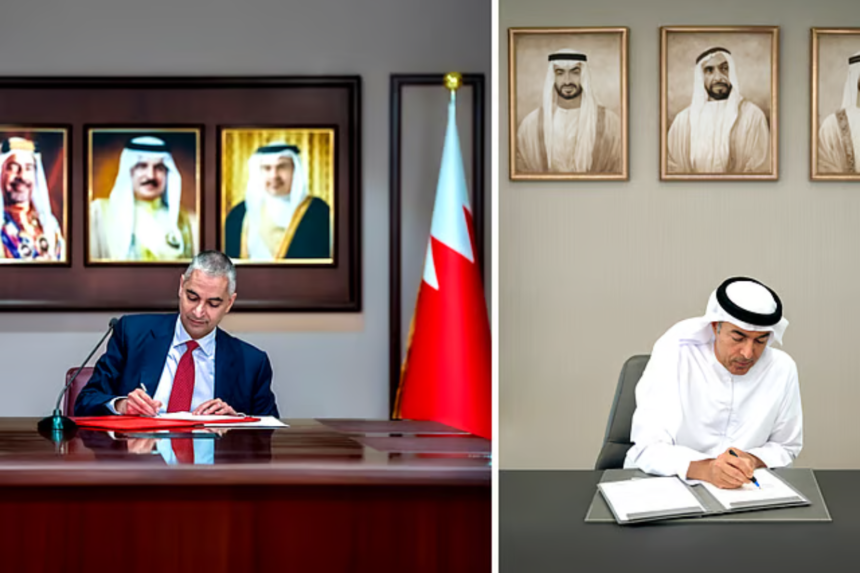
The Central Bank of the UAE and the Central Bank of Bahrain have signed a five-year currency swap agreement worth Dh20 billion, or BHD2 billion.
Under the agreement, both central banks will exchange the UAE dirham and the Bahraini dinar whenever needed. As a result, the two countries will strengthen monetary coordination and make it easier for businesses to trade directly in local currencies.
A Push for Deeper Economic Ties
Furthermore, Khaled Mohamed Balama said the deal reflects a shared commitment to expanding financial and monetary cooperation.
He explained that both countries want to strengthen trade and investment ties while also encouraging companies to use dirhams and dinars instead of relying on foreign currencies such as the US dollar. In this way, the agreement goes beyond providing liquidity and instead creates a more integrated financial relationship between the two economies.
Moving Toward Regional Financial Integration
Meanwhile, Khalid Humaidan described the agreement as an important milestone in the long-standing relationship between the two countries.
He said the swap arrangement will improve cooperation between the two central banks, strengthen the resilience of their financial systems, and support wider regional financial integration. In addition, the agreement could help both economies respond more effectively during periods of financial pressure or market instability.
Why Currency Swaps Matter
Currency swap agreements play an important role because they allow central banks to provide each other with liquidity in their own currencies.
For example, if banks or businesses in Bahrain need more UAE dirhams to complete trade transactions, Bahrain’s central bank can obtain them directly through the swap agreement. Likewise, the UAE can access Bahraini dinars when necessary.
Consequently, the arrangement reduces foreign exchange risk, lowers transaction costs, and helps trade continue smoothly even during periods of volatility. At the same time, it gives both countries a buffer against market shocks because they do not need to depend as heavily on global reserve currencies.
A Broader Strategic Shift
Most importantly, the agreement signals a wider shift in the Gulf region toward deeper financial coordination and greater use of local currencies.
Recently, the UAE has introduced several measures to protect its financial system from regional uncertainty. Therefore, this agreement complements those efforts by creating a stronger and more structured partnership with Bahrain. Together, the two countries are building a more resilient regional financial network that can support trade, investment, and stability over the long term.
Source: GN