


Flexible payment plans and incentives help sustain strong demand in Dubai real estate.
Dubai’s real estate market is entering a more measured phase, where investor caution has increased, but underlying demand continues to hold steady.
Transactions worth Dh3.8 billion were recorded at the start of March, with sales contributing nearly Dh2.93 billion, indicating that deal flow remains active even amid global uncertainty.
A Dh220 million villa sale on the World Islands further highlights sustained demand in the luxury segment, reinforcing the continued inflow of capital into prime assets.
Developers Prioritize Flexibility Over Price Cuts
Rather than reducing prices, developers are adjusting deal structures to maintain momentum while protecting long-term value.
Flexible payment plans, extended timelines, and incentives such as Dubai Land Department fee waivers are increasingly being used to close transactions.
Industry leaders emphasize that price corrections are unlikely among major developers, as maintaining pricing benchmarks is critical to preserving confidence in existing projects and communities.
Investor Behavior Shifts Toward Caution
Investor sentiment has evolved from urgency to deliberation. Buyers are taking more time, asking deeper questions, and seeking clarity before committing capital.
This shift does not signal an exit from the market but reflects a more informed and patient approach, with many investors adopting a wait-and-watch strategy while monitoring global developments.
At the same time, brokers are focusing more on building trust and providing data-driven insights rather than pushing immediate transactions.
Structural Strengths Continue to Support the Market
Dubai’s long-term appeal remains anchored in strong fundamentals.
The emirate continues to attract global capital due to its tax efficiency, safety, infrastructure, and strategic position as a financial and trade hub. High rental yields compared to global cities further strengthen its investment case.
Policy measures, including long-term residency visas linked to property ownership, continue to reinforce stability and encourage sustained investor participation.
Capital Remains Ready to Deploy
A significant portion of capital has not exited the market but is temporarily on hold, waiting for clearer signals.
This suggests that the current slowdown in decision-making could translate into a sharp rebound as sentiment improves, potentially leading to a rapid acceleration in transactions.
Market Segments Show Broad Stability
Demand remains distributed across segments, from luxury properties attracting high-net-worth individuals to mid-market and affordable housing supported by flexible payment structures.
There is no clear shift toward a single segment, indicating a balanced market rather than a concentrated surge.
Risks Are Present but Contained
External risks linked to geopolitical developments and rising energy costs remain a factor, particularly in terms of construction inputs and supply chains.
However, current assessments suggest that the likelihood of a sharp correction remains low unless disruptions become prolonged.
Construction activity continues largely unaffected, supported by Dubai’s established infrastructure and supply chain resilience.
A Market Anchored in Long-Term Confidence
Long-term investors continue to provide stability, focusing on capital appreciation and rental income rather than short-term volatility.
Dubai’s property market is adjusting to a slower, more thoughtful pace without losing its core momentum.
The direction remains unchanged. Only the speed has shifted.
Read More news, and follow us on Instagram
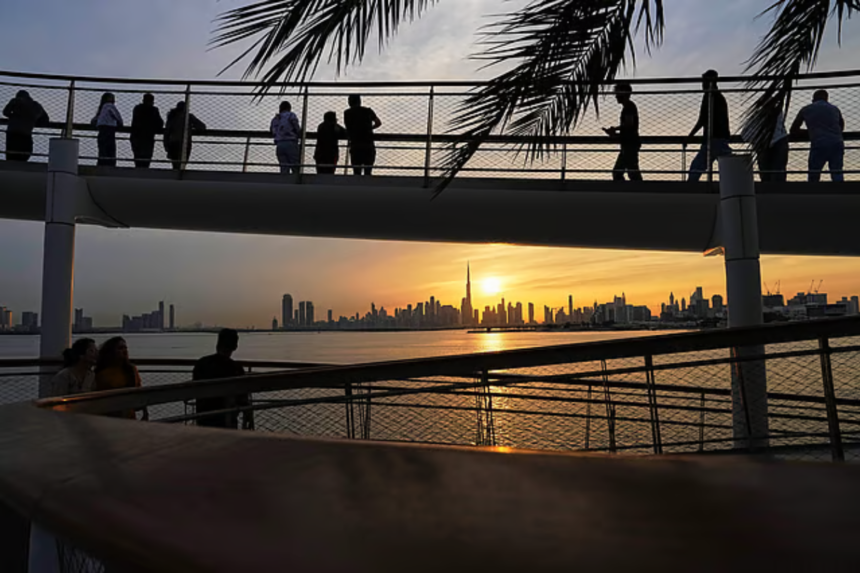
Dubai skyline
AP/ Gulf News