


The killing of a veteran leader exposes internal divisions within Iran’s ruling system.
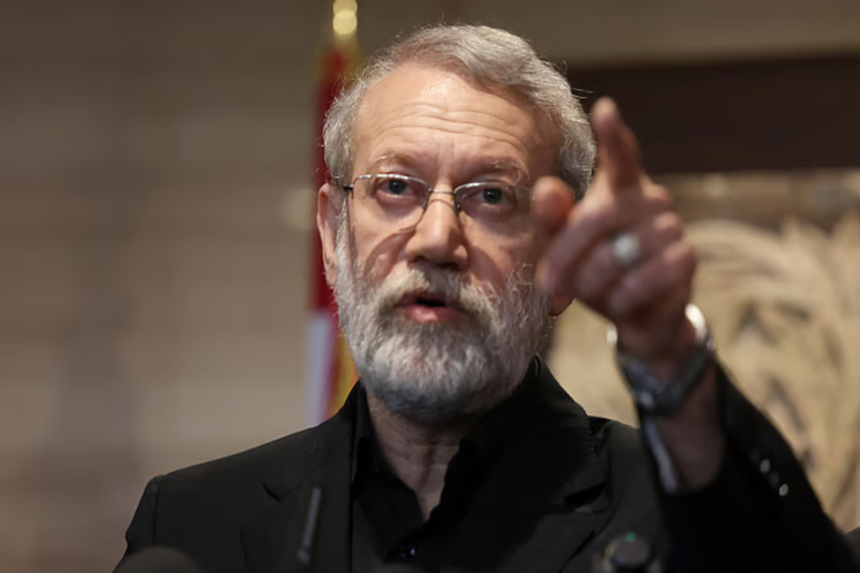
The killing of Ali Larijani marks more than the loss of a senior official. It removes one of the few figures capable of navigating Iran’s deeply layered power structure.
Alongside him, Basij commander Gholamreza Soleimani was also killed, compounding the impact on Iran’s wartime leadership.
For decades, Larijani operated not from a single seat of authority, but across multiple centers of influence, linking the clerical establishment, the Islamic Revolutionary Guard Corps, elected institutions, and foreign policy channels.
The Bridge Between Competing Power Centers
Unlike Ali Khamenei, whose authority was institutional, Larijani’s influence was functional.
He acted as a mediator in a system defined by internal competition, aligning military priorities with political messaging and diplomatic positioning.
As secretary of the Supreme National Security Council, he played a critical coordinating role, especially during periods of crisis, translating battlefield developments into strategic decisions.
That connective function is not easily replaced.
Achievements and Limitations
Larijani’s career reflected both strategic influence and structural constraints within Iran’s system.
His contributions included sustained engagement across factions, support for the 2015 nuclear agreement, and long tenure as speaker of parliament, where he shaped legislative direction during volatile periods. He also cultivated relationships with global powers such as China and Russia, strengthening Iran’s external positioning despite mounting isolation.
At the same time, his legacy carried limitations. He remained tied to a system criticized for repression, struggled to reverse Iran’s economic and diplomatic isolation, and faced setbacks in his own political ambitions. His ability to balance factions, while significant, could not fully alter the trajectory of hardline dominance.
Power Vacuum and Internal Risk
Larijani’s death creates an immediate vacuum in a system already under strain.
With Mojtaba Khamenei maintaining a low public profile, Larijani had effectively become a stabilizing presence, projecting continuity amid uncertainty.
His absence removes a key counterweight within the system, increasing the likelihood that decision-making will consolidate further within security institutions, particularly the IRGC.
This may strengthen short-term control, but it reduces flexibility in managing internal dissent or external pressure.
Diplomatic Consequences
Beyond internal politics, Larijani’s death carries external implications.
He was widely regarded as one of the few credible intermediaries capable of engaging in meaningful dialogue with global powers. His diplomatic relationships and pragmatic positioning gave Iran a channel, however limited, for negotiation.
Without him, that channel narrows.
A System Under Strain
The deeper issue exposed by this event is structural.
Iran’s leadership increasingly relies on a small circle of experienced figures capable of managing its complexity. With each loss, the system becomes more rigid and less adaptable.
Larijani’s removal does not simply shift power. It accelerates an underlying trend toward concentration, narrowing both internal debate and external engagement.
Unlike Ayatollah Ali Khamenei, whose authority was ultimately rooted in his position at the apex of the system, Larijani’s power came from his ability to operate across it.
Gulf News Archives